
We count 57 people whose fortunes come mainly from artificial intelligence and who are worth more than a billion dollars. For all of them, we research what is publicly known, and then produce calibrated estimates of their net worth.
We also looked into the next 90 most influential people in AI, for 147 total, to see the broader picture across a total of $320B in wealth that came primarily from AI. We calculate and visualize where that wealth comes from, showing wealth concentration, and breaking it down across US vs. China vs. Europe, frontier lab founders vs. other startup founder vs. prominent researchers vs. big tech, and other dimensions.
Contents
- All 57 AI billionaires, ranked
- All 57 AI billionaires, visualized
- Who are the 20 richest people in AI?
- How concentrated is AI wealth amongst individuals?
- Who leads among founders, startup founders, big tech, and researchers?
- Which AI billionaires are from the US, China, and Europe?
- What kind of wealth comprises the $320B of individual AI fortunes?
- How are the 20 largest individual AI fortunes held?
- How long have AI billionaires been working in AI?
- How old are the AI billionaires?
- Do wealthier people in AI have more degrees?
- Methodology
Net worth and source of wealth of all AI billionaires
Estimated personal net worth as of August 6, 2026. The figure is our median estimate; the range is the 80% confidence interval. Pure tech-company chiefs whose wealth is incidental to AI (Jensen Huang, Elon Musk, Mark Zuckerberg, all richer than anyone here) are left out.
| # | Name | Net worth | Who they are | Basis for the estimate |
|---|---|---|---|---|
| 1 | Chen Tianshi | $40B ($33B–$50B) | Founder of AI chipmaker Cambricon Technologies | Chen's estimate rests on his 28.4% direct stake in Cambricon Technologies (Shanghai-listed AI chipmaker), which at a current market cap near $139.5B values that holding at roughly $39.6B, matching the live Bloomberg Billionaires Index figure of $40.0B. The $40B median reflects the direct stake alone; an additional ~7.27% indirect stake via Beijing Aixi would push the total toward the $50B high end, and the main correction here was fixing a stale pre-surge market cap and a wrong CNY/USD rate. Sources: Mkt cap SimplyWall.st |
| 2 | Greg Brockman | $28B ($24B–$35B) | Co-founder and president of OpenAI | Brockman testified under oath in the May 2026 Musk v. Altman trial that his OpenAI stake alone is worth nearly $30B, implying roughly 3.5% of OpenAI at its $852B March 2026 valuation, and the $28.5B median applies a modest illiquidity haircut to that gross private mark. Smaller additive holdings in Stripe (~$471M), CoreWeave, Cerebras, and Helion account for the gap to the $35B high end but are not separately itemized. Sources: Business Std Barchart CNBC |
| 3 | Liang Wenfeng | $27B ($12B–$46B) | Founder of DeepSeek and hedge fund High-Flyer | Liang's wealth turns almost entirely on the as-of date for DeepSeek's valuation: published index marks (Forbes $11.5B, Hurun $4.6B) anchor to the old ~$15B mark, while the June 16 2026 primary round revalued DeepSeek to $52-59B, and applying his ~84% control stake to the new post-money gives the $44-50B high end. The $27B median sits well below a naive 84%-of-$55B because the round routes outside capital into an LP he manages rather than direct equity, so his post-round direct economic stake is lower than the pre-round 84% headline even though he retains control. Sources: Bloomberg TFN HK Standard |
| 4 | Brett Adcock | $19B ($15B–$23B) | Founder and CEO of robotics startup Figure AI | Adcock's $19.1B median matches the Forbes real-time figure and is dominated by his Figure AI stake marked against the $39B September 2025 Series C post-money valuation. The spread comes from the assumed ownership percentage: Forbes implies roughly 50% (~$19.5B gross, lightly discounted) while Bloomberg's implied ~42% gives about $16.4B, and his wealth is overwhelmingly illiquid Figure AI paper. Sources: Bloomberg Grizzlybulls TechCrunch |
| 5 | Edwin Chen | $16B ($11B–$22B) | Founder of data-labeling firm Surge AI | Chen holds an estimated ~75% stake in data-labeling firm Surge AI, reportedly valued between $24B and $30B, putting the fully-vested, undiscounted holding at roughly $18-22.5B. The $16.3B median sits between Bloomberg's $13B (heavier illiquidity discount) and Forbes' $18B, with the downside driven by secondary-market markdowns seen at competitor Scale AI and the upside by valuing the whole stake at the $30B round with minimal discount. Sources: Forbes Bloomberg Reuters |
| 6 | Ilya Sutskever | $12B ($9.0B–$16B) | OpenAI co-founder, now founder of Safe Superintelligence | Sutskever testified under oath on May 11 2026 that his OpenAI stake is worth about $7B, a figure that already bakes in recap dilution and is substantially monetizable given OpenAI's $500B October 2025 tender and $852B March 2026 round, so only a light illiquidity haircut applies. The $12B median adds an estimated ~15-25% founder stake in Safe Superintelligence, last valued at $32B (April 2025), worth roughly $4.8-8B, and the basis explicitly rejects stale-extrapolation figures of $100B+ that ignore dilution. Sources: Bloomberg WTVB Ground |
| 7 | Christopher Olah | $8.0B ($5.5B–$13B) | Anthropic co-founder leading interpretability research | Christopher Olah, who leads interpretability research, is one of Anthropic's cofounders who left OpenAI in 2021, and the estimate is a single sub-1 percent stake in Anthropic valued against the $965 billion Series H that closed in May 2026. Bloomberg's billionaires index marks all seven of the cofounders it tracks at about $8 billion each, just under 1 percent of the company, while Forbes reads the stake nearer 1.6 percent, which is what stretches the top of the range. The holding is illiquid private paper ahead of a confidentially filed IPO, and we value these seven identically because no public source distinguishes their individual stakes. Sources: Bloomberg Forbes Anthropic |
| 8 | Daniela Amodei | $8.0B ($5.5B–$13B) | Co-founder and president of Anthropic | Daniela Amodei, the president, who runs operations rather than research, is one of Anthropic's cofounders who left OpenAI in 2021, and the estimate is a single sub-1 percent stake in Anthropic valued against the $965 billion Series H that closed in May 2026. Bloomberg's billionaires index marks all seven of the cofounders it tracks at about $8 billion each, just under 1 percent of the company, while Forbes reads the stake nearer 1.6 percent, which is what stretches the top of the range. The holding is illiquid private paper ahead of a confidentially filed IPO, and we value these seven identically because no public source distinguishes their individual stakes. Sources: Bloomberg Forbes Anthropic |
| 9 | Dario Amodei | $8.0B ($5.5B–$13B) | Co-founder and CEO of Anthropic | Dario Amodei, the chief executive, is one of Anthropic's cofounders who left OpenAI in 2021, and the estimate is a single sub-1 percent stake in Anthropic valued against the $965 billion Series H that closed in May 2026. Bloomberg's billionaires index marks all seven of the cofounders it tracks at about $8 billion each, just under 1 percent of the company, while Forbes reads the stake nearer 1.6 percent, which is what stretches the top of the range. The holding is illiquid private paper ahead of a confidentially filed IPO, and we value these seven identically because no public source distinguishes their individual stakes. Sources: Bloomberg Forbes Anthropic |
| 10 | Jack Clark | $8.0B ($5.5B–$13B) | Anthropic co-founder leading policy | Jack Clark, who leads policy, is one of Anthropic's cofounders who left OpenAI in 2021, and the estimate is a single sub-1 percent stake in Anthropic valued against the $965 billion Series H that closed in May 2026. Bloomberg's billionaires index marks all seven of the cofounders it tracks at about $8 billion each, just under 1 percent of the company, while Forbes reads the stake nearer 1.6 percent, which is what stretches the top of the range. The holding is illiquid private paper ahead of a confidentially filed IPO, and we value these seven identically because no public source distinguishes their individual stakes. Sources: Bloomberg Forbes Anthropic |
| 11 | Jared Kaplan | $8.0B ($5.5B–$13B) | Co-founder and chief science officer of Anthropic | Jared Kaplan, the chief science officer, is one of Anthropic's cofounders who left OpenAI in 2021, and the estimate is a single sub-1 percent stake in Anthropic valued against the $965 billion Series H that closed in May 2026. Bloomberg's billionaires index marks all seven of the cofounders it tracks at about $8 billion each, just under 1 percent of the company, while Forbes reads the stake nearer 1.6 percent, which is what stretches the top of the range. The holding is illiquid private paper ahead of a confidentially filed IPO, and we value these seven identically because no public source distinguishes their individual stakes. Sources: Bloomberg Forbes Anthropic |
| 12 | Sam McCandlish | $8.0B ($5.5B–$13B) | Co-founder and chief architect of Anthropic | Sam McCandlish, the chief architect, is one of Anthropic's cofounders who left OpenAI in 2021, and the estimate is a single sub-1 percent stake in Anthropic valued against the $965 billion Series H that closed in May 2026. Bloomberg's billionaires index marks all seven of the cofounders it tracks at about $8 billion each, just under 1 percent of the company, while Forbes reads the stake nearer 1.6 percent, which is what stretches the top of the range. The holding is illiquid private paper ahead of a confidentially filed IPO, and we value these seven identically because no public source distinguishes their individual stakes. Sources: Bloomberg Forbes Anthropic |
| 13 | Tom Brown | $8.0B ($5.5B–$13B) | Anthropic co-founder and research lead | Tom Brown, a research lead and the lead author on GPT-3, is one of Anthropic's cofounders who left OpenAI in 2021, and the estimate is a single sub-1 percent stake in Anthropic valued against the $965 billion Series H that closed in May 2026. Bloomberg's billionaires index marks all seven of the cofounders it tracks at about $8 billion each, just under 1 percent of the company, while Forbes reads the stake nearer 1.6 percent, which is what stretches the top of the range. The holding is illiquid private paper ahead of a confidentially filed IPO, and we value these seven identically because no public source distinguishes their individual stakes. Sources: Bloomberg Forbes Anthropic |
| 14 | Liu Debing | $7.0B ($5.5B–$8.6B) | Co-founder of Chinese AI lab Zhipu AI | Liu's $7.0B median rests on the HKEX 2513 prospectus confirming that his personal holding vehicle Beijing Lianpai is 92.70% his own economic interest (not an employee ESOP), giving him ~7.38% beneficial ownership of Knowledge Atlas Technology / Zhipu AI, which traded at a ~HK$933.6B market cap on June 18 2026; like fellow founder Tang, his post-IPO shares are locked up for 12 months, so the $7.0B median already discounts the roughly $8.8B gross stake. The basis corrects an earlier $22.4B figure that had wrongly conflated his ~30.2% concert-party voting bloc with personal economic ownership, overstating his wealth roughly threefold. Sources: HKEX StockAnalysis |
| 15 | Tang Jie | $6.4B ($4.2B–$8.3B) | Co-founder of Chinese AI lab Zhipu AI | Tang's estimate is set by his 6.1% stake (26.8M shares) in HKEX-listed Knowledge Atlas Technology / Zhipu AI, which at prices from its post-listing low of HK$1,097 up to HK$2,094 gives a gross paper value of $3.77B to over $7.2B against a Forbes benchmark of $3.8B. The $6.4B median is marked to the same recent ~HK$933.6B valuation used for Liu, then discounted 15-25% for the 12-month lockup that runs until January 2027. Sources: HKEX Forbes Reuters |
| 16 | Sam Altman | $5.5B ($3.4B–$7.5B) | CEO of OpenAI, major investor in Helion | Altman's largest asset is his roughly one-third stake in fusion startup Helion, which on June 4 2026 tripled to a $15.5B post-money valuation in its Series G, lifting that holding from ~$1.7B (at the old $5.4B mark) to about $5.0-5.2B. The $5.5B median marks Helion at the new valuation plus ~$1-1.5B in Stripe, Reddit residual and other holdings, landing above stale real-time trackers ($3.4B) but below the fully-marked Forbes $6.5B; he notably holds no direct OpenAI equity. Sources: Helion Geekwire Polymarket |
| 17 | Yan Junjie | $4.5B ($3.4B–$5.6B) | Co-founder of Chinese AI lab MiniMax | Yan's wealth tracks his 25.36% beneficial interest in HKEX-listed MiniMax (ticker 0100), which Forbes valued at roughly $4.7B as of June 19 2026 and which translates to a $4B+ stake before discounts. The $4.5B median reflects daily public-market volatility plus a July 2026 lock-up expiry and the holding's structural complexity, which justify the wide interval. Sources: Forbes Bloomberg HKEX |
| 18 | Ben Mann | $3.5B ($1.0B–$8.0B) | Eighth co-founder of Anthropic | Mann is an Anthropic cofounder whose wealth would be dominated by equity at the $965B Series H post-money valuation, where a face-value 0.5-1.0% stake implies roughly $4.8B-$9.7B before discounts. The $3.5B median sits below the marquee cofounders' ~$8B because he is the eighth cofounder, the one Bloomberg's seven-person tally leaves out, and his illiquid private holdings carry a larger discount, producing the unusually wide $1.0B-$8.0B range. Sources: Anthropic Reuters Forbes |
| 19 | Wojciech Zaremba | $3.5B ($1.0B–$6.8B) | Founding research scientist at OpenAI | No genuine third-party net-worth figure exists for Zaremba, so his $3.5B median is calibrated off OpenAI cofounder stakes disclosed under oath in the May 2026 Musk v. Altman trial: Sutskever (founding Chief Scientist) at ~$7B and Brockman (President) at ~$30B. As the least prominent founding research scientist his equity grant would be a fraction of those, placing him in the low single-digit billions, with his exact undisclosed founding-grant percentage the main uncertainty. Sources: Bloomberg Yahoo Calcalist |
| 20 | Alexandr Wang | $3.2B ($2.5B–$3.8B) | Scale AI founder, now leads Meta Superintelligence Labs | Wang's roughly $3.2B rests less on his residual Scale AI equity than on the cash he banked from Meta's June 2025 deal. His original founder stake was around 14-15 percent, but Meta's ~$14.3B deal was structured largely as a secondary buyout of existing shareholders plus a special dividend, cashing out most of it and leaving residual equity worth only ~$1.3-1.5B. The key uncertainty is how much of that payout went to Wang versus how high to mark his remaining illiquid Scale stake. Sources: Stocktwits Tsginvest |
| 21 | Mark Chen | $3.0B ($1.5B–$6.0B) | Early OpenAI researcher, now chief research officer | Chen's ~$3.0B is an estimate of OpenAI profit-participation units for one of its most senior non-founder researchers (joined 2018, now Chief Research Officer), marked against the $852B March 2026 valuation. The figure assumes roughly 0.3-0.5% economic interest, calibrated below co-founders Sutskever (~$7B) and Brockman (~$30B); the stake percentage is undisclosed and is the dominant uncertainty. Sources: Bloomberg CNBC MIT Tech Review |
| 22 | Bret Taylor | $3.0B ($1.9B–$4.5B) | Co-founder and CEO of AI startup Sierra | Taylor's ~$3.0B is anchored to his founder stake in Sierra, valued at $15.8B post-money after the May 2026 Series E led by Tiger Global and GV; at a plausible 12-22% CEO stake, that is ~$1.9-3.5B on paper before a ~25-30% illiquidity discount, plus a ~$0.5-1.0B liquid base from prior exits (Quip, Salesforce). His exact Sierra ownership percentage is undisclosed and drives most of the spread. Sources: TechCrunch CNBC Bloomberg |
| 23 | Michael Truell | $2.6B ($1.5B–$3.3B) | Co-founder and CEO of Cursor maker Anysphere | Truell's ~$2.6B reflects his ~4.5% common-stock stake as Anysphere (Cursor) co-founder and CEO, marked against SpaceX's binding $60B all-stock acquisition signed June 16, 2026 (4.5% x $60B is ~$2.7B). A modest discount below that headline accounts for the deal not yet having closed (expected Q3 2026, pending regulatory approval) and the consideration being illiquid SpaceX stock subject to lockup. Sources: Fortune Yahoo Qz |
| 24 | Aman Sanger | $2.6B ($1.5B–$3.3B) | Co-founder of Cursor maker Anysphere | Sanger's ~$2.6B reflects his ~4.5% stake as an Anysphere (Cursor) co-founder, marked against SpaceX's $60B all-stock acquisition signed June 16, 2026 (4.5% x $60B is ~$2.7B), with a haircut for the unclosed deal and SpaceX-stock lockup. The basis explicitly rejects the inflated ~$5.5B figures from content-farm outlets as having no math basis. Sources: TechCrunch CNBC Revenuememo |
| 25 | Arvid Lunnemark | $2.6B ($1.5B–$3.3B) | Cursor co-founder, now founder of Integrous Research | Lunnemark's ~$2.6B reflects his ~4.5% economic stake as an Anysphere (Cursor) co-founder, marked against SpaceX's $60B all-stock acquisition formally signed June 16, 2026 (4.5% x $60B is ~$2.7B), discounted because the deal is unclosed and faces antitrust review (a $4B regulatory-termination plus $10B general break fee signal real risk). His stake reportedly survived his October 2025 departure intact. Sources: TechCrunch Qz Revenuememo |
| 26 | Sualeh Asif | $2.6B ($1.5B–$3.3B) | Co-founder and CPO of Cursor maker Anysphere | Asif's ~$2.6B reflects his ~4.5% common-stock stake as Anysphere (Cursor) co-founder and CPO, valued against SpaceX's $60B all-stock acquisition agreed June 16, 2026 (4.5% x $60B is ~$2.7B), with a modest haircut because the deal awaits a Q3 2026 close and the SpaceX-stock consideration carries a post-IPO lockup. Founders hold common, so investor liquidation preferences do not erode the stake in this acquisition. Sources: TechCrunch Cbsnews |
| 27 | Aravind Srinivas | $2.5B ($2.0B–$3.0B) | Co-founder and CEO of Perplexity AI | Srinivas's ~$2.5B is anchored to his founder stake in Perplexity, marked at the ~$22.6B December 2025 round; an implied ~12% stake gives ~$2.7B before discounts, consistent with Hurun's $2.5B figure after a modest illiquidity haircut. The spread turns on his exact ownership percentage (~10-12.5%) and which valuation date is used. Sources: Tracxn TFN |
| 28 | Jakub Pachocki | $2.5B ($800M–$4.5B) | OpenAI chief scientist, successor to Sutskever | Pachocki's ~$2.5B is an estimate of OpenAI profit-participation units for its Chief Scientist (joined December 2017, successor to Sutskever), marked against the $852B March 2026 valuation. With no disclosed ownership percentage, the figure is calibrated against Sutskever's sworn ~$7B stake and assumes a roughly 0.25-0.35 percent economic interest, putting accumulated grants in the low-single-digit billions; the exact stake is the central uncertainty. Sources: Bloomberg CNBC |
| 29 | Szymon Sidor | $2.4B ($800M–$5.5B) | Early OpenAI Technical Fellow | Sidor's ~$2.4B is an estimate of OpenAI profit-participation units for a 2017-vintage Technical Fellow (OpenAI's top IC rank), marked against the valuation run from the $500B October 2025 tender to the $852B March 2026 round. With no disclosed percentage, the figure assumes a ~0.2-0.4% effective economic stake after PPU illiquidity and capped-profit discounts; the stake size is the main uncertainty. Sources: Samaltman CNBC |
| 30 | Sanjay Ghemawat | $2.4B ($1.0B–$5.2B) | Co-founder of Discovery Loop, longtime Google senior fellow | Ghemawat's $2.4B combines a $1.6B Google component with his Discovery Loop stake marked to expected value. The Google figure still has no third-party estimate; it infers from his late-1999 early-employee status, Senior Fellow rank, pre-IPO options, and two decades of RSU vesting against an ~80-100x post-IPO run, calibrated against Forbes marking Alphabet's own CEO at $1.7B and trimmed for Alphabet's ~5% drop on the departure news; unvested forfeiture affects only future compensation and is not deducted. The Discovery Loop co-founder stake adds roughly $0.75B in expectation at our forecast's $5.8B first-round median. Sources: Wikipedia Forbes GeekWire FS forecast |
| 31 | Prafulla Dhariwal | $2.2B ($900M–$4.5B) | Early OpenAI Technical Fellow, co-creator of GPT-3 | Dhariwal's ~$2.2B is an estimate of OpenAI profit-participation units for a 2016-vintage Technical Fellow (co-creator of GPT-3 and DALL-E 2, leads the GPT-4o Omni team), marked against the $852B March 2026 valuation. The figure assumes ~0.1-0.4% of OpenAI's profit interest (0.25% is ~$2.1B); his exact undisclosed stake is the dominant uncertainty. Sources: CNBC Fortune |
| 32 | Nicholas Joseph | $2.1B ($950M–$4.3B) | Anthropic founding-cohort researcher, heads pretraining | Joseph's ~$2.1B is an estimate of Anthropic equity for a member of the founding cohort of 11 (though not one of the seven named co-founders worth ~$8B each) who now heads Pretraining, marked against the $965B May 2026 Series H valuation. Anchoring off the named founders' ~1.8% stakes, the figure assumes he holds ~0.1-0.5%; his exact undisclosed percentage drives the wide range. Sources: Bloomberg Anthropic Fortune |
| 33 | Yang Zhilin | $2.0B ($1.4B–$4.0B) | Founder of Moonshot AI, maker of Kimi | Yang's ~$2.0B is driven by his estimated 20-25% stake in Moonshot AI (Kimi), with the central case applying a ~22% stake to the $20B May 2026 valuation under a ~25% private-company discount. Uncertainty is wide because the stake could be diluted toward 15% and a reported $30B June round was not yet confirmed. Sources: Forbes Bloomberg |
| 34 | Gundbert Scherf | $2.0B ($1.5B–$2.6B) | Co-founder of defense AI firm Helsing | Scherf's ~$2.0B matches the Forbes real-time mark and rests on his Helsing co-founder stake, with the figure reconciling that anchor against the company's newer ~$18B Series E round. A presumed ~13-15% stake applied directly to $18B would push higher (~$2.5-2.8B), while heavy dilution or illiquidity discounts pull it lower; his undisclosed exact stake is the key uncertainty. Sources: Forbes TechCrunch |
| 35 | Igor Babuschkin | $2.0B ($500M–$6.0B) | xAI co-founder, now founder of River AI | Babuschkin's $2.0B carries no third-party index corroboration and is a soft estimate of his undisclosed xAI founding stake marked against the post-SpaceX-acquisition $250B xAI valuation, now illiquid SpaceX stock. Hard floors are observable (a ~£60M London penthouse, a pledge of up to $100M into his new River AI), establishing him as comfortably nine-figure but well short of a confident multi-billion mark; his new venture should not be double-counted as realized wealth. Sources: Bloomberg TechCrunch Thenationalnews |
| 36 | Jeff Dean | $2.0B ($900M–$4.5B) | Co-founder of Discovery Loop, ex-Google chief scientist | Dean's $2.0B combines two components. Vested Alphabet equity accumulated since 1999, pre-IPO grants plus two decades of GSUs net of historical selling, contributes about $1.0B; resigning forfeits only unvested grants, which were never counted in current wealth. His Discovery Loop founder stake adds roughly $1.0B in expectation: our forecast puts the company's first priced round at a $5.8B median, a lead founder plausibly holds 15-25%, and the round is very likely to close, so the stake is marked to its expected value now rather than at the close. An angel portfolio of 37+ AI startups (Perplexity, Sakana AI, World Labs) adds further upside. Sources: SEC Wired FS forecast |
| 37 | Torsten Reil | $1.9B ($1.2B–$2.6B) | Co-founder of defense AI firm Helsing | Reil's ~$1.9B comes almost entirely from his stake as one of three roughly equal Helsing co-founders, marked against the $12B June 2025 Series D (and a reported but unconfirmed ~$18B Round E). No individual founder percentage is publicly disclosed; the estimate is modeled from a ~0.60-0.65 dilution-retention factor with Daniel Ek's Prima Materia as the largest shareholder at ~16%, making the founder stake the dominant uncertainty. Sources: Sifted TechCrunch Sacra |
| 38 | Arvind Jain | $1.8B ($1.1B–$2.4B) | Founder of enterprise AI platform Glean | Jain's ~$1.75B combines a transparent public holding of 11.17 million Rubrik shares (~$785M) with his founder stake in Glean, which reached a $7.2B valuation. A conservative 15-25% retained Glean stake, lightly discounted for secondary-market illiquidity, implies ~$1.0-1.5B, and the two together set the median near $1.9B; the Glean ownership percentage is the main uncertainty. Sources: SEC Reuters Glean |
| 39 | Mati Staniszewski | $1.8B ($1.4B–$2.3B) | Co-founder and CEO of ElevenLabs | Staniszewski's ~$1.75B rests on his ~16% co-founder stake in ElevenLabs, marked against the $11B post-money valuation from the Sequoia-led Series D that closed February 4, 2026 (~16% x $11B is ~$1.76B gross, less a ~10% illiquidity haircut). Repeated employee and founder tender offers at the earlier $6.6B mark mean some wealth is already realized cash, lowering lockup risk. Sources: TechCrunch Bloomberg Bloomberg |
| 40 | Piotr Dabkowski | $1.8B ($1.2B–$2.4B) | Co-founder and CTO of voice-AI firm ElevenLabs | Dabkowski is cofounder and CTO of ElevenLabs, holding roughly half the founder equity (an implied ~16% economic stake after discount) in a company valued at $11B in its February 2026 Series D led by Sequoia. The $1.75B median matches Forbes Real-Time Billionaires, which marks his illiquid private paper off that $11B headline with an embedded liquidity haircut; the main uncertainty is the unverified exact founder split and the fact that no IPO or secondary cash-out has occurred. Sources: TechCrunch CNBC Wikipedia |
| 41 | Niklas Köhler | $1.7B ($1.1B–$2.6B) | Co-founder of European defense-tech firm Helsing | Köhler is a cofounder of European defense-tech firm Helsing, and his $1.7B estimate rests on a roughly 12-13% founding stake derived from the €12B (about $13.5B) June 2025 Series D round, close to Forbes's $2.0B mark. The key uncertainty is whether his real-time figure incorporates the reported but unconfirmed $18B Series E and how heavily private defense-tech equity is discounted. Sources: Forbes TechCrunch Forbes |
| 42 | Arthur Mensch | $1.7B ($1.1B–$2.4B) | Co-founder and CEO of Mistral AI | Mensch is cofounder and CEO of Mistral AI, and his $1.7B figure assumes a roughly 13% economic stake against Mistral's ~€11.7B ($13.7B) September 2025 post-money, higher than Bloomberg's conservative 'at least 8%' assumption that yields $1.1B. The $1.1B-to-$1.8B spread is driven by the stake percentage and whether the newer, unclosed ~€20B round is applied; no illiquidity discount appears to be reflected in any of these private paper marks. Sources: Bloomberg Bloomberg |
| 43 | Mira Murati | $1.7B ($900M–$3.5B) | Founder and CEO of Thinking Machines Lab | Murati's $1.7B rests on an assumed 15-25% founder-CEO stake in Thinking Machines Lab, which is marked at a $12B post-money seed valuation. The dominant external figure of about $1.4B assumes a lower ~14% stake at the same $12B mark, so the entire divergence is the undisclosed founder ownership percentage rather than the valuation, and an earlier $50B-implied figure is now stale. Sources: Bloomberg CNBC CNBC |
| 44 | Daniel Levy | $1.6B ($700M–$2.8B) | President and co-founder of Safe Superintelligence | Levy is President of Safe Superintelligence (SSI), valued at $32B in its April 2025 round, and his $1.6B estimate assumes a cofounder stake somewhere between 5% and 15% of that mark plus residual OpenAI holdings. The figure carries deep uncertainty because his equity percentage is undisclosed, roughly half is likely unvested, and SSI is a pre-product private lab warranting heavy discounts. Sources: TechCrunch Bloomberg Forbes |
| 45 | Guillaume Lample | $1.5B ($1.0B–$2.3B) | Co-founder and chief scientist of Mistral AI | Lample is cofounder and Chief Scientist of Mistral AI, and his $1.5B estimate anchors to Bloomberg's 'at least 8%' economic stake at the closed €11.7B ($13.7B) Series C, which yields $1.1B, adjusted upward toward the rumored but unclosed ~€20B June 2026 round net of dilution. The figure sits below the naive $1.85B because the doubling is unconfirmed and an illiquidity discount applies to unrealized private paper; reported ~13% economic stakes likely conflate voting control with economic ownership. Sources: Bloomberg TechCrunch |
| 46 | Timothée Lacroix | $1.5B ($1.1B–$2.3B) | Co-founder and CTO of Mistral AI | Lacroix is cofounder and CTO of Mistral AI, and his $1.5B rests on Bloomberg's economic stake of about 8% per founder, which marked each at $1.1B against the closed €11.7B ($13.7B) Series C. The estimate is held below the $1.8B prior because the only published third-party net-worth figure is $1.1B and the ~€20B round that would roughly double it remains rumored and unclosed; founders hold majority voting control but only a minority economic stake. Sources: Bloomberg TechCrunch |
| 47 | Gabriel Pereyra | $1.5B ($900M–$2.0B) | Co-founder and president of legal-AI firm Harvey | Pereyra is cofounder and President of legal-AI firm Harvey, and his $1.5B rests on an estimated 10-15% economic stake (one of two roughly equal cofounders after a heavy option pool) against Harvey's $11B March 2026 Series G valuation, lightly discounted for illiquid private paper. No public cap table exists and no founder secondary cash-out was found, so the stake percentage is the main uncertainty. Sources: TechCrunch CNBC |
| 48 | Winston Weinberg | $1.4B ($950M–$2.1B) | Co-founder and CEO of legal-AI firm Harvey | Weinberg is cofounder and CEO of Harvey, and with no Forbes or Bloomberg figure published, his $1.4B is built bottom-up from dilution math: after eight priced rounds his individual economic stake is estimated at ~12-20% of the $11B March 2026 Series G valuation, before discounts. He has himself called his wealth 'in the billions, but on paper,' confirming it is illiquid and unrealized. Sources: CNBC Harvey Fortune |
| 49 | Liam Fedus | $1.3B ($500M–$2.5B) | Co-founder of Periodic Labs, former OpenAI VP | Fedus is a cofounder of Periodic Labs and a former OpenAI VP, and his $1.3B reflects an assumed 15-30% post-seed stake against the company's ~$7B March-June 2026 valuation, discounted for illiquid private paper. No third party publishes a figure for him, so the estimate is entirely valuation-derived and turns on his undisclosed ownership percentage. Sources: Bloomberg TechCrunch |
| 50 | Alec Radford | $1.3B ($450M–$3.0B) | Early OpenAI researcher behind GPT-2 and CLIP | Radford is the most significant individual-contributor researcher in OpenAI's history (lead author of GPT-1/GPT-2/CLIP/Whisper), joining around 2016 and accumulating PPUs and vested stock across the run to OpenAI's $852B March 2026 valuation. His $1.3B places him at the top of the non-founder equity pool (cap-table reporting showed ~30 former employees holding 3.47%, or about $29.6B, at the $500B mark), below the founder tier, with most of the stake illiquid since the tender capped cash-outs at $30M per person. Sources: CNBC Sherwood The Information |
| 51 | David Silver | $1.2B ($600M–$2.0B) | Ex-DeepMind AlphaGo architect, founder of Ineffable Intelligence | Silver, the ex-DeepMind AlphaGo architect, founded Ineffable Intelligence, which raised a $1.1B seed at a $5.1B post-money valuation in April 2026, and as sole founder he likely retains a majority stake worth ~$2.55B on paper. The $1.2B estimate is heavily discounted because he has pledged via Founders Pledge to give away 100% of his Ineffable proceeds to charity, and the stake is illiquid, vesting, and tied to a pre-product company; his true personal wealth is essentially his pre-existing assets. Sources: TechCrunch CNBC |
| 52 | Aidan Gomez | $1.1B ($550M–$2.3B) | Co-founder and CEO of Cohere | Gomez is cofounder and CEO of Cohere, and his $1.1B reflects an estimated ~10-11% individual stake against Cohere's last firm priced mark of $7B (September 2025), not the unconfirmed $20B Cohere/Aleph Alpha merger figure whose anchoring Series E had not closed. The estimate deliberately discounts the speculative $20B synergy premium and models one founder's equity rather than the collective founder bloc. Sources: Betakit TechCrunch Axios |
| 53 | Mike Krieger | $1.1B ($600M–$2.2B) | Instagram co-founder, now chief product officer at Anthropic | Krieger's $1.1B combines a firm floor of realized Instagram/Meta wealth (Facebook paid $715M for Instagram) with a partially vested Anthropic executive grant marked off the company's $965B Series H valuation. The figure is uncertain because his Anthropic stake size and vesting are undisclosed, and the private equity warrants a meaningful discount. Sources: Cbsnews Reuters Anthropic |
| 54 | Scott Gray | $1.1B ($400M–$2.8B) | Early OpenAI engineer, senior individual contributor | Gray joined OpenAI in July 2016 as one of its earliest technical staff and is a senior individual contributor (not an executive), giving him a roughly decade-long, top-vintage PPU stake marked against OpenAI's $852B March 2026 valuation. His $1.1B reflects accumulated and refreshed grants worth several hundred million to low-single-digit billions, with most of it illiquid since the October 2025 tender capped sales at $30M per person. Sources: Crunchbase Bloomberg CNBC |
| 55 | Yuntao Bai | $1.0B ($350M–$2.6B) | Anthropic founding researcher, later moved to OpenAI | Bai is a 2021-vintage Anthropic Principal Researcher and lead author of its flagship alignment papers (Constitutional AI, HH-RLHF), giving him a roughly 0.04-0.18% early-IC stake of Anthropic's $965B valuation (about $0.4B-$1.7B), plus OpenAI PPUs accrued after his later move there. The $1.0B estimate is uncertain because his exact equity band is undisclosed and it spans two illiquid private holdings. Sources: Bloomberg Arxiv CNBC |
| 56 | Aditya Ramesh | $1.0B ($450M–$2.2B) | OpenAI VP of research, creator of DALL-E and Sora | Ramesh is a ~2018-vintage OpenAI VP of Research who created the DALL-E line and built Sora, placing him at the top tier of non-founder PPU holders. His $1.0B reflects early-vintage plus VP-level accumulated and refreshed PPUs marked against OpenAI's $852B valuation, with most of it illiquid since the October 2025 tender's $30M figure is a sell cap rather than total holdings. Sources: CNBC Yahoo |
| 57 | Manuel Kroiss | $1.0B ($300M–$2.6B) | xAI co-founder who led pretraining | Kroiss is an xAI cofounder who led pretraining and departed in March 2026 with a largely vested founder grant, and with no published third-party figure his $1.0B is a bottom-up estimate of a roughly 0.35% economic stake. That stake is marked against xAI's value within the SpaceX merger (xAI holders own ~20% of the combined entity, worth about $420B after SpaceX's June 2026 IPO), and is now liquid public SpaceX stock subject to a 180-day lockup; the individual stake percentage is undisclosed. Sources: TechCrunch CNBC CNBC |

Below the cluster of mega-founders at the top, the list thins out fast. Chen Tianshi sits alone above 30 billion, and the seven Anthropic cofounders (Dario Amodei and Jared Kaplan among them) bunch together at about 8 billion each, while most of the 57 land between one and four billion. Even Brett Adcock, fourth on the list at 19 billion just four years after starting Figure AI, is closer to the pack than to the top.

The top of the list is almost entirely founders, and the single richest person in AI is not a household name. He is Chen Tianshi, whose stake in the Shanghai-listed chipmaker Cambricon is worth roughly 40 billion, ahead of OpenAI president Greg Brockman, who told a court his stake alone is worth nearly 30 billion.

Wealth here is extraordinarily top-heavy. A handful of founders at the far right hold more than the rest of the field combined, while most of the 147 fall well short of a billion, including some of the most celebrated names in the science. Yann LeCun lands near 400 million and Fei-Fei Li near 550 million, each worth a small fraction of the founders building on their ideas.
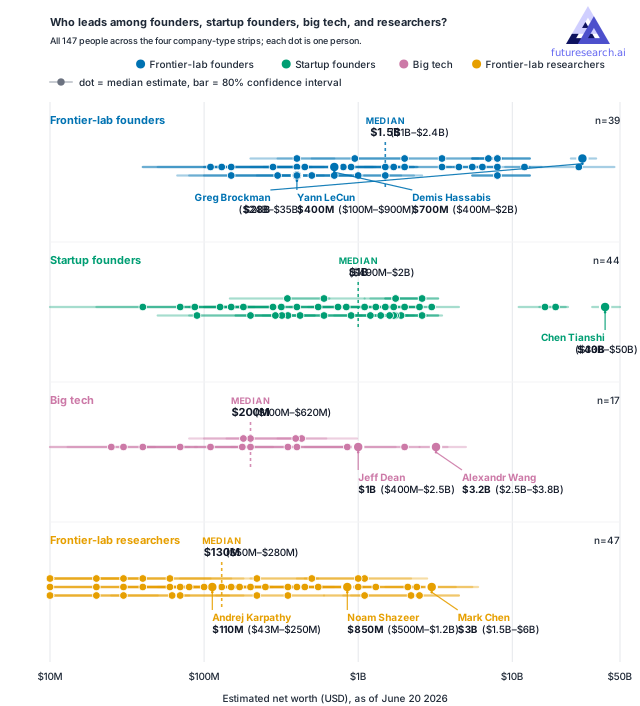
Founders run the top of every group, and the salaried researchers, however senior or decorated, mostly sit in the low billions or below. Demis Hassabis, who runs Google DeepMind, comes in under a billion, and within the researcher tier the best paid are people like Mark Chen and Noam Shazeer rather than the famous academics. Andrej Karpathy, for all his renown, sits near 110 million.

American and Chinese nationals hold most of the tracked wealth, and the seven Chinese billionaires, led by Chen Tianshi of Cambricon and Liang Wenfeng of DeepSeek, average far more each than the eighteen Europeans. Europe has more than twice as many billionaires as China but much smaller individual fortunes, from Anthropic's British cofounder Jack Clark down to Mistral's Arthur Mensch and Thinking Machines founder Mira Murati. The richest outside the big three blocs are Ilya Sutskever, raised in Israel, and Perplexity cofounder Aravind Srinivas of India.
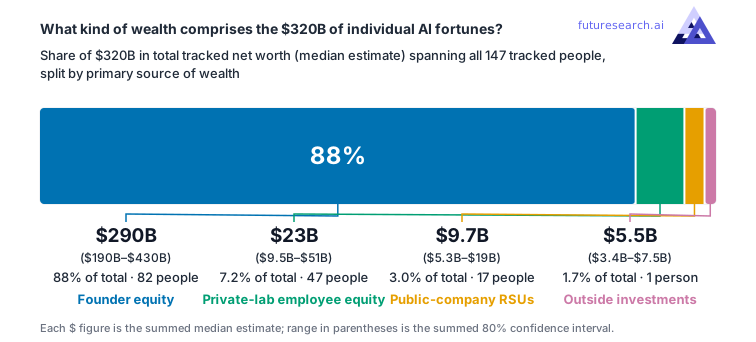
Almost all of this wealth is illiquid founder equity in private companies, and very little of it has turned into cash. Only about 10 billion of the 320 billion total is public-company stock, and even the employee-equity slice is mostly locked up. Alec Radford, the researcher behind GPT-2 and arguably OpenAI's most important individual contributor, holds paper he largely cannot sell.
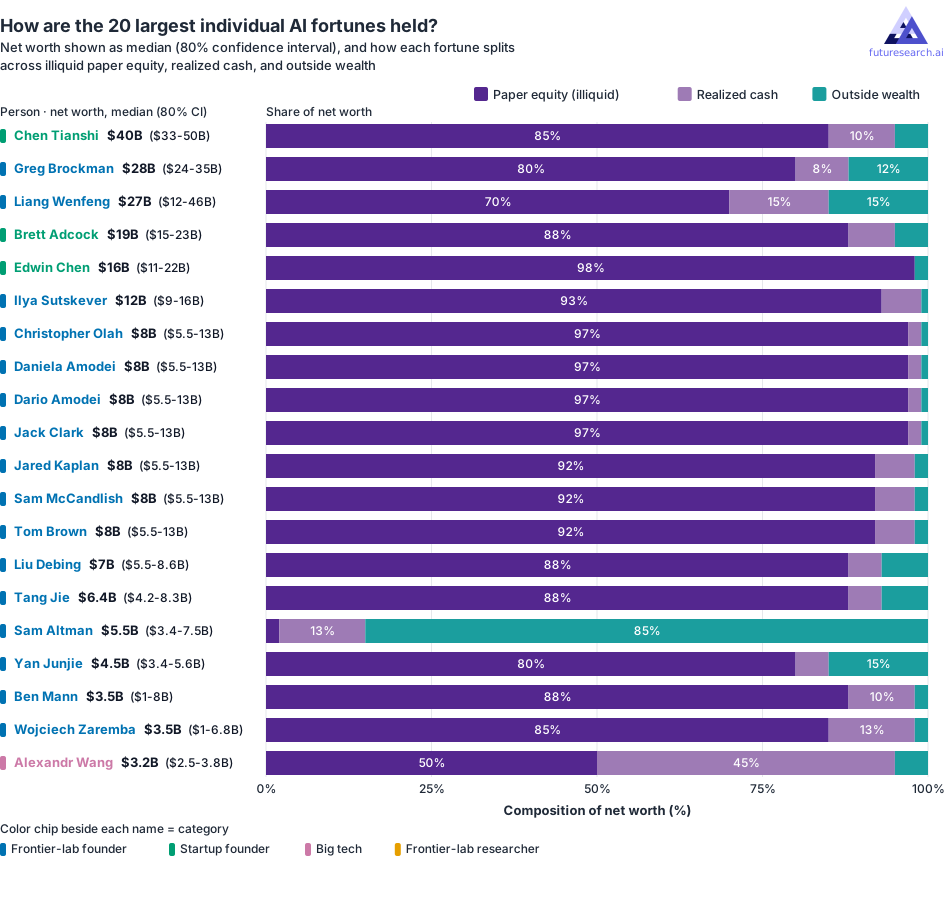
Even at the very top, the fortunes are mostly paper. Sam Altman is the rare figure whose wealth sits almost entirely outside his main company, in bets like the fusion startup Helion, since he holds no direct OpenAI equity. Alexandr Wang is the other exception, with nearly half his net worth in cash banked when Meta bought into Scale AI.
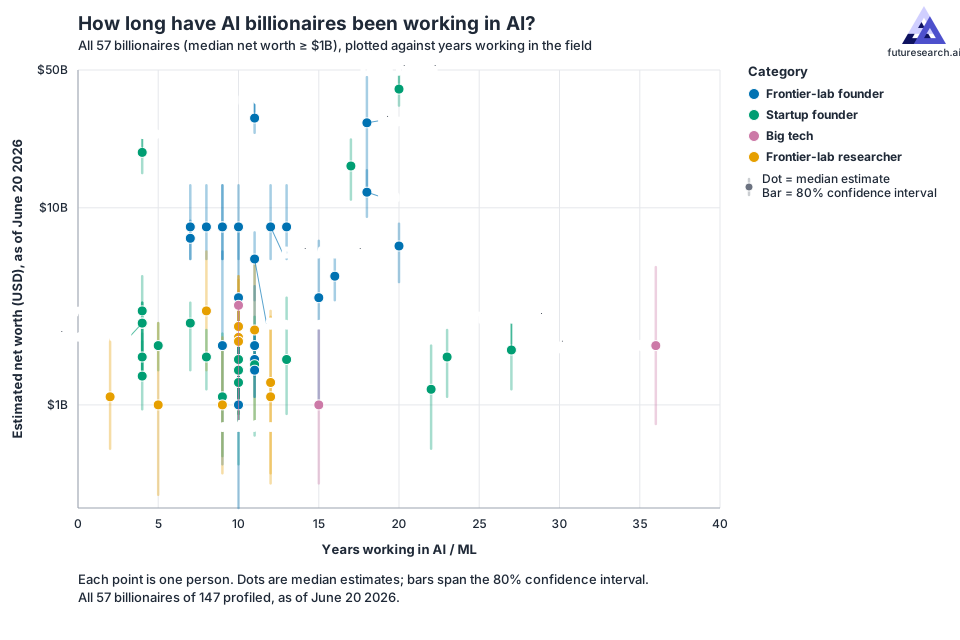
Time in the field barely tracks with wealth. Mike Krieger reached a billion roughly two years after moving into AI, on the strength of his Instagram payout and an Anthropic grant, and Bret Taylor built a multibillion-dollar stake in Sierra within four years of turning to AI agents. At the other end, Sanjay Ghemawat has 36 years in the field and David Silver built AlphaGo over two decades, yet neither cracks the top 20.

The fortunes skew strikingly young. The four Cursor cofounders, led by 25-year-old Michael Truell, are each worth billions before turning 27, and Aidan Gomez of Cohere reached a billion at 29, less than a decade after co-authoring the Transformer paper as an intern. The oldest billionaire on the chart, Sanjay Ghemawat, is around 60.
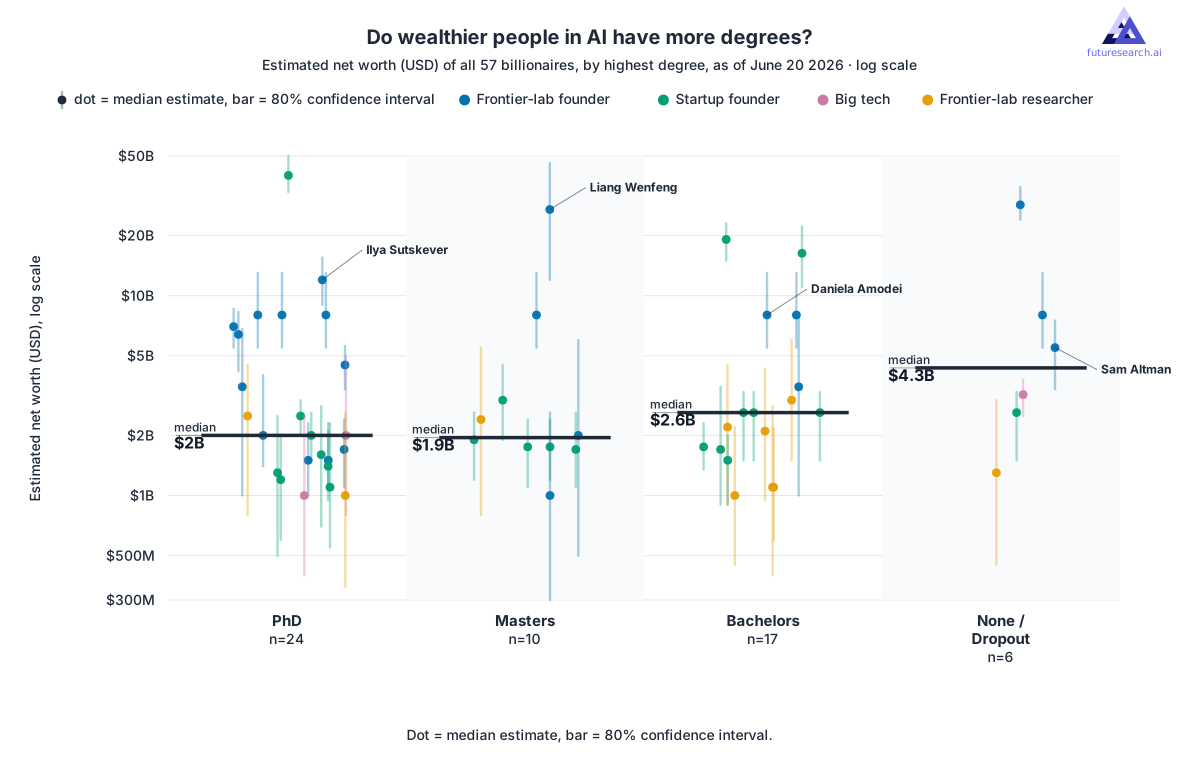
A PhD is neither necessary nor sufficient. The group medians sit within about two times of each other, and the richest people with no degree at all (Greg Brockman, Sam Altman, and Anthropic interpretability lead Christopher Olah) outrank most of the doctorates. Liang Wenfeng built the third-largest AI fortune with only a master's.
Methodology
We started from a roster of about 150 of the most prominent people in AI, generated by a team of parallel research agents (multi_agent) across the frontier labs, big tech, AI startups, and the major non-US labs. One web-research agent then ran per person (agent_map) to gather the inputs that determine net worth, namely the equity stake and its source, the employer’s latest valuation, what has vested, and realized cash. We passed that evidence into a calibrated numeric forecast of each person’s net worth, which returns a full range with an 80% confidence interval rather than a single number. All three are operations in the FutureSearch SDK.
We then re-checked every figure across several independent rounds against Forbes, Bloomberg, and Hurun, corrected what was stale or wrong, and ran a final consistency audit so that people in the same situation are valued the same way. The numbers are estimates with real uncertainty, not precise accounting, and each rests on a named source rather than a guess. Figures are as of June 20, 2026, with the Discovery Loop founders re-estimated on August 6, 2026.