
I started with this FutureSearch prompt:
Please find a list of interesting prediction market questions. Pick 100 of them where you think there might be profit opportunity.
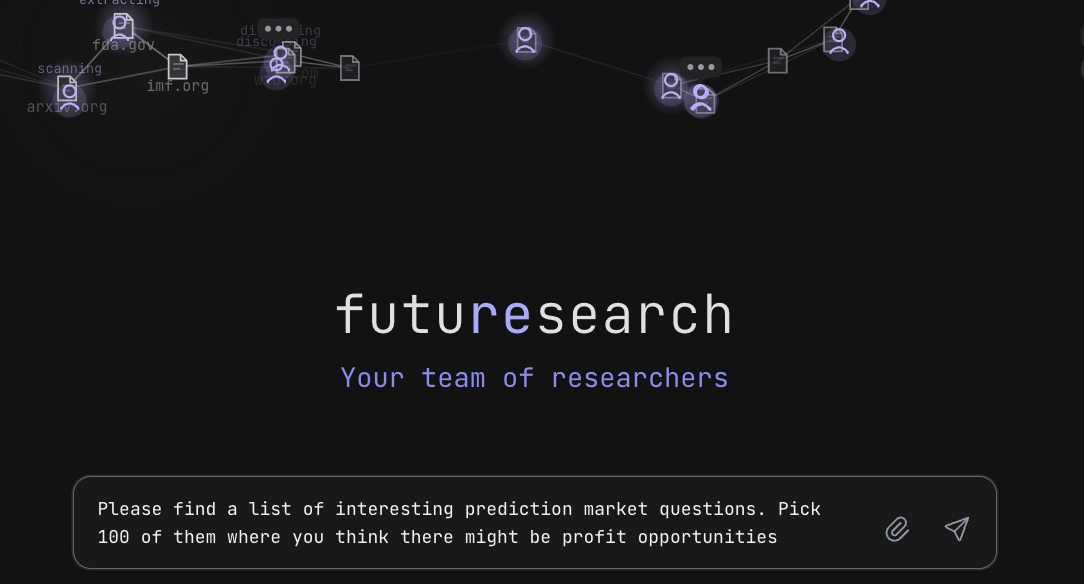
This led to a mix of Kalshi and Polymarket questions, on inflation, China, AI, Iran, Trump, Apple, etc. For convenience, I decided to use only the Polymarket questions:
Please filter to Polymarket, then forecast these questions.
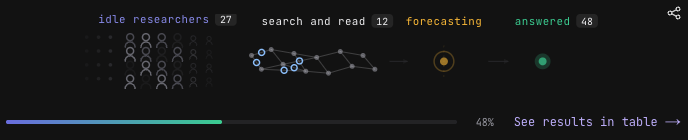
It sent 40 research agents out across those questions. Each forecasting question gets 6 research agents, but some agents are shared between related questions, and it took about 10 minutes to get through all the questions:
When they were complete, I got forecasts like this, one result card per question:
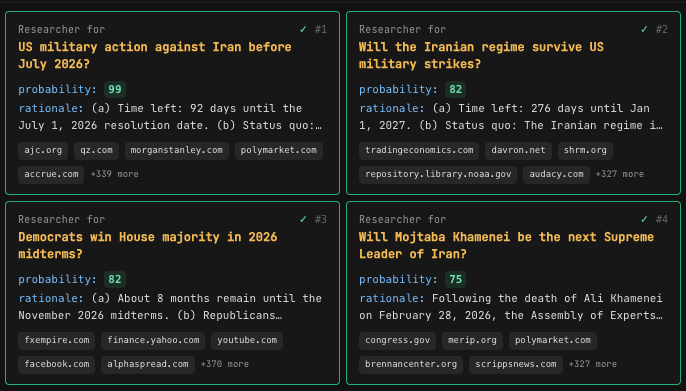
It ended up forecasting 55 of the 100 questions. The rest were filtered out because they resolved too soon, had too little volume, or were in categories where AI forecasting is less useful (sports, crypto).
Once the forecasts were done, I sent a third prompt:
Please use the polymarket API to fetch order book data for the markets here on polymarket. Then use the volume between the price on Polymarket, and this forecast, to compute the expected value profit if these forecasts here are right, and all volume is traded.
The Claude Agent in FutureSearch wrote ran a Python script that pulled live order book data from Polymarket's API, and computed the annualized expected return if we were to execute trades for all the volume in the order book between Polymarket's price and our forecast. Of the 55 forecasted questions, 31 had enough liquidity on Polymarket to be worth trading.
The output is a table sorted by annualized ROI. Annualizing the ROI is important because betting on a prediction market means locking up money until resolution, so all things equal, a small edge in a market resolving next week is probably better than a large edge in a market resolving a year from now.
Results:
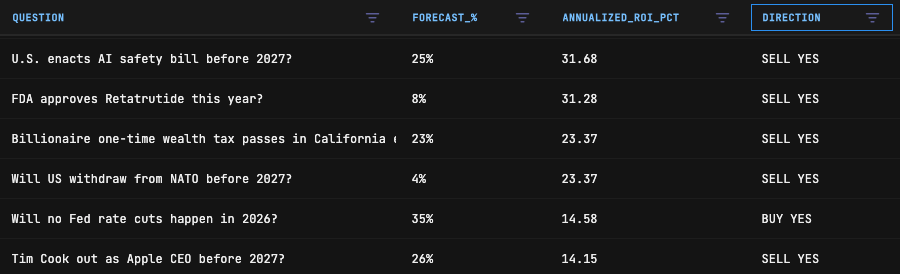
Now, even a high quality forecast is not enough for me to trade or assume a 30% annualized ROI is really that high. I want to do more research first. The important thing is that I've identified promising markets where I can productively spend more time, money, and tokens doing research to pick what I actually want to bet on. (This was a similar strategy that we used in our Python notebook to forecast Kalshi prediction markets.) Now, I can ask:
Research the FDA approval of Retatrutide further. Find the 25 most similar drugs, and find whether they were approved or not and why.
Ultimately, the most profitable strategies on prediction markets are not with pure AI, but using the most intelligent research agents to guide your own strategy.
And while there are many tools to help you with Polymarket, if accurate research and forecasting is your angle, though, it's really as simple as this.