


We recently enabled world modeling for everyone who runs a forecast with FutureSearch. Ask a forecasting question, and the forecaster now draws on a world model assembled from thousands of forecasts.
Modeling the world's interlocking uncertainties is an old ambition in forecasting. In 1966 at RAND, Theodore Gordon and Olaf Helmer built cross-impact matrices: grids of how each future event would shift the probability of the others, filled in by hand, and interesting enough that the CIA adopted the method within a few years. Judea Pearl's Bayesian networks gave the idea a formalism in the 1980s: draw the graph of causes and a machine can propagate evidence between linked uncertainties. Both approaches hit the same wall: an expert had to draw the graph, and the world changed faster than anyone could redraw it.
The payoff has been documented for over a decade: forecasters who keep their probabilities coherent across related questions are more accurate on each one, and re-weighting a forecasting crowd by its coherence beats a simple average by as much as 30 percent. Prediction markets enforce the same discipline through arbitrage: price two linked contracts inconsistently and traders will profit from you until you stop. A forecasting agent answering one question at a time faces no such pressure. Mutually exclusive outcomes can sum above 100 percent, or the same question may return a different number a week later with nothing meaningful in between. Each answer may be defensible based on its own interpretation and research. But taken together, they describe a world that cannot exist.
Meanwhile AI research converged on the same concept from the other direction. A "world model" is the internal representation that lets an agent predict consequences before acting. Many have explored this idea, from Ha and Schmidhuber's recurrent world models to LeCun's argument that they are the missing piece of machine intelligence. We think a forecaster is the purest use-case for one. Its whole job is assigning probabilities to states of the world, and LLM agents remove the wall that stopped the hand-built graphs: our forecaster discovers the drivers underneath the thousands of questions it is asked, keeps what it learns, and redraws the graph as the world moves. The structure is discovered rather than imposed, which is the version of the old ambition that can survive contact with a changing world.
Does FutureSearch's world-modeling improve accuracy?
It was the first thing we checked, on BTF-3, our pastcasting benchmark of already-resolved questions. Running the pass over our production forecaster improved its score by 0.0014 on the first thousand questions. We then ran it over eight different base agents, frontier models from Claude Opus 4.8 to GPT-5.6 driven through our ReAct harness or their vendors' agent SDKs, each of them researching a question for several minutes across dozens of pages at about a dollar per forecast. It improved all eight, by 0.0008 to 0.0021 Brier, with the two largest gains significant at p around 0.001. Margins like these are what the frontier looks like. A gain of 0.002 is roughly the gap between fourth and sixth place on our leaderboard. Most benchmark questions have no related questions to reconcile against, so the pass leaves them alone; on the questions where it acts, the average gain is about 0.005, half the gap between our full system and the strongest single-model agent we have measured. And the pass costs a few dollars per benchmark run, next to a few thousand dollars for the agent research it refines.
The full analysis is in The best forecasters agree with themselves, including a result we did not expect: how much an agent's forecasts have to move to become consistent predicts its accuracy, without waiting for a single question to resolve.
The ultimate test is still live questions graded by someone else. At the time of writing, FutureSearch is first in Metaculus's Summer 2026 FutureEval tournament and in the 90th percentile on ForecastBench.
What you see in the product
The best way to see world modeling is to forecast something you care about. Head to futuresearch.ai/app and ask about a situation with a few moving parts.
While the forecast runs, if your question overlaps with others, a line appears such as "Drawing on 3 of your past forecasts and 5 public forecasts". When it finishes, you'll see a short note on how the world model either upheld or adjusted the raw forecast. You'll also see a list of all the other forecasts which were considered.
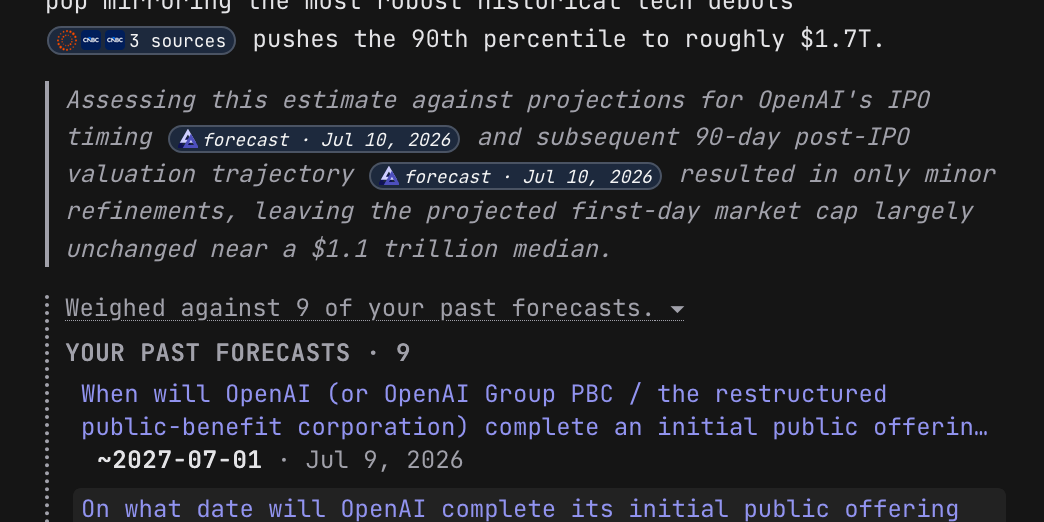
The app tells you how the world model affected the result, as well as the other forecasts it considered.
Privacy
Your forecasts stay private by default and out of the shared world model. Your questions can draw on your own private forecasts, but they won't inform anyone else's forecasts.
To add yours to the pool, publish it. The globe icon on any forecast's results creates a permanent public page for it, and published forecasts join the shared world model. They start informing related questions, yours and other users', and the pool gets richer for everyone.
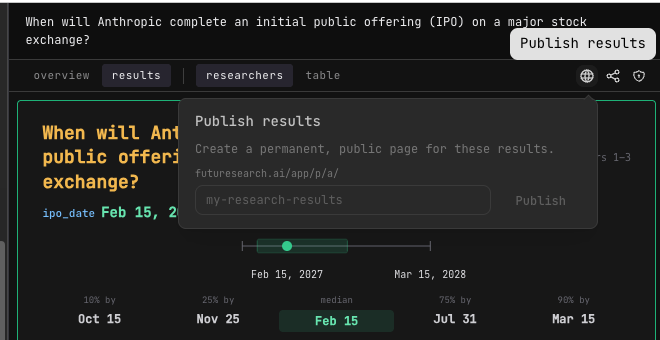
By default, all forecasts are private. Publishing a forecast results makes it public and adds it to the shared world model for others to draw on.
Add to the world model
Ask the forecaster something that overlaps with questions you have asked before, at futuresearch.ai/app or through Claude, and watch it reconcile the new answer against the ones it already holds. If you want, you can publish the result to contribute it to the shared world model so everyone can benefit.
More on the forecaster behind the pass: how we iterate on it, the live benchmarks, the strategic-reasoning paper, and the BTF-3 dataset.