
Prediction markets can be thought of as a way of "scaling" human forecasting. More liquidity, more accuracy. In AI, the "scaling" we're used to is more data, more parameters, or more compute to get better performance.
Here, we show a preliminary scaling law in AI forecasting accuracy.
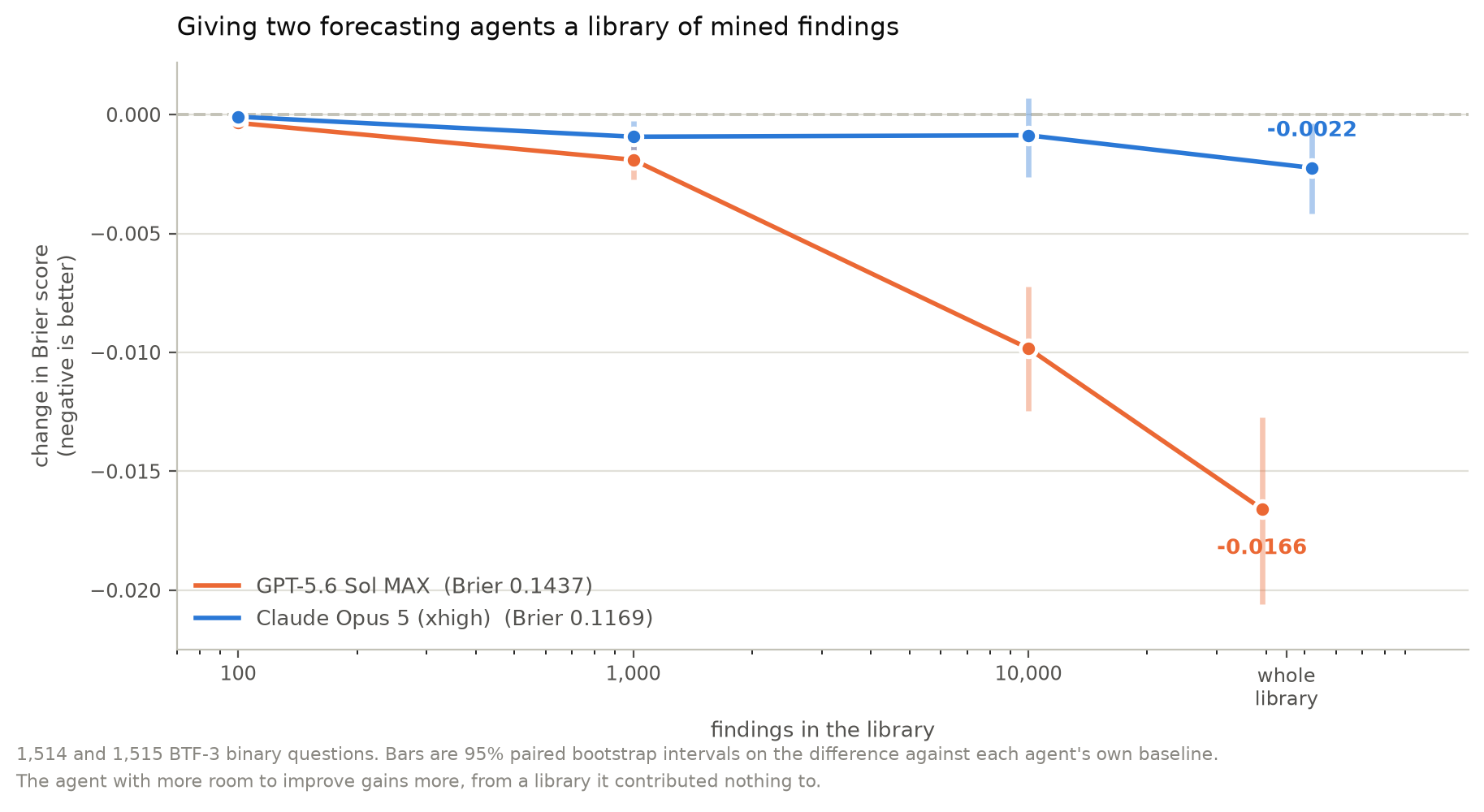
We built a library of 52k distinct research findings mined from 4,517 forecasting rationales on 1515 questions in the BTF-3 set, gave a retrieved slice of it back to a forecasting agent, and scaled the library from 100 findings upward. We tested this on an Opus 5 agent, and a GPT-5.6-Sol-Max agent.
Each of the 52k research findings is evidence from a forecast rationale, like "The IMF Executive Board calendar, updated 15 May 2026, listed no Lebanon meeting scheduled through 1 July 2026." (These are in the past, since BTF-3 is past-casting questions, which is necessary for replayability.)
Both curves show accuracy improvements scaling with library size, and neither curve has flattened at the max library size. Claude Opus 5 (xhigh), the strongest single agent on our leaderboard, improves by 0.0022. GPT-5.6 Sol MAX improves by 0.0166, which is more than the entire spread between first and fourth place on that leaderboard. (Returns to more data are largest where there is most left to find, which is what you would expect if the binding constraint is research rather than reasoning.)
Neither agent contributes anything to the library it is shown.
The bottleneck is search, not reasoning
The answer to "is there a return to more research" has to depend on the quality of the data, because in one sense a forecasting agent already has all of it. Our past-casting corpus is 10M+ docs, and the internet is effectively endless. So it's less about access to data, and more about getting the right data at the right time when researching.
How much does critical information does a frontier forecasting agent miss, that was available? We can measure this directly. Comparing the rationales of Claude Opus 5 (xhigh) and GPT-5.6 Sol (high) on the same BTF-3 questions, we had a judge align them fact by fact and mark how much each fact bore on the resolution. Among the decisive facts, the ones where knowing that single item gets you most of the way to the answer, 23.7% were found only by Opus 5 and 7.5% only by GPT-5.6.1
That asymmetry is most of what we think separates the agents on our leaderboard. Every frontier model we test is decent at the last judgment step of a simple forecasting agent: give several of them the same fixed set of findings and they produce similarly well-calibrated forecasts. The research is the difference.
We also now have direct evidence of where the variance lives. When we run the final forecasting step repeatedly against a frozen set of inputs, the spread it produces is modest. When we run the whole agent twice, research included, the spread is much larger. Across three such comparisons the frozen-input step accounts for 22% to 29% of the total run-to-run variance, leaving roughly three quarters to the web research. Two runs of the same agent disagreeing about a question are mostly disagreeing about what they found.
So the forecasting questions mainly come down to how to compile a high-quality set of findings.
Mining findings from rationales
One way to find facts that are hard to find is to let a lot of agents look, and keep what they came back with. Every forecast our agents produce leaves a rationale behind, and a rationale is a research report of the facts.
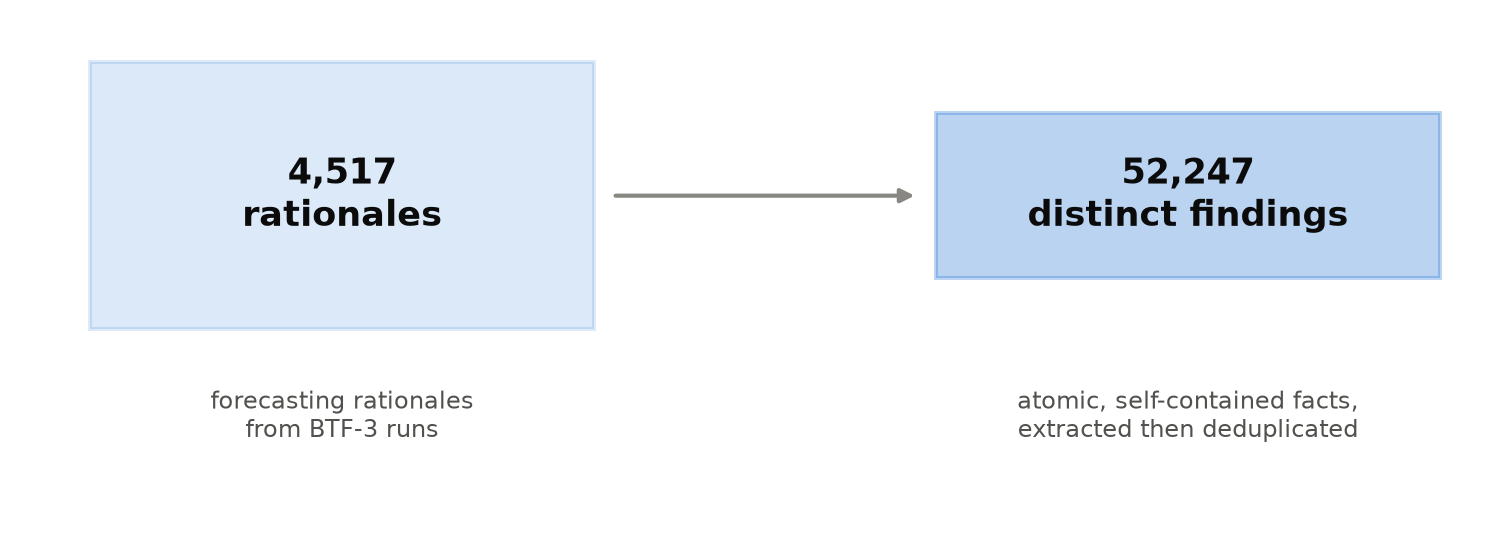
Only checkable world knowledge survives the extraction: a filing, a dated event, a figure, a schedule, a quote, a base rate, or a check that came back empty. The agent's own reasoning, weighting and probability are thrown away. The hard requirement is that each finding has to stand on its own for somebody working on a different question, so every entity is named in full, the register or publication is named, and the date lives inside the sentence. Three drawn at random:
The STF order of March 24, 2026 grants Jair Bolsonaro humanitarian house arrest for 90 days counted from his March 27, 2026 hospital discharge, after which a medical examination is to assess a possible extension.
As of May 2, 2026, Congress.gov's actions list for H.R. 8398 showed only two entries: introduced in the House on April 21, 2026, and referred to the Committee on Financial Services the same day.
These are facts about the world, not any forecasting question. They are facts about a court order, a bill's docket and an institution's calendar, and they bear on every question that turns on any of those.
Then we take a forecaster's own output, its rationale and its probability, select the findings relevant to that question, and ask it to update. Everything is dated on both sides: a finding carries the date its finder was researching and the date it is asserted as of, and it is only eligible for a question if both fall on or before that question's research cutoff. Neither step can reach the live web, and the run being revised contributes no findings of its own.
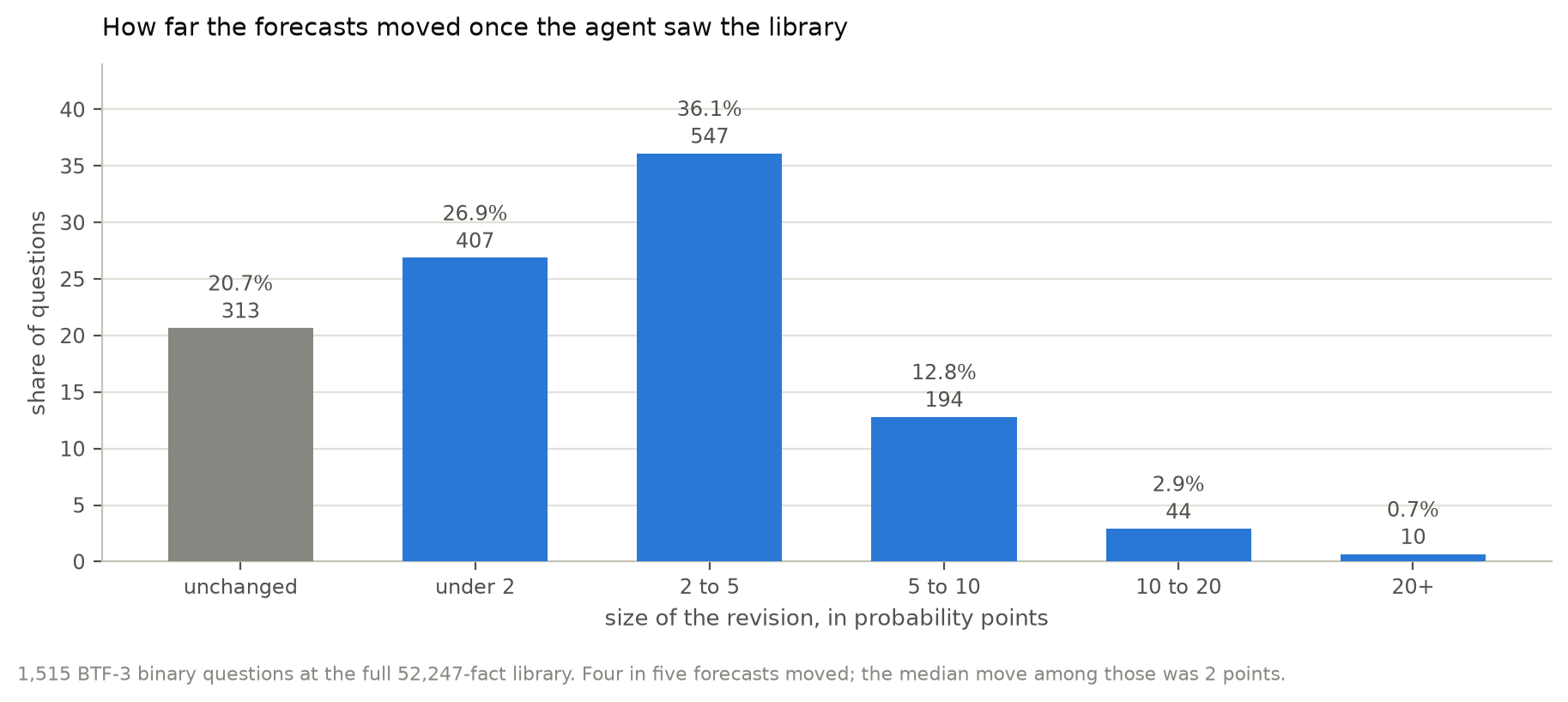
Four in five forecasts moved. Most moves are small, a median of two probability points among those that moved at all, and the tail is thin: 3.6% of questions moved by more than ten points.
Might this scaling stop?
There are two potential reasons.
The first is that selection degenerates. The more findings in the library, the harder it is to pick out the relevant ones, so past some size the retrieval step drowns and the agent is handed noise. The second is saturation. Even with perfect selection, the useful findings get found early, and adding more just adds redundancy.
We don't see either of these yet, even at 52k findings. With the full library Opus 5 is shown 38.6 candidates per question, judges 31.7 of them relevant to this question, and marks 8.9 as both relevant and new, so 23% of what it sees survives both tests. And, as we reported above, the improvement in Brier does not saturate.
GPT-5.6-Sol-Max makes this more obvious by starting at a lower baseline. Its curve is monotone across every step, 0.0004 then 0.0019 then 0.0098 then 0.0166, with each arm beating the no-information control at p = 0.0001. Opus 5's flat stretch between 1,000 and 10,000 findings looks less like a property of the method than like an agent that had already found most of what mattered.
The saturation objection assumes the useful findings are easy to find. Suppose instead that a given finding is hard: any single research run on a related question turns it up with probability . Then such runs surface it with probability , so at it takes 14 runs before the odds are even that anyone has seen it at all. A finding like that is effectively invisible to any single forecast and routine across a few dozen.
And that is the arithmetic for one finding bearing on a handful of questions. A court order's terms, a bill's docket position, an institution's meeting calendar: each is one such finding, each touches every future question that turns on it, and there are a great many of them. The library is how you accumulate what no single run was ever likely to reach.
Footnotes
-
95% intervals 17.1 to 30.7 and 4.2 to 11.4, on 32 questions judged twice with the agents blinded and their labels swapped between passes. Restricting to decisive items matters, because Opus 5 is the more verbose agent and reports more of everything. On merely peripheral colour its apparent advantage is an artefact of that verbosity, with 76% found only by Opus 5 and almost nothing shared. ↩