
You have a list of 500 leads, but no CRM with built-in scoring. Do you review them manually? Buy an expensive tool like Clay? Traditional lead scoring requires CRM setup, rules configuration, and ongoing maintenance. This tutorial shows how to score and rank leads in a spreadsheet using AI that understands your ICP, prioritizing high-value prospects for $28, without any CRM infrastructure.
My Use Case
I work at a company full of research scientists and AI forecasters. They build tools for AI labs and financial institutions. However, I kept running into problems in my non-developer day-to-day tasks where I needed exactly the kind of semantic understanding our tools provide. But I was trying to solve them with tools built for ops people: Clay, Apollo, HubSpot, and whatever else people recommended on Reddit.
I finally tried our own tool on what felt like a simple operational task: rank a list of investment firms by how likely they are to pay for research tools.
Turns out the thing we built for complex research queries also handles complex CRM problems better than anything else I tried.
Here's what I did and what I learned.
Lead Prioritization is complicated
This wasn't a "company size < 25 = good fit" situation. It required researching each firm, checking if they publicly stated their thesis (and understanding what differentiates them beyond the jargon that every fund claims to do), looking for signals of tool usage, figuring out whether it was a 1-person shop or a large team.
Why Clay failed
I'm inundated with Clay (clay.com) ads on the NYC subway. What they advertise: every GTM data point imaginable, in one place seemed like a perfect fit for what I was after. I set up a workbook with multiple tables: a Funds table for scoring firms, then a Contacts table for pulling the right people at each firm.
Here's where it fell apart.
The Credit Burn
In December, I burned through 1,912 credits (64% of my monthly 3,000 credit allotment) on this one workbook:
| Table | Rows | Credits Used | Cost/Row |
|---|---|---|---|
| Funds table | 85 | 748 | ~8.8 credits |
| Contacts table | 659 | 931 | ~1.4 credits |
| Bottom half list | 83 | 233 | ~2.8 credits |
| Total | 1,912 |
At $229/month for 3,000 credits, that's roughly $0.076 per credit. My Funds table alone cost me ~$57 for 85 firms. That's $0.67 per firm just to score them. The individual firm cost sounds small, but this was before I even got to pulling and enriching multiple contacts from each of these firms.
And the credit burn wasn't just from running enrichments. Even though Clay shows previews, I would need to be a seasoned user to avoid situations where I burn credits on an enrichment that I later end up abandoning.
Alternatives Didn't Work Either
Enterprise ABM Platforms
Tools like 6sense start around $10,000/month. Even if I had the budget, users describe them as black boxes. You get a score but no explanation of WHY an account ranks high or low.
Doing It Manually with ChatGPT
I considered exporting the list, researching each firm manually, using GPT to help synthesize.
At 5 minutes per firm and $50/hour for my time, that's $4.17 per account. For 229 firms: $954 and 19 hours.
Not scalable. And inconsistent. My judgment at firm #1 would differ from my judgment at firm #229.
What I actually needed was pretty simple: something that could read a firm's website, understand what they actually do, tell me why it scored them a certain way, and not charge me every time I changed my mind.
Trying Our Own Ranking Tool
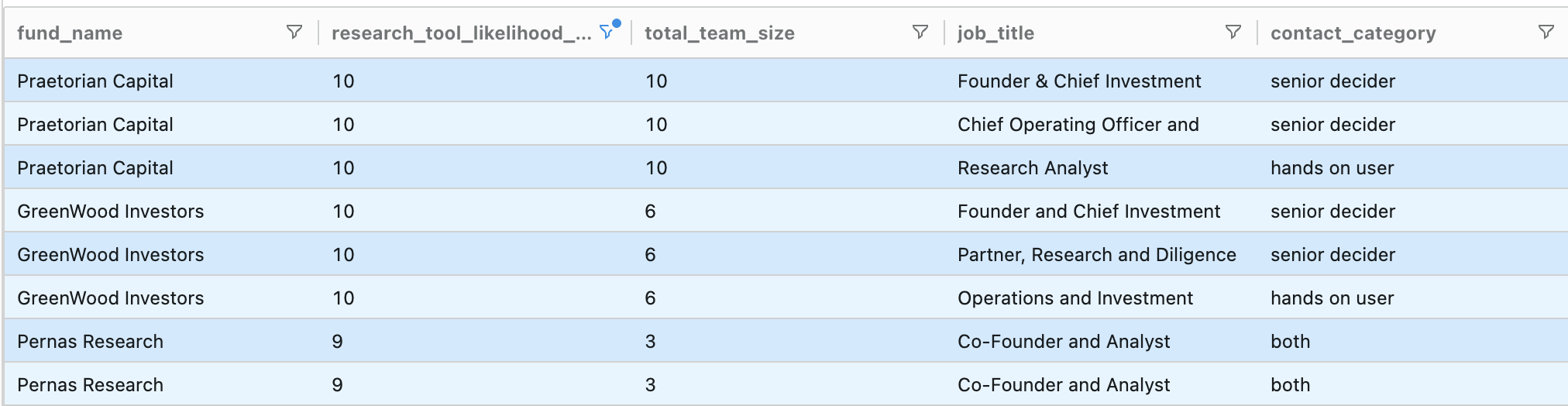
Here's the simplest version of the workflow: take a list of firms and rank them by likelihood to pay for investment research tools, based on public information about tool usage, job postings, and stated research processes.
Example scores:
- Longleaf Partners Funds: 10
- Smead Capital Management: 10
- First Eagle Global Value Fund: 10
- Wedgewood Partners: 9
- Diamond Hill Capital: 9
- Greenlight Capital: 6
- Pabrai Investment Funds: 3
- Semper Augustus: 4
The Numbers
| What I Did | Clay Cost | FutureSearch Cost |
|---|---|---|
| Score 85 firms by ICP | $57 (748 credits) | |
| Clay Total (initial pass) | $145 | |
| Rank firms by research tool likelihood | Included | |
| FutureSearch Total | $28 |
The entire end-to-end process with FutureSearch cost $28. The Clay cost was $145 just for the initial pass, and I would have burned more credits iterating.
If you want to rank leads like an analyst and keep iteration cheap, this is the workflow I landed on.
It's free to test on your own data at FutureSearch.