
Since Ilya Sutskever started Safe Superintelligence in Sept 2024, valued at $5 billion after just the seed round (now reportedly worth $32 billion), AI researcher talent has been a defining factor of AI startup valuations. Matt Levine joked that the perfect AI startup would have two assets: a speculative chance to make enormous future profits by “build[ing] God,” and elite researchers who refuse to discuss a business model.
Following Ilya were Mira Murati (seed round in July 2025, startup valued at $12 billion) and Yann LeCun (seed round in March 2026, startup valued at $4.5 billion), who also raised primarily on their names alone. So I thought to ask: who else might start a new AGI lab, and how much would it be worth?
To forecast this, I assumed that (a) the startup would be somewhat AGI-related, not some "agents for customer service" type play; (b) the founder would recruit other prominent researchers in their network, but that they would be the most prominent person (so it's "their" startup), and (c) that they would announce the company today having already raised a seed round.
I started with a list of 116 famous AI researchers, and then excluded people who have already started AGI startups, like Demis Hassabis or the Anthropic cofounders. It is interesting to think what would happen if folks like that left, but I wanted to focus on first-time AGI-company founders.
Here are the results:
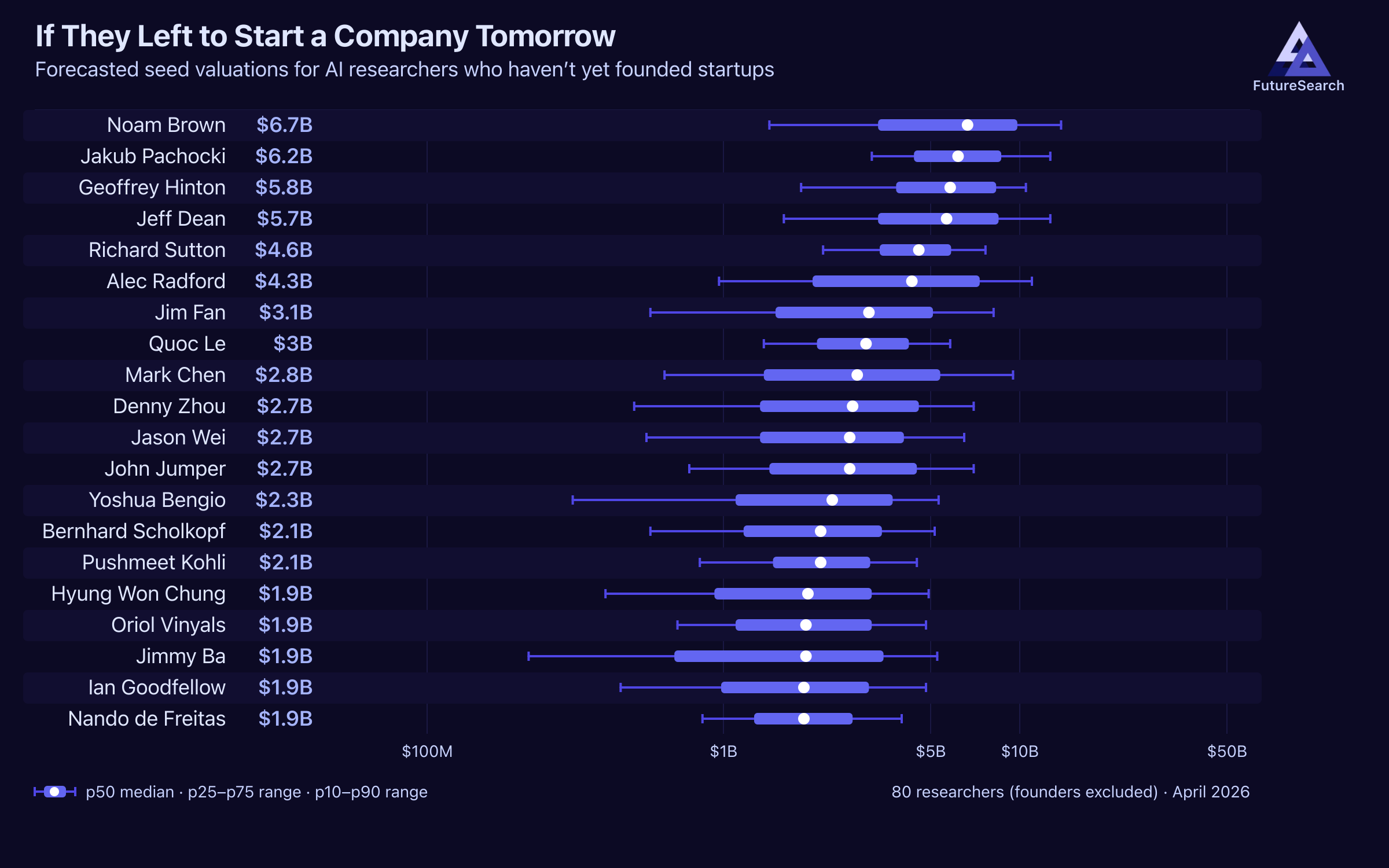 Forecasted by the FutureSearch app. White dot is the median; bar is the 50% confidence interval; whiskers are the 80% confidence interval.
First, some of the more obvious choices:
Noam Brown tops the list at $6.7 billion ($1.4B to $13.8B). Brown is a research scientist at OpenAI, best known for poker AIs and OpenAI's o1 reasoning model. Investors would likely believe that he could do another "reasoning" breakthrough and have a horse in the AGI game.
Geoffrey Hinton ($5.8 billion) would be a wild development. The "godfather of deep learning" is focused on AI safety advocacy, so if he started a lab, it might be like Sutskever's "Safe Superintelligence". Presumably the main value of Hinton's startup would be in the other researchers he would attract. (Yoshua Bengio, the other "godfather", who I forecast would make a startup worth $2.3 billion, is in a similar position, he's focused on AI governance right now.)
Alec Radford ($4.3 billion) was the lead author on GPT-1, GPT-2, CLIP, Whisper, and DALL-E, and has advised Murati's Thinking Machines. The low end of $1B only applies if he deliberately chose to build a small research lab rather than a frontier competitor, while the high end of $11B puts him squarely in the "OpenAI mafia mega-seed" tier alongside Sutskever and Murati.
A few that I forecast command high market power but may be less well known:
John Jumper ($2.7 billion) is the lead scientist at DeepMind behind AlphaFold2, the protein structure prediction model that earned him a share of the 2024 Nobel Prize in Chemistry. It's unclear what the relationship between drug discovery and AGI is, but presumably whatever he would do would be catnip both to AGI investors and to people trying to use AI to actually make something worth billions of dollars.
Tri Dao at $1.8 billion created FlashAttention (which nearly every frontier model uses) and co-created Mamba, so he's big on compute efficiency. The forecast values his startup higher than most because efficiency is the rare AI subfield where commercial value would be immediately obvious to investors who want to bet on AGI but need something more grounded to anchor to.
Andrew Yao at $1.4 billion is China's only Turing Award winner and Dean of AI at Tsinghua University. His forecast is shaped almost entirely by geopolitics: the range spans from $280M (if US-China capital decoupling severely limits his investor base) to $5.3B (if he's backed by sovereign wealth as a "national champion" in the mold of China's push for AI self-sufficiency).
Been Kim at $930 million is a senior staff research scientist at Google DeepMind and creator of TCAV, one of the most widely-used tools for explaining what neural networks are actually doing. An interpretability-based startup might command a huge valuation, and she might command the highest valuation for an AGI startup centered around that.
Finally, of the people mentioned in this article, who is most likely to actually do it? I ran a FutureSearch forecast on this too, and of the most obvious candidates, the one that jumps out to me is Noam Brown, mostly because people really like leaving OpenAI (a factor I weighted heavily in my Jan 2026 forecast that Anthropic would be king in 2026 due to their talent, which is looking like a very good forecast so far!) Jakub Pachocki is an obvious candidate for the same reason, or Jason Wei at Meta. Compare that to folks like Jeff Dean, who surely would command a ridiculous valuation, but is presumably going to stay loyal to Google, which has treated him so well so far.
I would say, if any of the aforementioned people are reading this, you may want to act now while investor sentiment is hot. The window may be closing to make what Matt Levine called "the platonic idea of a tech startup pitch" to all the investors who fear they're missing out on AGI.