
SpaceX filed confidentially for an IPO on April 1, 2026, targeting a $1.75 trillion valuation and a June listing. If completed, it would be the largest IPO in history. To test whether $1.75 trillion is the right price, we broke SpaceX into seven business segments and forecast the fair market value of each using FutureSearch forecasting agents, which independently research each question and produce probability distributions.
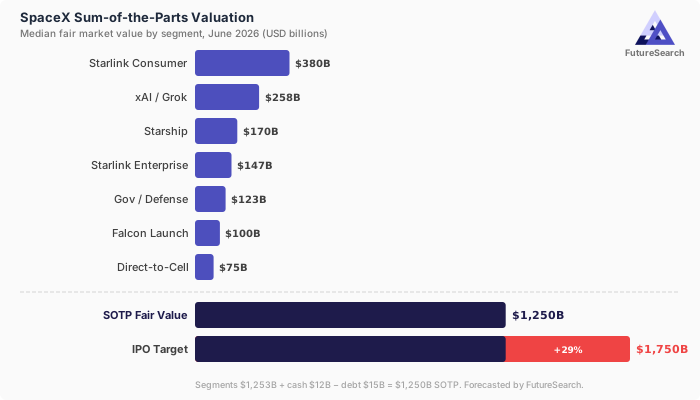 All bars on the same scale. Red portion of the IPO bar shows the 29% premium over SOTP fair value.
The seven segments, at median forecasted values:
- Starlink Consumer Broadband: $380B. 9.2M subscribers, ~$10B revenue, valued at ~38x revenue.
- xAI / Grok: $258B. Anchored by the $250B merger price from February 2026. ~$1.7B/year revenue against ~$5.8B/year in losses.
- Starship Commercial Launch: $170B. Pre-revenue. Pure option value on reducing launch costs by 10-100x.
- Starlink Enterprise / Maritime / Aviation: $147B. ~$2-3B revenue at much higher per-customer prices than residential.
- Government / Defense: $123B. ~$22B contract backlog across Starshield, NASA HLS, NSSL, and classified programs.
- Falcon 9/Heavy Launch Services: $100B. ~$5B revenue, ~60-70% of global orbital launches. Mature and cash-generative.
- Starlink Direct-to-Cell: $75B. Pre-revenue. Backed by $17-19B in EchoStar spectrum licenses for satellite-to-smartphone connectivity.
Segment total: $1,253B. Adding $11.6B in cash and liquid assets, subtracting ~$15B in total debt (SpaceX standalone obligations, remaining xAI inherited debt, EchoStar spectrum commitments), the sum-of-the-parts equity value is approximately $1,250 billion: 29% below the $1.75 trillion IPO target.
Where does the $500 billion gap come from? The SOTP method sums independent medians, but the IPO prices correlated upside. If investors are bullish on Starlink, they're simultaneously bullish on Starship, xAI, and defense. Taking the 75th percentile across all segments instead of the 50th brings the total to ~$1,675B, close to the target. The $1.75T price is "everything goes right" pricing.
SpaceX may also be one of the rare conglomerate premium cases. Conglomerates usually trade at a discount because investors prefer pure-play exposure. But the narrative that Starlink + Starship + xAI creates something no single segment could (orbital data centers, AI-powered global connectivity) may justify paying above the sum of parts. And the largest IPO in history will generate extraordinary retail demand: reportedly 30% retail allocation versus the typical 5-10%.
A few things stand out. Starlink in all three forms (consumer, enterprise, direct-to-cell) accounts for $602B, or 48% of segment value and 34% of the IPO price. Everything hinges on whether Starlink can grow from 9.2M subscribers to 50M+ while expanding revenue per user through enterprise, maritime, aviation, and direct-to-cell channels. xAI at $258B is the most speculative component: ~$430M quarterly revenue against $1.46B quarterly losses, valued almost entirely on the merger anchor from four months earlier. Starship at $170B is pure option value on technology still in advanced testing. And the physical assets (satellites, launch pads, factories, the Falcon fleet) are worth roughly $46B at fair market value, 2.6% of the IPO price. Nobody is buying SpaceX for its factories.
Our forecasted fair value of ~$1,250B suggests the $1.75T IPO embeds about 40% upside to the median case. That is not irrational for a company with SpaceX's growth trajectory, but it leaves very little margin of safety. The price requires Starlink subscriber growth, Starship commercial success, xAI momentum, and defense expansion to all happen together.