
Resolved (July 1, 2026). On June 30 the US Commerce Department lifted the order (CNBC), and Fable 5 returned worldwide on July 1 after Anthropic shipped a new safety classifier that blocks the reported jailbreak in more than 99% of cases (Anthropic). Mythos 5 came back on June 26 for roughly 100 vetted US critical-infrastructure entities (Axios). Against that outcome, the forecast below scored well on three of its four main calls. Restoration timing was close, a median of July 9 against an actual July 1. Mythos staying gated was right, since it returned only for vetted US entities rather than a broad commercial release. A negotiated compromise as the modal resolution fits, since the lift came in exchange for a new safety classifier rather than a clean win for either side. The clear miss was foreign access, which the forecast put as probably not returning in 2026 and which in fact came back worldwide on the same day. The original forecast is preserved in full below.
On June 12, 2026, the US government forced a deployed, commercial, frontier AI model offline, Anthropic's three-day-old Claude Fable 5. As I write this on June 23, Fable is still unavailable, eleven days on. The politics ran hot then cold: the President said on June 19 that Anthropic is no longer a national-security threat, but the order has not been lifted, and newly surfaced reporting that an NSA red-team had the more powerful Mythos model break into classified test systems in hours has complicated how benign any of this looks.
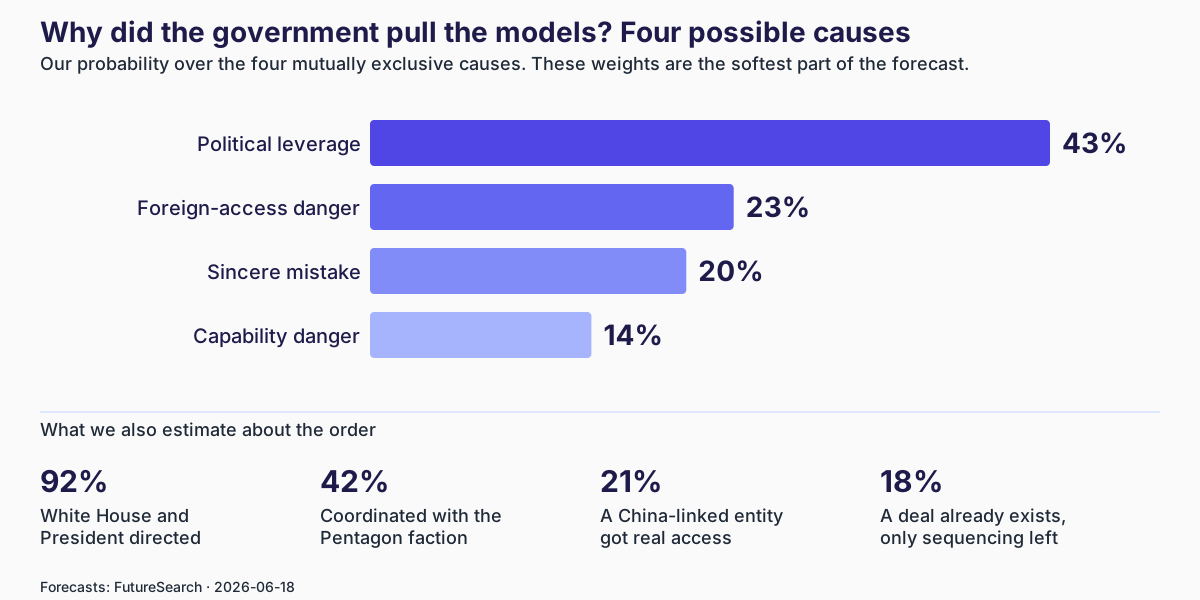
I wanted to forecast when Fable will return. (We at FutureSearch got a lot of evals and projects out of it, and it is really an amazing model.) But it all hinges on why it was pulled in the first place. Was it a sincere but mistaken panic over a capability that turns out to be ordinary? Is the model genuinely dangerous in a way the public record does not yet show? Is the real worry that an adversary got access? Or is it all politics?
My best guess is still politics. The biggest change since I first wrote this is that the honest-mistake reading has faded and the foreign-access worry has grown, as the picture of how capable and contested these models really are has sharpened. I'm still uncertain and put real probability weight on all four scenarios. So to forecast the outcome, I had to research all of them. Here is my view:
Updates: Originally published June 18 with a median forecast of July 12 for Fable's return to Americans; updated June 20 to July 7; updated June 23 to July 9; resolved July 1, 2026, when Commerce lifted the order and Fable returned worldwide (see the note at the top).
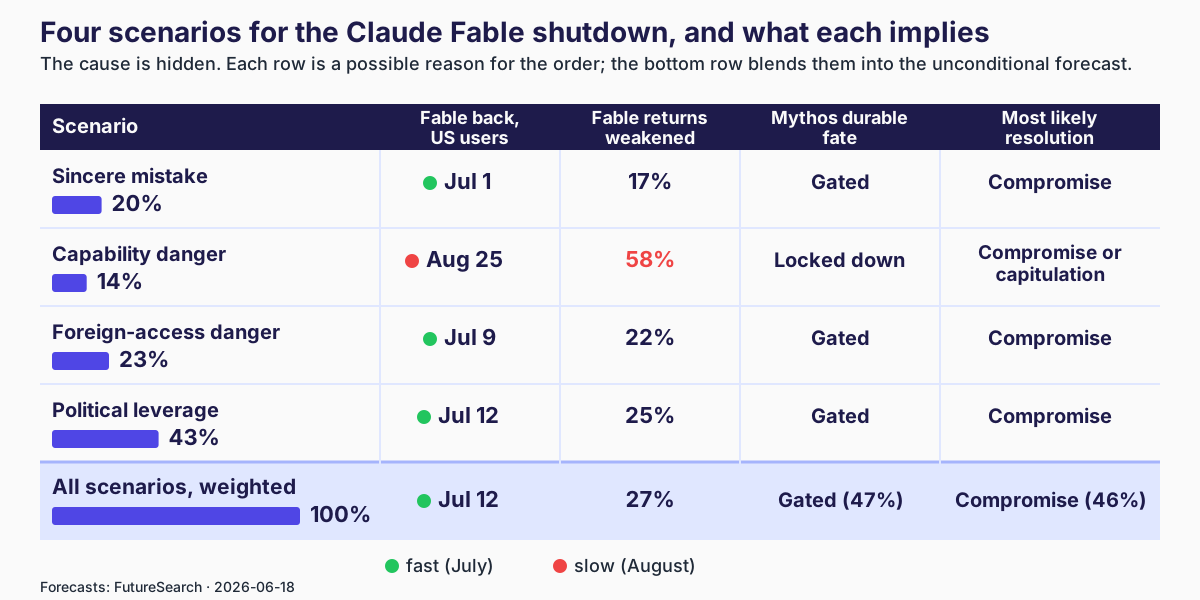
Even though "it's just politics" is my top hypothesis, at just over half, I give the rest of the probability to the other three scenarios, with the foreign-access worry now the largest of them. The rest of the piece goes through these scenarios one by one. Then I produce my unconditional forecast of what will happen by summing up all the possibilities.
A companion piece, The Claude Fable ban barely changes Anthropic's IPO timing or valuation, works the financial impact. This one is about the dispute itself.
What happened
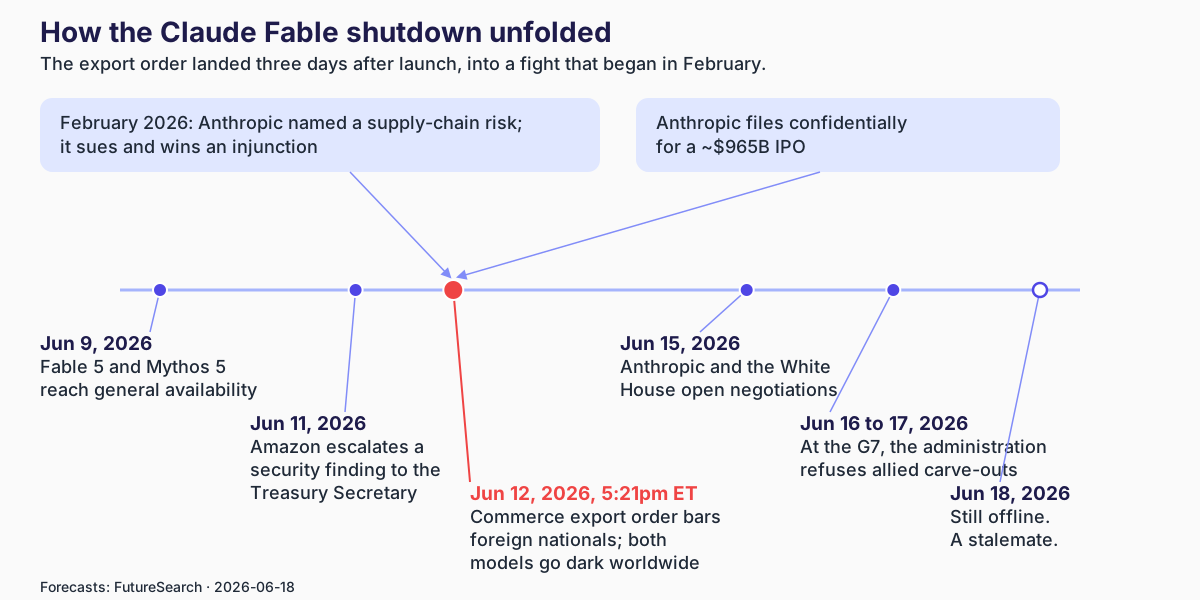
I'll describe what happened only briefly, with this summary timeline, as there are plenty of other sources on what happened when.
Anthropic launched a new top tier above Opus, Sonnet, and Haiku. Mythos 5 is the most capable of the two and was kept tightly restricted: Anthropic's own red-team reporting describes a model that can autonomously find and exploit zero-day vulnerabilities across major operating systems and browsers (red.anthropic.com). Fable 5 is the guardrailed public version of that capability, with safety classifiers meant to block the high-risk cyber and bio territory.
On June 11, Amazon's Andy Jassy escalated a security finding to Treasury Secretary Scott Bessent. Within roughly a day, the matter ran through an NSA review and the National Cyber Director, Sean Cairncross, and on June 12 at 5:21pm ET, Commerce, through a Bureau of Industry and Security "is-informed" letter under the Export Control Reform Act, ordered Anthropic to bar all foreign nationals from both models (Politico). The stated trigger was a "narrow, non-universal jailbreak," reportedly a prompt that asked the model to read a codebase and fix its flaws, which surfaced a handful of previously known minor vulnerabilities (Snyk). I am going to treat it as established, as most of the security community does, that this particular trigger is not a genuine novel vulnerability. It is ordinary dual-use behavior that peer models like GPT-5.5 also exhibit. (This doesn't mean the model isn't dangerous, though.)
From there, in the order of the timeline above:
June 12. Anthropic complied, took both Fable and Mythos offline worldwide, called the order a misunderstanding, and went into daily negotiations.
June 16 to 17, the G7. The administration refused allied carve-outs as "completely illogical" and set its terms: a full accounting of the roughly fifty to a hundred and fifty entities given Mythos access through Project Glasswing, and guardrails close to "jailbreak-proof," a standard cybersecurity experts consider technically impossible (Wired). Commerce signaled even the safer Fable's return was "contingent upon fully resolving the jailbreak concerns" (Wired).
June 18. After talks collapsed the previous Friday over a demand to de-deploy Fable, a week of in-person meetings, with Anthropic represented by policy head Sarah Heck and co-founder Tom Brown, led both sides to begin building a shared framework to grade jailbreak severity, and the administration conceded that no model can be made completely jailbreak-proof (Politico). The controls were not lifted.
June 19. In an interview taped after he met Amodei at the G7, President Trump said Anthropic was no longer a national-security threat, "not now, but a week ago, maybe," praised it for "behaving very responsibly," and said he was not sure he still needed to act against it (Reuters). Bipartisan members of Congress separately demanded the administration justify the restrictions (Liccardo).
June 21. Via Senator Mark Warner, it emerged that the NSA's director had told him the more powerful Mythos model, in a classified red-team, broke into "almost all" of the agency's classified test systems "in hours." The claim is unverified, and the Economist editor who relayed it cautioned against reading it literally, but it points to a real, demonstrated capability sitting behind the flimsy public trigger.
June 23, as I write. Eleven days in, the models are still down, no deal has been announced, and the restoration markets have drifted lower rather than higher.
It's important to state that this did not come from nowhere. Anthropic had refused to let the Department of War use its models for some uses it would not name, and in February the administration designated the company a "supply chain risk." Anthropic sued, and a federal judge granted a preliminary injunction, calling the government's move "Orwellian" (Anthropic PBC v. U.S. Department of War). The government appealed. The June order lands in the middle of that ongoing feud and just after Anthropic filed confidentially for a roughly $965B IPO. Second, the legal vehicle is novel and contested. Treating remote access to a hosted model as a "deemed export" of the model to foreign persons stretches export law in a way scholars call possibly illegal (Politico), but the same statute, ECRA, strips the standard route to challenge it in court.
Which of those four readings is correct shapes everything that follows. The four sections below take each scenario as true in turn and forecast every outcome inside it.
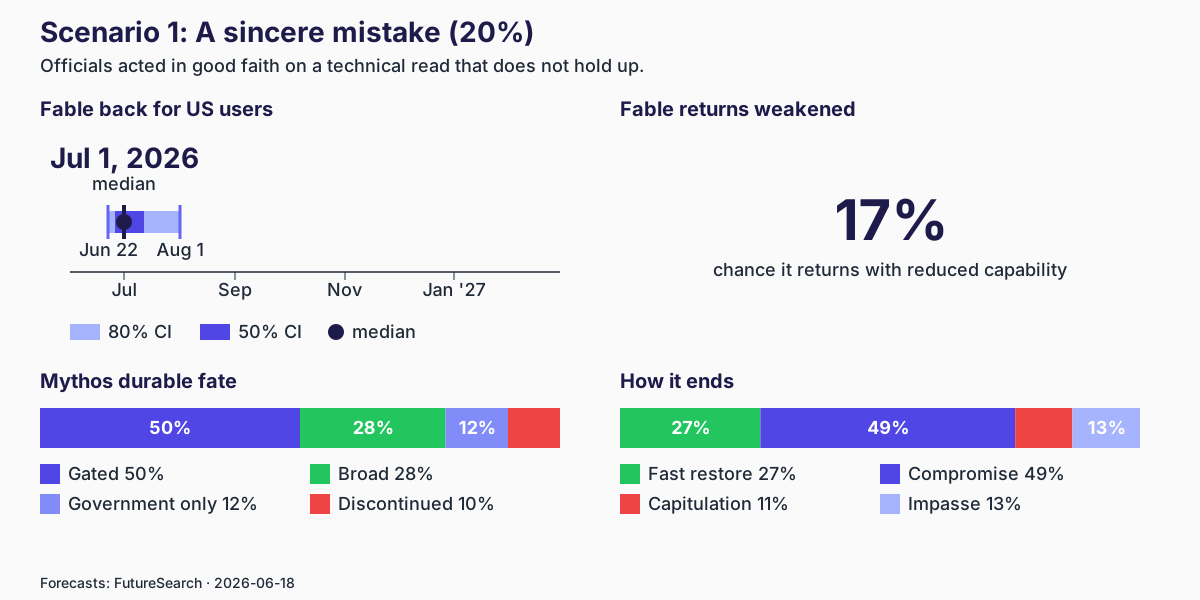
Scenario 1: A sincere mistake (10%)
In this world, the people who pulled the trigger believed in a real threat and were wrong. The "fix this code" demonstration genuinely alarmed non-technical officials in a fast, 24-to-72-hour cycle, and the alarm does not survive contact with the technical facts. The evidence that this is at least part of the story is strong. The process was a reactive scramble. The administration's demand that Anthropic make guardrails impossible to circumvent is something security experts uniformly call technically impossible, which reads more like naivety than calculation (Wired). Over a hundred cybersecurity researchers signed an open letter arguing the move misunderstands the technology and helps attackers more than it stops them (freefable.org), and Alex Stamos called the shutdown a death penalty for a speeding ticket.
What caps this scenario, now at just 10%, is that the alarm was probably not a mistake about something ordinary. Selectivity is one reason: a sincere, generic worry about cyber-capable models would have the government asking hard questions of GPT-5.5 and other peers, not singling out the one company it was already fighting in court, the week after its landmark IPO filing. The bigger reason is clearer now than when I first wrote this. The government was not reacting only to the ordinary "fix this code" trigger. A classified NSA red-team result, briefed to the officials who authorized the order the day before they signed it, points to their having seen the underlying model do something genuinely alarming. You can argue the worldwide order was disproportionate, but "good-faith overreaction to ordinary behavior" is a poor fit once a real, demonstrated capability is in the picture, and the reported Lutnick line to Amodei, "that's the point," reads as a deliberate aim rather than a panic.
If we are in this world, the path back is the friendliest of the four, because a good-faith actor adjusts when shown its premise was wrong. But "friendliest" is not "fast and clean". Even a government that realizes its technical premise was shaky cannot simply reverse a President-directed action without a face-saving exit. The administration has dug in publicly, refused allied carve-outs, and tied Fable's return to resolving jailbreak concerns it has already stated. So the natural shape of resolution here is not a clean climbdown. It is a package that lets both sides declare victory.
Concretely, conditional on Scenario 1, I forecast Fable back for US persons with a median around July 3, the fastest of any scenario, with a real chance of much sooner. The most likely mechanism is Anthropic's own KYC machinery, a privacy-policy change effective around July 8 that lets the company verify nationality and gate foreign nationals out, which is exactly the "recipient accounting" the government says it wants. On the question of how the dispute primarily resolves, even this friendly world lands on a negotiated compromise as modal at 45%, with a clean Anthropic-favorable fast restore now up to 36% after the President's de-escalation, an impasse into 2027 at 11%, and an outright Anthropic capitulation on its red lines at just 8%. The reason fast-restore is capped even here is the same face-saving logic: the moment Anthropic deploys a KYC gate, that gate is itself a concession, and what looked like a clean win reclassifies as a compromise.
The most useful thing about Scenario 1 is that if the premise was simply wrong, there is no reason to weaken Fable. I put the chance that Fable comes back materially capability-reduced, as opposed to returning essentially as launched with access gating, at only 14% in this world.
Scenario 2: The capability really is dangerous (8%)
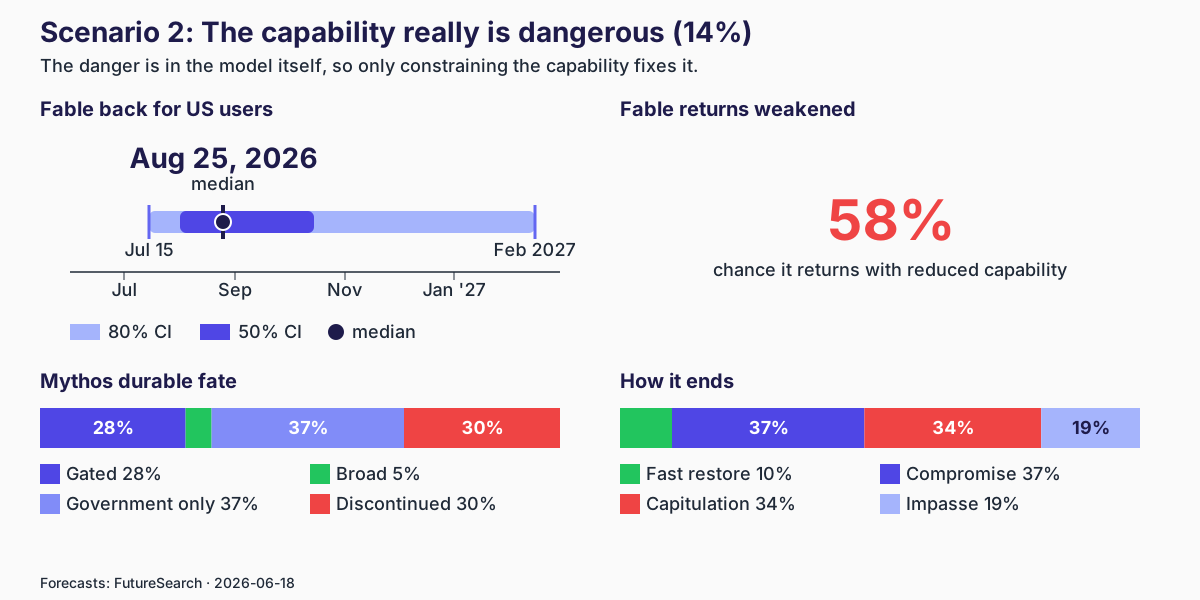
This is the world where the government is substantively right, and right in the hardest way: the danger is intrinsic to the model. Mythos can autonomously find and exploit zero-days, Fable is a guardrailed wrapper over that same engine, and if the guardrails can be stripped, then the capability is loose regardless of who is nominally authorized to use it. In this world a vetted American with a jailbreak is as much a problem as a foreign adversary, and the only real remediation is to constrain what the model can do.
The case for this scenario is the genuine potency of the underlying capability, which is not in dispute. Anthropic's own materials describe Mythos finding serious vulnerabilities at scale, and the company itself had declined to make Mythos generally available, citing severe cyber risk. Reporting indicates an NSA review concluded the launch guardrails could be stripped. So the raw ingredients for a real, capability-level danger are present.
The case against, and the reason this is the lowest-weighted scenario at 8%, is the shape of the remedy. If the government believed the capability was dangerous in anyone's hands, barring foreign nationals while leaving Claude for Government and NSA access intact would be a strange cure. You do not solve a nationality-agnostic danger with a nationality filter. The order's structure, foreign-persons scope with domestic carve-outs preserved, points away from "the capability itself is the problem" and toward access. This is the single most important consistency check in the whole analysis, and it is why, when I split the broad "the security concern is real" case into its capability and access versions, the access version came out larger. The gap has only grown, to 30% against 8%. The newly public NSA red-team result makes the underlying capability real rather than imagined, but the remedy is still a nationality filter, and the same government is reportedly readying Mythos for its own offensive use. The theory that fits is keeping a dangerous asset away from adversaries, not banning it in every hand. The remedy reveals the theory.
If we are nonetheless in the capability world, almost everything gets harder and slower, and this is the scenario that should worry a Fable user the most. Restoring access to US persons does not actually fix the stated problem, so the median US restoration slips to around September 18, with a fat tail into 2027, the slowest of the four. More strikingly, this is the scenario where the product comes back diminished. I put the chance that Fable returns materially weakened or re-guardrailed at 58% here, against 14 to 22% in every other world, because a genuine capability danger can only be met by actually reducing the capability, and the government's "jailbreak-proof" demand, impossible to satisfy perfectly, forces real degradation as the negotiated approximation. Mythos fares worst of all: in this world it most likely never returns to broad commercial use, ending up government-only or quietly superseded.
The endgame here is the one place the government has real leverage to win. Conditional on Scenario 2, compromise is now more clearly modal at 49%, but government-favorable capitulation stays elevated at 27%, by far its highest across the four worlds. If the danger is real and intrinsic, the government can legitimately demand heavy constraints, and Anthropic's commercial desperation, a flagship offline during an IPO run, gives it little room to refuse. Impasse into 2027 sits at 13%, and a clean fast restore is nearly off the table at 11%.
Scenario 3: The foreign-access worry is real (30%)
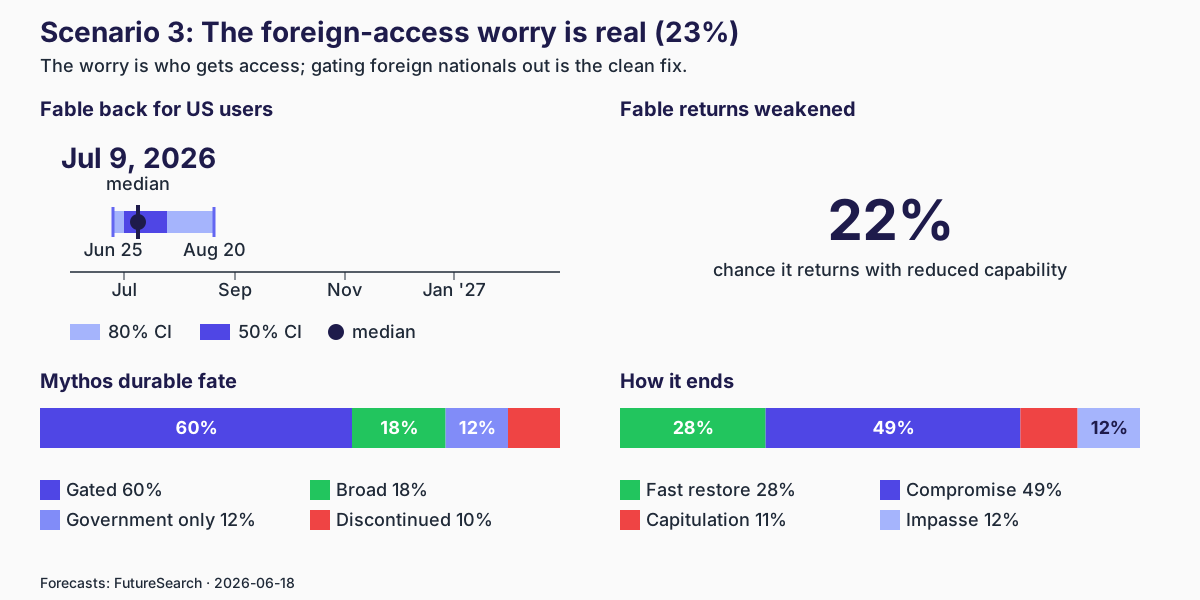
This is the most coherent of the "the government is right" stories, and at 30% it is now the largest single alternative to politics. Here the concern is who gets access. The model is acceptable in vetted American hands, but not in an adversary's.
The evidence for this scenario is the order itself. It legally targets foreign nationals, full stop, and it preserves domestic government access. That is exactly the shape you would design if your worry were diversion rather than the capability. The factual seed is that Anthropic had expanded Mythos access through Project Glasswing to a list that included SK Telecom, and the White House's loss of trust reportedly centered on that expansion, with Commerce Secretary Lutnick citing the risk of the models being diverted to Chinese or Russian military intelligence (Reuters, Washington Post).
There is a newer piece of evidence here, and it is the same NSA story that complicated everything else. Reporting that the agency is readying Mythos for its own offensive cyber operations, against targets like China and Iran, fits the access reading better than any other: an asset the United States wants to wield is exactly one it would move to keep out of an adversary's hands. Cutting the other way, the administration refused to exempt even Five Eyes allies, which a narrowly justified diversion worry would not do, and which is part of why I hold this scenario at 30% rather than higher.
The evidence against a strong version is that the specific diversion worry is thin. I separately forecast the chance that a China-linked entity actually obtained meaningful Mythos access at only 21%. SK Telecom is a flagship Korean ally whose China ties are historical and minor, it denies improper access, and no public evidence shows real diversion. So Scenario 3 is most plausible as "a legitimate, precautionary access concern after a trust breakdown," and least plausible as "we caught an actual Chinese operation." A precautionary concern can be met with verification and accounting, which is tractable; a confirmed operation would harden into something closer to the capability world.
If we are in the access world, the path back is the most mechanically clean of any scenario, and it is the engine of my relatively optimistic US-restoration timing. Anthropic deploys its KYC verification, excludes foreign nationals, and the stated concern is addressed without touching Fable's capability. Conditional on Scenario 3, US restoration has a median around July 9, nearly as fast as the sincere-mistake world, and the product comes back essentially intact, with only a 21% chance of material capability reduction. The cost is borne entirely by the cohort the order actually targets: foreign-national access is the last and hardest thing to return.
The endgame is the friendliest-to-Anthropic of the substantive scenarios. I give compromise as most likely at 54%, a clean fast restore at 26%, and capitulation at just 8%, because a foreign-access problem is cleanly solvable by gating and does not require Anthropic to abandon its defense-use red lines.
Scenario 4: It is mostly politics (52%)
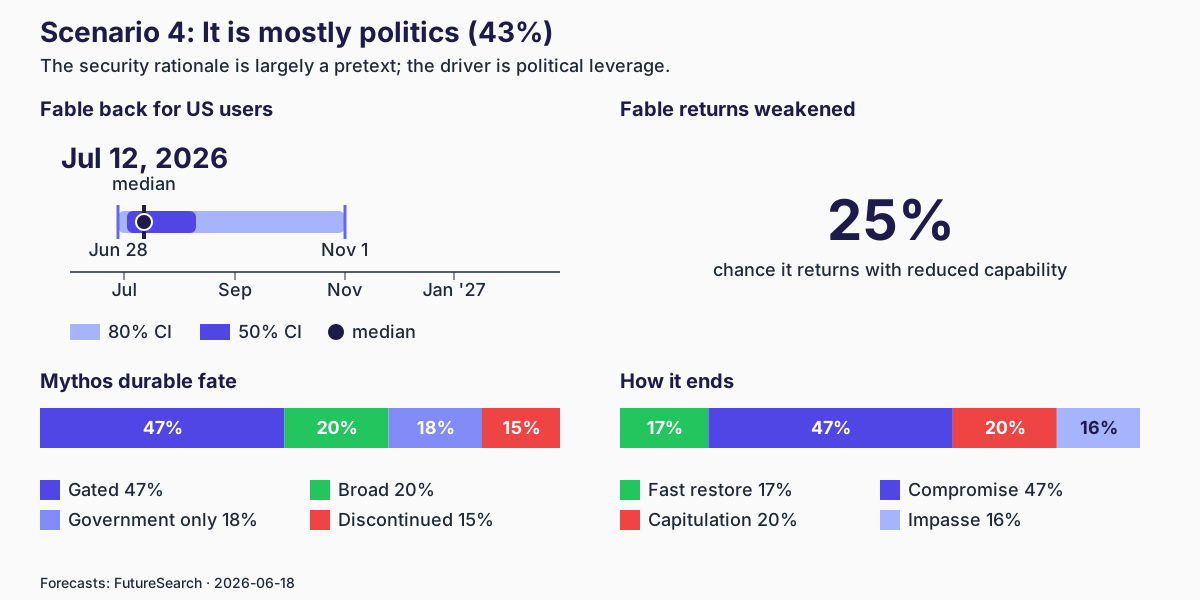
This is my single most likely scenario, at 52%. It doesn't claim there is zero security content, but that the content is a pretext for leverage and retaliation in the broader fight between the Trump administration and Anthropic. Two things keep it on top even after the NSA disclosure complicated the picture. The public trigger the government actually cited stayed flimsy, ordinary "fix this code" behavior present in peer models. And Commerce Secretary Lutnick is reported to have answered Amodei's "this means we can't have the model out" with "that's the point," which is the language of an intended outcome, not a security fix. The President's June 19 climbdown, praising Anthropic for "behaving very responsibly," reads the same way: a leverage play that got what it wanted.
The case rests on three things the other scenarios struggle to explain together. The first is selectivity. The disclosed trigger is ordinary dual-use behavior present in peer models, yet only Anthropic was hit. The second is the relationship. This is the same administration that, months earlier, designated Anthropic a supply-chain risk in a move a federal judge called "Orwellian" and likely retaliatory, after the company refused certain Department of War uses. The third is the instrument and the timing. The government reached for a novel, legally vulnerable "deemed export over SaaS" theory, against this one company, days after it filed for a roughly $965B IPO, when a model offline is maximally painful. Put those together and the most parsimonious account is leverage, not an emergent threat (Lawfare).
Why is my forecast for this scenario not higher still? Because the leading alternative is no longer "they made an honest mistake," which is weak, but "the foreign-access worry is genuine," which is strong. The newly public NSA result, and the reporting that the United States wants Mythos for its own offensive use, give the keep-it-from-adversaries story real substance, so a chunk of probability that might otherwise read as politics sits in the access scenario instead. There is also a structural caveat: this order looks like it routed around the specific Pentagon faction from the February fight, so a pure-retaliation read would need a broader anti-Anthropic coalition than the one revealed then.
The implications of Scenario 4 are the most counterintuitive. If this is leverage, then the obvious "fast technical fix" does not actually unlock the door, because the door was never really about the technology. Holding the flagship offline is the leverage. That cuts both ways on timing. It argued, a week ago, for a slower and messier resolution than a sincere-but-fixable story would, because no amount of guardrail work satisfies a political bar. But leverage is also reversible overnight once Anthropic pays the price, and the price is political, not technical. That is roughly what just happened. The President's June 19 reversal reads like the goalpost sliding back once Anthropic had cooperated enough, which is why, in this scenario, the fast-restore odds jumped rather than the timing dragging out. Commerce had tied Fable's return to "fully resolving jailbreak concerns," which in a pretext world was always a movable goalpost, not a fixed bar.
This scenario's endgame moved twice. Compromise is still my top forecast at 49%. A clean fast restore, which I had jumped to 33% right after the President's reversal, has come back to 29%, because the de-escalation has not actually produced a restore in the days since, warm words and all. Government-favorable capitulation sits at 10%, since the administration looks like it is declaring victory rather than squeezing for a deeper concession, and I put 12% on impasse into 2027. Anthropic still almost certainly keeps its defense-use red lines, no autonomous weapons and no mass domestic surveillance, which it already won an injunction in the parallel fight to defend.
What holds in every scenario
As I wrote above, forecasting the outcomes is hard because the four scenarios disagree about a lot of basic facts about what is going on. The places they overlap are the conclusions I hold with the most confidence, because they do not require me to be right about the cause.
Four likely things in any scenario:
- A negotiated compromise, with Fable restored under expanded oversight while Anthropic keeps its red lines and Mythos and foreign access stay limited, is the single most likely resolution in every scenario, modal at 45% to 54% across the four.
- The cohorts come back US persons first, then Anthropic's own foreign-national employees, then a gated Mythos, and international customers last.
- Anthropic almost certainly keeps its defense-use red lines, and concedes expanded oversight instead, or some other concession
- Anthropic probably does not win this in court, and probably does not need to, about a 14% chance a court narrows the order by the end of 2026, because the likely path is a settlement anyway.
The first is the closest thing to a robust unconditional prediction in the piece. When I forecast the endgame conditional on each cause, the compromise-package archetype comes out modal in all four worlds: 45% under the sincere-mistake story, 49% under the capability story, 54% under the access story, and 49% under the political story. The reasons differ by world, a face-saving exit here, a legitimate safeguard there, a leverage settlement in the political case, but they converge on the same shape, because both sides have strong incentives to settle and a ready-made way to do it, namely Anthropic's KYC accounting plus the June 2 executive order's voluntary pre-deployment review.
The second follows from the legal structure of the order, which targets foreign-national access. Restoring Americans is then a matter of gating, while restoring foreigners requires the government to actually lift or license the restriction, a much higher bar; Anthropic's vetted employees sit in between, defensible as a narrow licensed carve-out but still, under the deemed-export theory, a controlled export. This ordering held in every scenario when I forecast the cohorts separately and blind to each other, which is a useful internal consistency check. A US user and an international user are not waiting on the same clock, and the gap between them is months, not days.
Graded July 1, 2026. This cohort ordering was the forecast's one clear miss. When Commerce lifted the order on June 30, Fable 5 came back for US and international users on the same day rather than US persons first with foreign access months behind. The gap I expected here did not appear (see the resolution note at the top).
The third rests on the export fight being substantially decoupled from the older Department of War feud. Anthropic already does extensive national-security work and holds a $200M Department of Defense agreement, so its real red lines, no fully autonomous weapons and no mass domestic surveillance, are narrow and identity-defining, and it has a live court win backing its right to draw them. The concession the headlines reach for, a reversal of those red lines, is the one I think least likely. What Anthropic gives up to end this is far more likely to be oversight and recipient accounting than its founding principles.
The fourth turns on ECRA. The deemed-export-over-SaaS theory is novel and, several scholars argue, possibly unlawful, but ECRA strips the standard Administrative Procedure Act route to challenge an export control, leaving only a narrow and deferential ultra vires path that courts rarely grant against a national-security action. I put the chance a court blocks, narrows, or vacates the order at about 14% by the end of 2026 and 22% by mid-2027, with a large mass on never, because the modal path is a negotiated settlement that moots any lawsuit. The likely legal event is not a dramatic injunction but a quiet protective administrative appeal, which Anthropic's counsel has reason to file by the EAR Part 756 deadline around July 27 to preserve its rights while the talks continue; when I forecast that Anthropic files a formal legal or administrative challenge, the roughly 45% by year-end is mostly that protective filing.
When Fable comes back, and why I am under the market
Here is the headline number, the one most people actually want, and the one where I disagree most with the crowd.
I forecast Fable 5 back for US persons with a median around July 9, roughly 29% by July 1. The right tail is shorter than it was two weeks ago, but I pulled it back out a little this week: the order is still in force on day eleven, and the de-escalation has not produced the quick restore its tone implied. This is shown below, against the prediction markets as of June 23.
I built it two independent ways, as before, and this time they pull apart. The bottom-up build, forecasting US restoration inside each scenario and weighting by the scenario probabilities, now gives a median around July 10, anchored on the verification mechanism Anthropic can switch on around July 8. The top-down one-shot still says July 2, but it is pricing a handshake that the last two weeks did not deliver. So I lean toward the bottom-up and land around July 9.
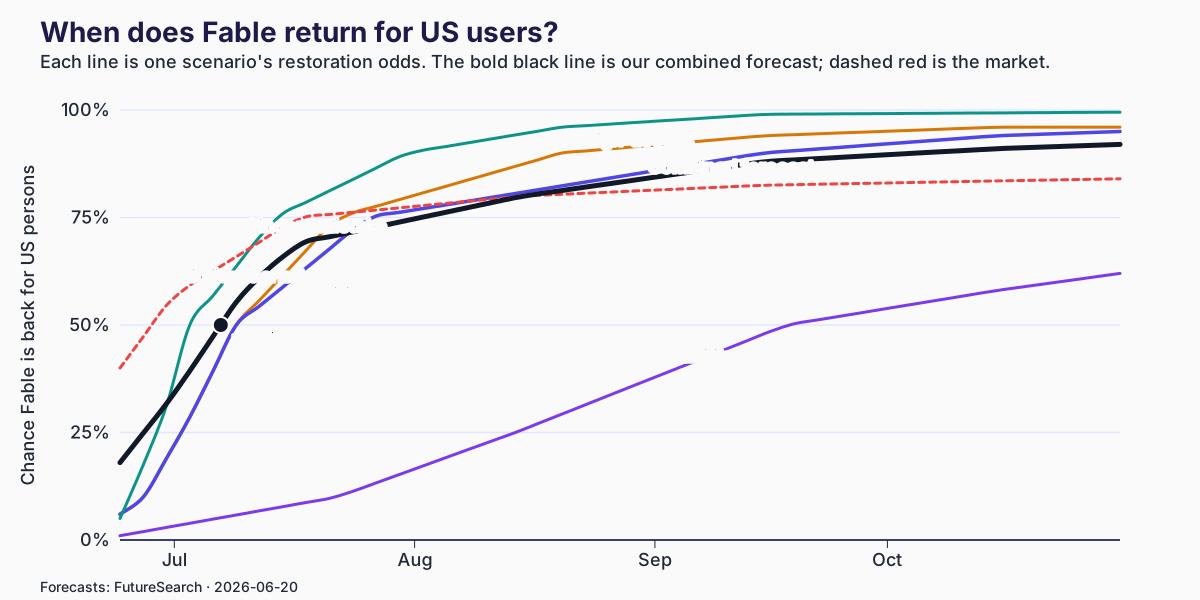
Here is how my forecast and the prediction market have moved across my four updates:
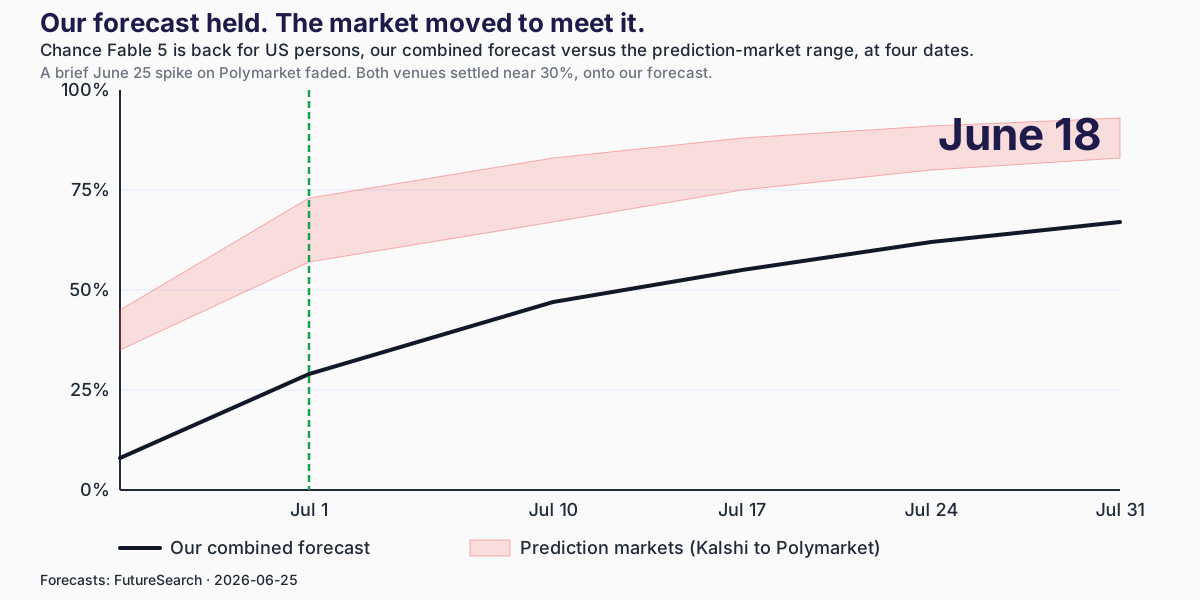
The charts above are the June 23 picture, and the two days since were violent. By the evening of June 25 the near-date market had come back to my number. Both venues now put restoration by July 1 at about 30%, against my 29%. Kalshi has come down from the high 50s in mid-June (CNBC on Kalshi). Polymarket round-tripped hard, a 73% peak on June 18, a collapse to about 34% by June 23, a brief intraday spike back toward 51% on June 25, and then a settle to about 30%. That spike was thin and faded the same day. Further out the two venues largely agree and sit a little above me, Kalshi near 79% and Polymarket near 83% by July 17, climbing toward 89% by the end of the month, while my own distribution is more spread out around a median of July 9. The remaining disagreement comes down to one question, which I forecast on its own. Can Anthropic re-enable US access unilaterally, just by gating foreigners out?
I put the "fast, unilateral, decoupled" path at 40%. I had briefly raised it to 48% on the de-escalation, then cut it back, because the de-escalation conspicuously did not unlock a fast decoupled restore: eleven days on, with warm words from the President, the order still stands and the models are still dark. The reasons it was never high in the first place hold. Commerce coupled even Fable's return to "fully resolving the jailbreak concerns," a guardrail standard experts call impossible, and a reported "zero-defect" patching demand is, if real, unmeetable. Add a President-directed action Anthropic is loath to defy mid-IPO and a legal recourse ECRA has mostly closed, and the clean technical fix does not unlock the door as cleanly as the market assumes.
The other cohorts trail, and by a lot. Restoring Fable to foreign-national and international customers is the hardest tier, because lifting that restriction is the actual concession, not a side effect. I put it at roughly 5% by July 1, with a significant chance that international access does not come back in 2026 at all. Anthropic's own foreign-national employees land in between. Here this is in a graphic:
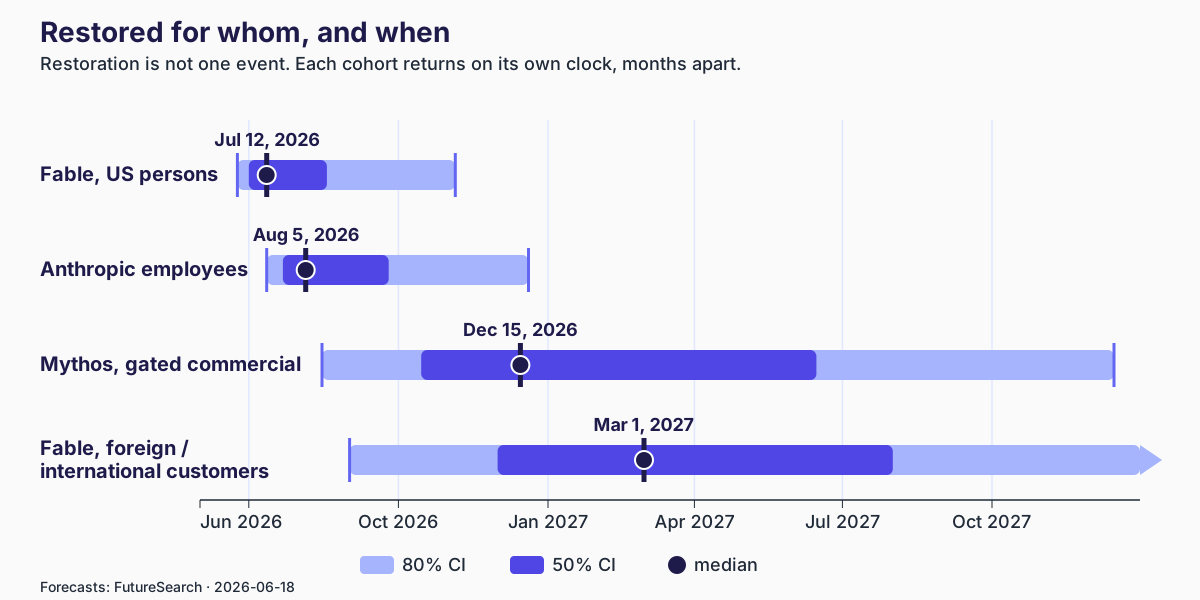
Two weeks ago this analysis felt too pessimistic, and the de-escalation pulled it earlier. This week pulled it back a touch: the warm words did not produce a restore, the markets cooled, and the NSA disclosure put a real capability back in the frame. So my distribution sits a little later than it did on June 20, though still far short of the hardened-standoff worlds. The near-term median waits on the verification mechanism, live around July 8, and on an order that has not formally been lifted.
For what this timing does to Anthropic's IPO and valuation, which is a separate question with its own tail risks, see the companion financial forecast. The quick answer is that I think this actually doesn't effect the IPO much, other than making the worst-case outcomes more likely for Anthropic.
What about Mythos?
Most of the public attention is on Fable, because it is the consumer-facing model. Mythos matters too, for cybersecurity reasons, and maybe some recursive-self-improvement reasons inside Anthropic.
Before the order Mythos was available only to a vetted set of roughly fifty to a hundred and fifty critical-infrastructure organizations through Project Glasswing, and Anthropic itself said it would not make the model generally available, citing severe cyber risk (Anthropic).
My modal outcome, now at 50%, is that Mythos returns to roughly the restricted footprint it had, vetted and gated, and goes no further. There is about a 66% chance of some commercial availability and about a 34% chance it never returns to any non-government commercial use, either locked into a federal enclave or quietly aged out during a long standoff. The White House reportedly opposes expanding Mythos commercial access on its own merits, and the newer reporting that the NSA wants Mythos for its own offensive operations pushes a little more weight toward the government-only end: an asset the state wants to wield is one it is less likely to let run broadly in the market.
So here is my overall assessment of what will happen to Mythos:
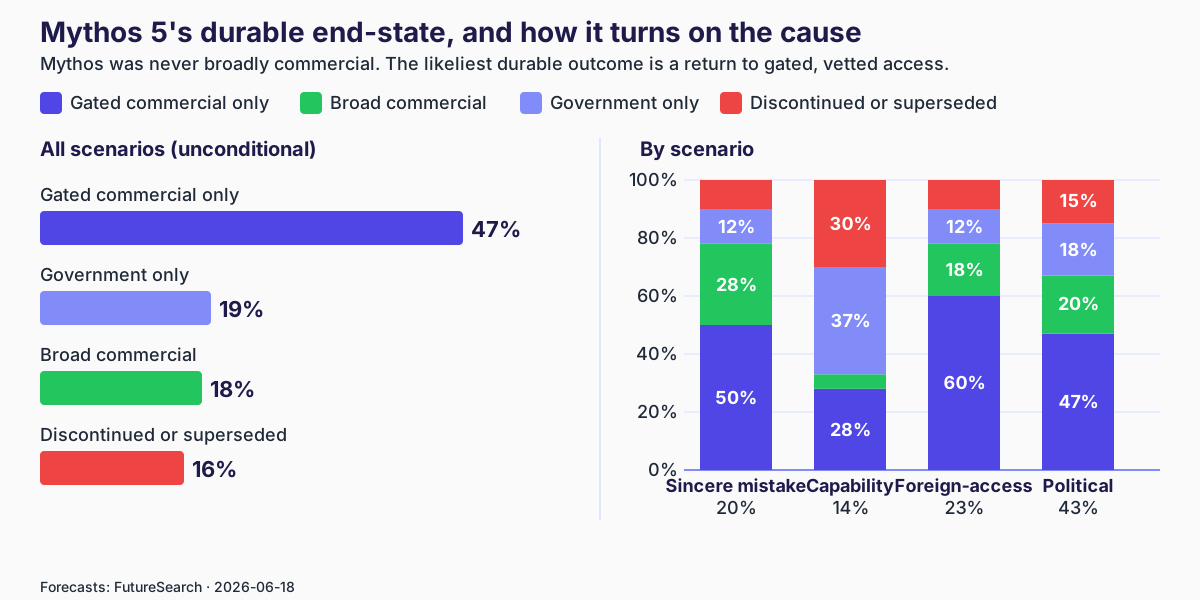
Mythos most likely returns to gated, vetted access. Whether it returns commercially at all depends on the cause.
How it all ends
Pulling the threads together, I forecast how the dispute primarily resolves across four endgame scenarios:
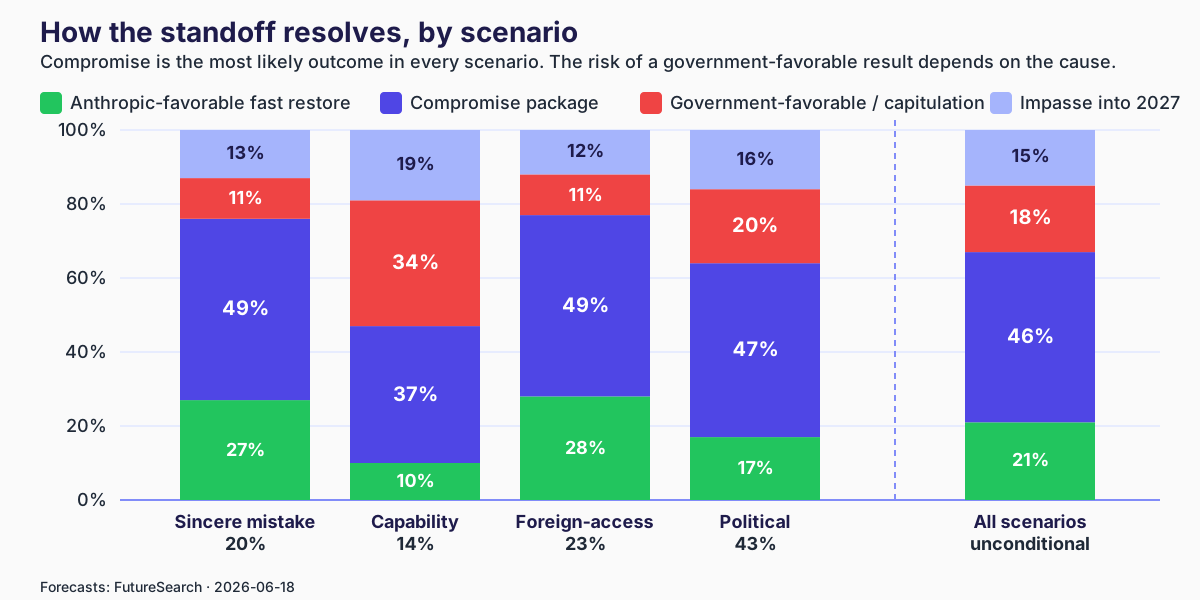
The single most likely way this ends is a compromise package: Fable returns for US persons under a verification and oversight regime, Anthropic grants the recipient accounting the government wants and accepts some pre-deployment review, but keeps its defense-use red lines, while Mythos and foreign access stay gated or phased. That outcome is modal no matter which scenario is true, which is why I lead with it as the base case despite all the uncertainty about which root scenario we're even in.
The next most likely, at 27%, is an Anthropic-favorable fast restore, where the government effectively backs off and the models return quickly with little substantive concession. I had this at 30% right after the President's reversal; it has come back a little, because two weeks of warm words have not actually produced a restore. It lives mostly in the political and access worlds, where a clean release is available, and is nearly absent from the capability world, where a real danger cannot be waved off.
At 11% is a government-favorable resolution, where Anthropic concedes more than it wants to in order to get its flagship back. This fell from 18% as the politics cooled: with the President praising Anthropic rather than squeezing it, the world where the government extracts a heavy win looks less likely. What is left of this tail is concentrated in the capability world, where the government would have a legitimate basis to demand real constraints. Note that "government-favorable" does not have to mean Anthropic drops its red lines; more often it means accepting capability limits or a permanent Mythos restriction.
At 12% is an impasse into 2027, a prolonged stalemate or grinding litigation with the models absent, intermittent, or US-only well past year-end. I had this at 15% two weeks ago; the de-escalation trimmed it, and the failure to actually restore has since nudged it back up a point. It is still a real tail, because some version of it is possible in all four scenarios.
Finally, I took a look at the implications beyond just Anthropic and its models.
Will this spread to other AI labs?
A reasonable fear, after the first time a government switches off a frontier model, is that it becomes routine. I think that fear is mostly misplaced on a one-year horizon.
I give a 12% chance that another frontier lab (OpenAI, Google DeepMind, Meta, xAI, Mistral) gets a comparable order restricting one of its deployed models by the end of 2026, 20% by mid-2027, and 30% by the end of 2027. The action really looks idiosyncratic to Anthropic to me. The administration is reportedly unlikely to extend similar controls to peers, and those peers are cooperative in a way Anthropic is not: they have signed voluntary pre-deployment evaluation agreements with the government's testing body, and OpenAI maintains explicit defense partnerships. For another lab to get this treatment you would need both a severe capability discovery and a breakdown in that cooperative posture.
A standardized regime is a closer call, and the Anthropic fight may be its seed. As of June 18, the White House and Anthropic were reported to be jointly building a framework to grade the severity of AI security flaws and guide government intervention, an approach other labs and G7 leaders endorsed (Politico). That is the embryo of exactly such a regime, the Lutnick letter already asserts that foreign access requires a Commerce license, and Senator Warner used the NSA disclosure to argue for exactly this kind of mandatory independent testing of frontier models. So I put around a 27% chance the government stands up a formal, binding frontier-model licensing or pre-deployment regime by the end of 2026, higher than the low odds I would have given two weeks ago. It stays a minority outcome: the June 2 executive order explicitly disclaimed mandatory licensing, the administration recently cancelled a planned FDA-style vetting process over competitiveness concerns, and a severity-grading benchmark is not yet binding licensing. But the near-term default is no longer pure status quo.
June 12 did set a precedent that can be used again, but the conditions that produced it, a uniquely adversarial relationship, a specific trust breakdown, and a legally aggressive instrument, do not obviously generalize. I do wonder if such a "kill switch" is a good thing for the US government to have, but sticking with forecasts, not my own suggestions, I don't think we'll see more of this.
What would change my mind
I would not be surprised to find out tomorrow we're in one of my less likely scenarios, e.g. it wasn't primarily politics. That would invalidate most of this research, and I could spend more time thinking about the scenario we're actually in. But what if we don't find out? Shifting probability around these 4 scenarios might be the best we can do for some weeks.
Two signals already arrived, and they pulled in opposite directions. The President's June 19 reversal moved me toward politics and a faster resolution; the June 21 NSA disclosure moved me partly back, toward a real capability and the foreign-access reading, and away from an honest mistake. The next ones to watch: direct evidence the order was coordinated with the Department of War faction would lift the political weight; hard evidence of an actual foreign diversion would lift the access weight further; and the order actually being lifted, rather than talked about, is the signal that would finally settle the timing.
Notes on methods
There is a vast amount of research to consider, and dozens of forecasting questions when looking at all 4 scenarios. I couldn't keep it all in my head, so I did this by guiding the best FutureSearch forecaster through a scenario modeling exercise.
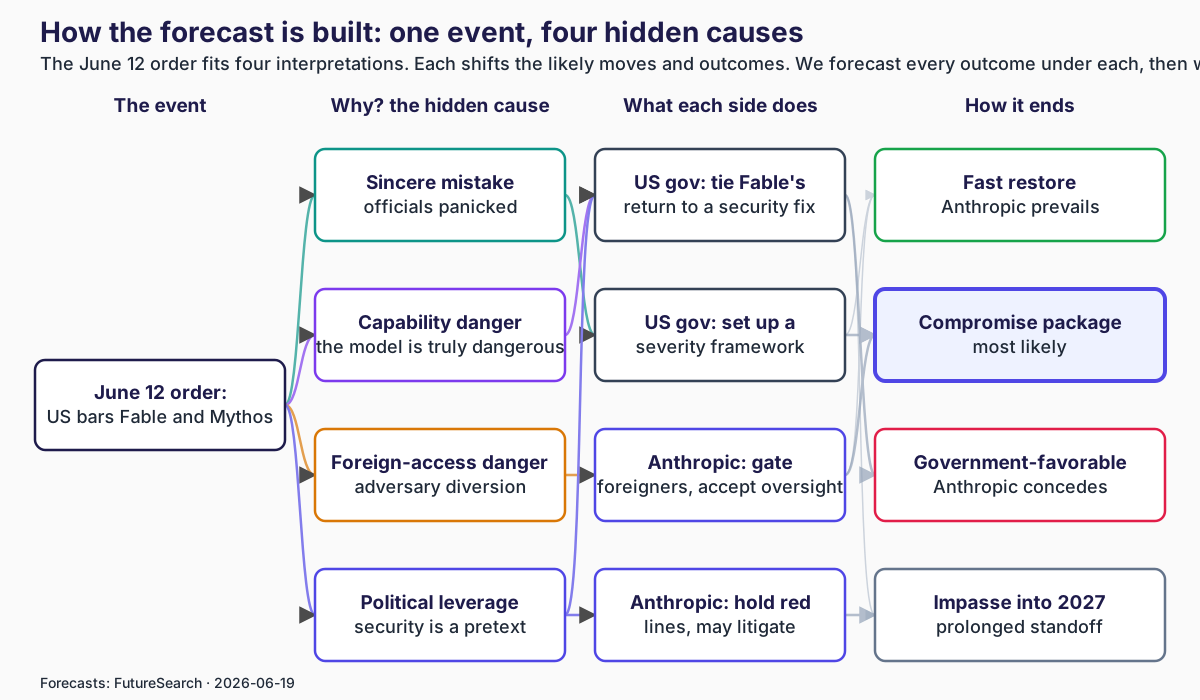
The shape of the model: one event, four hidden interpretations, the moves each side can make, and the outcomes. Every outcome is forecast under each interpretation, then weighted by how likely the interpretation is.
First of course was figuring out what the scenarios were, and shaping them to cover the outcomes and be mutually exclusive. I initially had 3 but decided I needed 4. Then I could choose the forecasting questions that mattered the most to outcomes. Then I could run each forecast (every downstream outcome, restoration timing for each cohort, the terms of return, Mythos's fate, Anthropic's concessions, the endgame) conditional on each scenario. I did some iteration to align the outcomes with my views.
Then I had to do a lot of consistency fixes, since this many independent forecasts led to inconsistent world states. In some case I tweaked forecasts directly, other times I simply passed in more research and re-ran them. Also, the research in the forecasts uncovered new questions I wanted answered, which I then added in.
One nice thing about this is that I have all these forecasts available. So if something changes, I can re-run every forecast in the entire scenario and update views much faster than I could if I did all this forecasting as a human, or with a team of humans. That is exactly what these updates are: when the President reversed course on June 19, and again when the NSA disclosure surfaced on June 21, I re-weighted the scenarios and pulled the new numbers through every chart in an afternoon.
Run this forecast yourself in the FutureSearch app and ask it to forecast any set of these scenarios or questions.
See also: The Claude Fable ban barely changes Anthropic's IPO timing or valuation and the full Anthropic financial forecast.