
The following is FutureSearch's forecast for Anthropic's financial and technological path through May 2027, first published May 28, 2026 and re-run through August 29, 2026. My central case has ARR reaching $138B by May 2027 (p10 $85B, p90 $220B), with Claude Code contributing about $23.5B, and the IPO pricing around October 26, 2026.
June's defining event has resolved. Anthropic brought its Mythos-class tier to general availability on June 9 as Fable 5 and Mythos 5, a Commerce Department export-control order forced both offline three days later, and Commerce lifted the order on June 30 with both models back worldwide on July 1. The suspension had stretched the delay and downside tails on almost every forecast here; the restoration unwound most of that, and this update re-prices what remains. The full episode, including how our restoration forecasts graded, lives on in the companion pieces on the standoff and its financial fallout.
The distributions anchor to the Series H close at $965B post-money (Crunchbase), the $47B run-rate disclosure that came with it, the June 1 confidential S-1 filing (Anthropic) that started the listing clock, and the July restoration of the Mythos-class tier. OpenAI joined the listing race with its own June 8 filing and has since drifted toward 2027. For the head-to-head, see Anthropic and OpenAI IPO dates and valuations.
At the $965B Series H mark, Anthropic trades at roughly 15x the $65B run rate it disclosed for the end of July and about 7x my median 2027 ARR. I expect the public market to price it well above that mark. My median for the 90-day post-IPO market cap is $1.85 trillion.
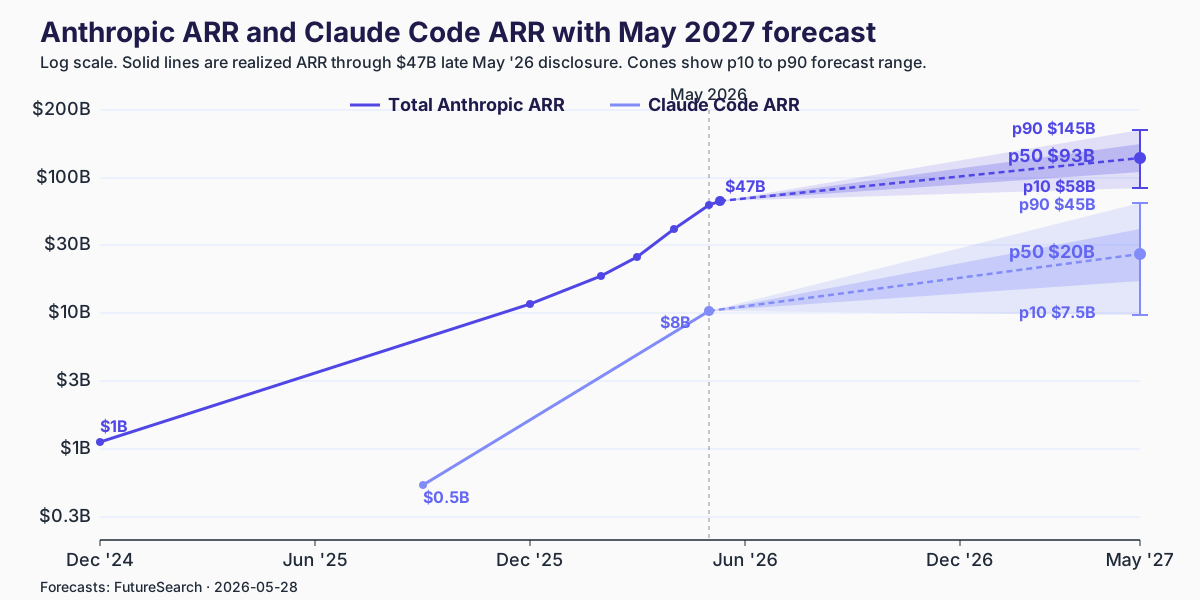
Anthropic disclosed $47 billion in run-rate revenue as of mid-May 2026, per the May 28 Series H announcement (Anthropic), That is no longer the last word: the run rate reached $65 billion at the end of July (Reuters), landing just under the $69B to $74B third-party trackers had estimated (NextBigFuture), which is consistent with the company tightening its ARR definition ahead of a listing. The walk continues: CFO Krishna Rao's $47B extended Dario Amodei's earlier sequence ($9B Dec 2025, $14B Feb, $19B March, $30B April, $44B early May), and Q2 landed above $11.5B with a first operating profit of $559M (Bloomberg), beating the $10.9B projection shared with Series H investors (CNBC).
The re-run p50 of $138B by May 2027 (p10 $85B, p90 $220B), up from $115B on August 6, is the same mechanical logic one print further on: the $65B end-July base lowers the growth Anthropic needs to hit any given May number, and bankers are reportedly underwriting the offering against 2028 revenue of $190-200B (Reuters). The structural drivers are unchanged: enterprise concentration (1,000+ customers spending $1M+ annually, up from 500 in February per Sacra), the coding moat (54% of coding-specific LLM spend per Menlo), and cross-cloud distribution no competitor has matched.
Claude Code is the live ammunition. It went from $500M ARR in September 2025 to $8B in May 2026, and trackers put it near $15B by August. The p50 of $23.5B by May 2027 (p10 $12B, p90 $45B) assumes the doubling-every-six-weeks cadence keeps cooling toward the single-digit monthly growth it showed in late summer. The case for the right tail is that agentic workloads consume 10 to 100 times more compute per developer-day than chat, and Anthropic owns the coding category. The Claude 5 family's launch theme reinforces it, with the flagship tier built around orchestrating hundreds of parallel subagents and running codebase-scale migrations from kickoff to merge.
Cursor is the live counter. It launched its own model in November 2025 and is now near $4B ARR with a 60% enterprise mix (MLQ), double where it sat at launch. The disintermediation risk is real, and I no longer wave it off. What the June suspension showed is the other side of the ledger: Claude Code runs on the Opus and Sonnet lines, which the export order left untouched, so the category's revenue base kept compounding through the same shock that pulled the flagship offline.
The single biggest tail risk on the revenue line is the gross-revenue accounting question. Anthropic books cloud-reseller end-customer spend on a gross basis (Sacra), so full customer spend hits revenue and partner payouts hit expenses. A forced restatement to net during IPO due diligence would cut headline ARR by 20 to 40% in one print. I think that risk is real but overstated. Stripe books gross. Shopify books gross. The cloud-reseller relationship is the genuine customer-of-record arrangement, not a flow-through, and I put the auditor risk in the single digits rather than the 20-30% the $400-500B public-market targets imply.
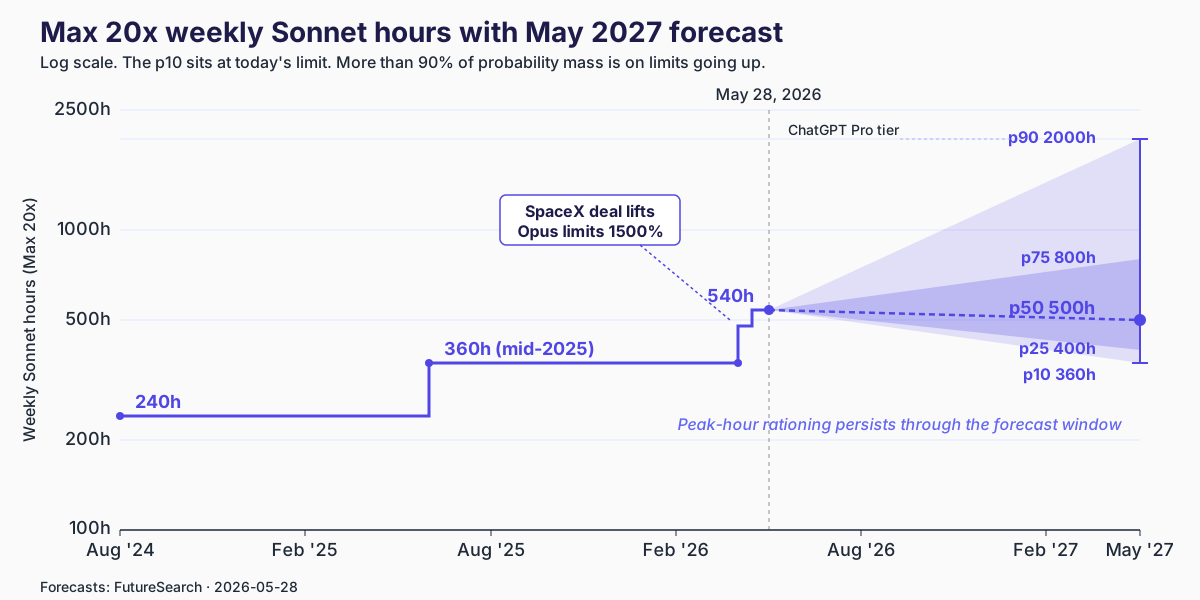
The 20x weekly Sonnet hour cap is the most-watched consumer proxy for whether Anthropic has compute headroom. The line stepped from 240 hours in 2024 to 360 through most of 2025, then jumped three times in five weeks in early May (Medium), all following the SpaceX/xAI deal that lifted Opus API limits more than 1500% (Anthropic). That looked like the constraint breaking.
The Series H announcement complicates the picture. Anthropic "has struggled to meet demand in recent months, forcing it to institute usage limits during peak hours and incentivize off-peak use" (Reuters). Anthropic is managing the rationing. It has not cleared it. There is also a measurement wrinkle the re-run surfaced: Anthropic's current plan documentation leans on relative multipliers and dynamic counters rather than published hour-denominated caps (Claude Help Center), so the resolved number may key off a conservative republished figure. The forecast sits at a p50 of 545 hours (p10 300, p90 950), down from 593 in June, with the trim mostly about that documentation drift rather than about capacity.
Pricing tells the sharper story. The Mythos-class tier shipped at $50 per million output tokens ($10 input), double the $25 Opus anchor that held across four consecutive generations, and Fable 5 still lists at $50 today. The July restoration collapsed most of the June bimodality, but not all of it: my re-run forecast for the top GA model's output price in May 2027 keeps the p50 at $50 with a p90 of $75, while the lower quartile (p25 $30) now covers the worlds where the cheaper near-frontier Opus 5 line, launched July 24, carries the top GA slot or competitive pressure forces the flagship price down. Even at $50 Anthropic is pricing on capability rather than rationing demand through price.
Capacity is arriving. Anthropic announced fresh commitments alongside the Series H: AWS expansion of up to 5GW, Google and Broadcom for 5GW of TPUs, and SpaceX access to Colossus 1 and 2. Strategic memory and storage suppliers (Micron, Samsung, SK hynix) joined the equity round, an unusual signal of long-term supply preference. Demand is absorbing it faster than the May evidence alone suggested.
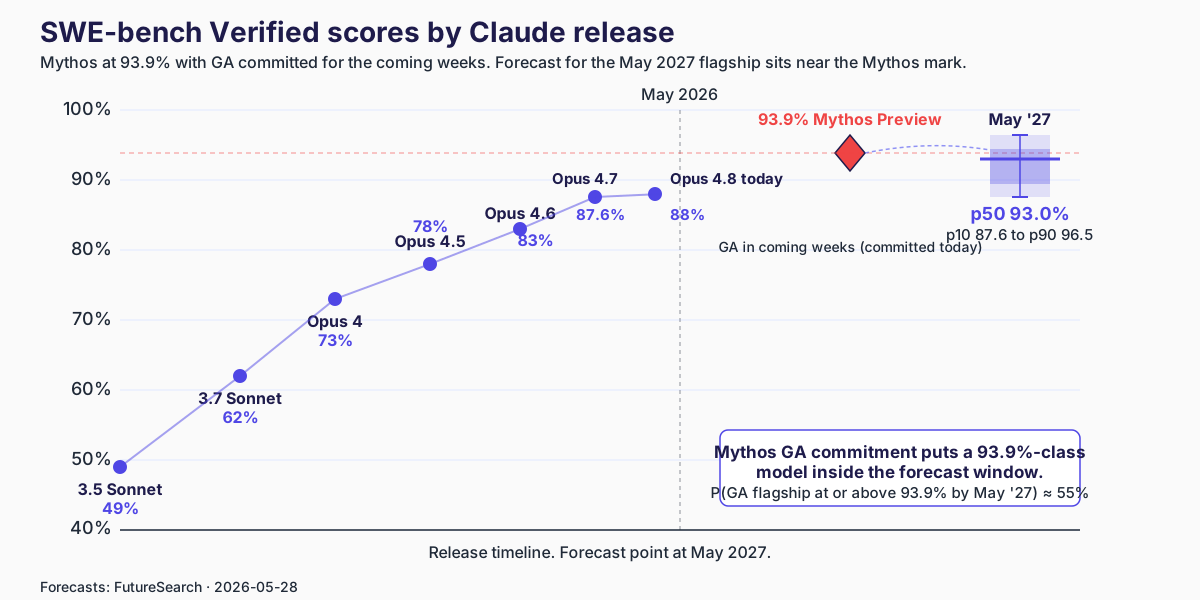
On June 9, Anthropic brought Mythos-class to general availability as Fable 5 and Mythos 5, the first public tier above the Opus line. Fable 5 posts 95.0% on SWE-bench Verified and 80.3% on the harder SWE-bench Pro (Axios). That delivered on the roadmap split Anthropic signaled in late May, positioning Mythos-class as a premium tier above incremental Opus 4.x releases rather than as a single model branded "Claude 5."
SWE-bench Verified is saturated, so the live frontier metric is now SWE-bench Pro. My re-run forecast for the top GA model's Pro score by May 2027 is a p50 of 84.3% (p10 80.3%, p90 91.5%), down from 88.2% in June. Opus 5 arrived on July 24 positioned as a cheaper near-frontier model and scored 79.2%, below the flagship (Anthropic), so beating 80.3% likely waits for the next Mythos-class release rather than an incremental one.
The June 12 suspension question resolved fast. Commerce lifted the export order on June 30 and Fable 5 and Mythos 5 returned worldwide on July 1. My June 18 forecast had put restoration at a median of July 22 with a p10 in late June; the companion page's June 23 refinement said July 9; the actual was July 1, inside the p10-p50 band both times. The full grading lives on the Fable forecast page. What remains forward-looking is durability, and the re-run puts the probability that a Mythos-class model is available and unsuspended on May 21, 2027 at 90%, up from 85%, with the residual 10% covering a renewed order or a licensing regime that re-gates the tier.
The ASL-4 question hardened against an early determination. The Claude 5 family system cards formally assessed Fable 5, Mythos 5, Sonnet 5, and Opus 5 as below the CB-2, Cyber Tier 2, and automated AI R&D thresholds, while describing Mythos 5 as "near the border" on CB-2 (Anthropic). Ruling models below the line while flagging proximity is exactly the pattern of a lab that upgrades safeguards without triggering a formal threshold declaration, and the security-readiness target of July 1, 2027 sits just past this window. I now put the probability of an ASL-4-equivalent determination by May 2027 at 21%, down from 38%.
One cadence note, corrected from the June view. In June I wrote that the next generational jump would ship as a Mythos-class release rather than a model called "Claude 5." The truth was both: the family that launched June 9 is named Claude 5, with Fable 5 and Mythos 5 at the top, and it has since filled out downward with Opus 5 and Sonnet 5. The tiering logic I described survived even though the naming call missed.
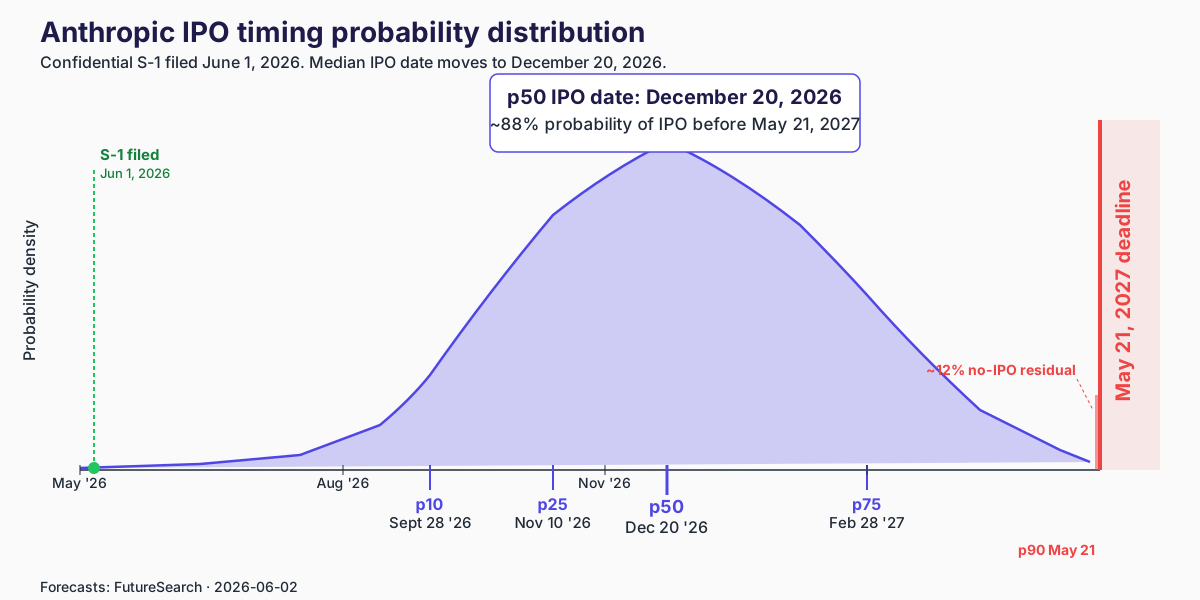
Anthropic filed a confidential draft S-1 on June 1, 2026. That resolved the open Series H question, whether the round was a substitute for an IPO or a bridge to one, in favor of bridge. The investor list is the cleanest evidence: Capital Group co-led, with Fidelity and T. Rowe Price participating. Mutual funds pay $965B for early access to a listing they expect above that mark, not for a long-term private position.
The procedural calendar pulls the median earlier and trims the tail. Confidential SEC review for a company of Anthropic's scale runs three to six months, then a public flip, a 15-day cooling period, a one to two week roadshow, and pricing. SpaceX ran about 11 weeks confidential to pricing; Reddit ran nine months on multiple comment rounds. Anthropic still carries two friction factors: gross-vs-net accounting, the item reviewers spend the most time on, and the Department of War litigation, which needs material risk-factor disclosure. The third factor from June, the export action, has moved from active risk to historical footnote, and press reports now point at an October Nasdaq window with Goldman Sachs, JPMorgan, and Morgan Stanley leading.
The re-run distribution lands at p10 September 30, 2026, p25 October 13, p50 October 26, p75 November 25, and p90 March 3, 2027. The August 6 view had a November 30 median with a p90 out at May 2027; the reported October window, the start of testing-the-waters meetings and a pre-IPO credit facility climbing past $10B pulled the median in another five weeks and cut the tail back by two and a half months. Polymarket has moved the same way and further, now pricing roughly 74% on a listing by October 31 and 87% by year-end, against about 36% and 70% when this page last ran.
Valuation is the more important number, and the cleanest comp has now moved twice. In June, SpaceX had priced at $1.77T and traded above $2T, the exuberance case for mega-cap listings. It fell to about $1.4 trillion after its first earnings report repriced the AI capital spending underneath it, then recovered to roughly $1.75 trillion by August 20 (see our updated SpaceX valuation). Both halves of that round trip matter: public investors have now watched the year's biggest IPO surrender its scarcity premium and earn much of it back. My re-run median for Anthropic's 90-day post-IPO market cap is $1.85 trillion (p10 $1.0T, p90 $3.1T), up from $1.14T on August 6, because the $65B July print, the reported October window and pre-IPO secondaries marking $1.4T to $1.6T all moved in the same direction at once. At $1.85T against $138B of forward ARR, that is about 13x forward revenue.
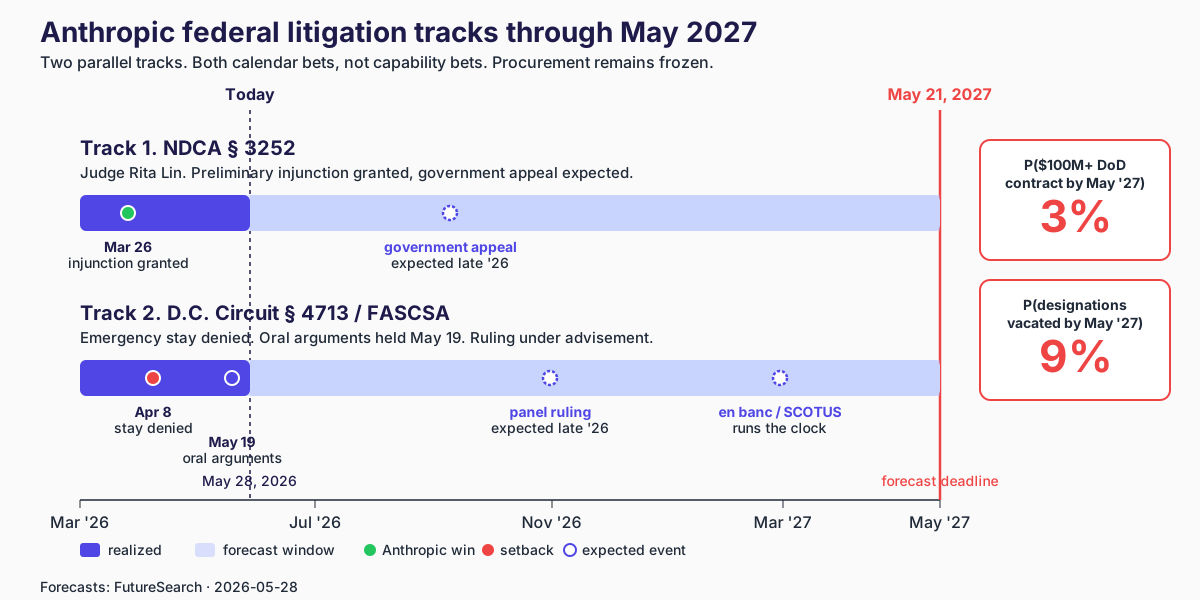
The Department of War designated Anthropic a supply-chain risk on March 3-4 under 10 U.S.C. § 3252 and FASCSA. Judge Rita Lin granted a preliminary injunction on March 26 (CNN); the D.C. Circuit denied an emergency stay on April 8; oral arguments ran May 19, where Judge Henderson called the designation "spectacular overreach" and Judge Katsas pressed Anthropic on its shifting usage policies (Axios). The panel ran skeptical of the government, and the ruling is under advisement. Secretary Hegseth doubled down on the designation on June 4.
The June 12 export action was a sharper lever than the procurement designation. It hit the product itself, where the procurement designation only ever touched the contracts, and even though it lasted just nineteen days, it demonstrated a capability the S-1's risk factors now have to describe. That demonstration is what keeps the federal track a live input to this forecast, no longer the sideshow I treated it as in the spring.
The litigation now runs on two tracks, and the re-run moved my numbers in opposite directions. The § 3252 designation sits enjoined before Judge Rita Lin in the Northern District of California, while the parallel FASCSA designation, reviewable only in the D.C. Circuit, remains fully operative: the Department of War reaffirmed it on reconsideration in early June, and contractor removal is proceeding toward a September deadline (Mayer Brown). The D.C. Circuit panel that heard argument in May ran skeptical of the government, and the case record has, in one court reporter's phrase, gotten worse for the government since (FedScoop). I now put the supply-chain designation vacated by May 2027 at 46%, up from 31%, with the residual weight on remand-without-vacatur outcomes and appeal timelines that outrun the window.
The contract question went the other way. The $200M CDAO agreement that anchored the bull case for federal revenue was cancelled in early 2026 amid the dispute over "all lawful use" clauses (Wikipedia), so a qualifying award now needs a fresh prime contract with a publicly confirmed $100M+ value while the procurement ban is still being enforced. The NSA relationship is real (Axios; FT), but classified awards rarely surface a public figure. I put a $100M+ DoD or IC prime contract by May 2027 at 11%, down from 20%.
None of this changes the revenue base by more than a few percent. Anthropic is on pace for $138B ARR without federal procurement, where a $100M contract rounds to noise. What the federal track sets is the disclosure surface and the tail risk, not the trajectory.
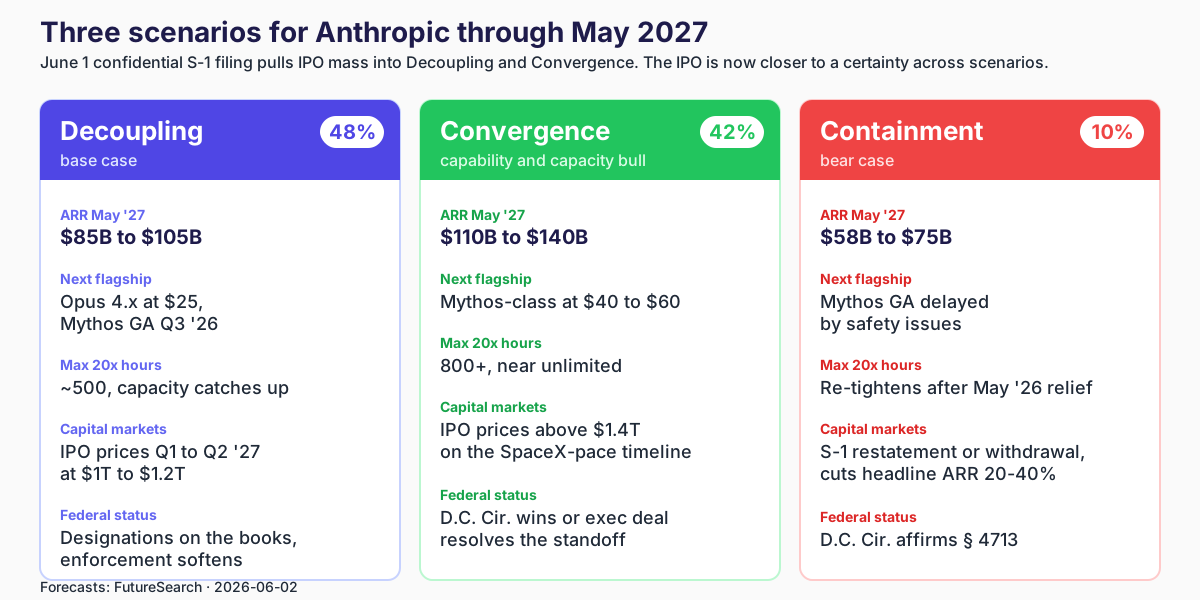
The three scenarios come out at decoupling with friction 56%, convergence 30%, and entanglement 14%, re-derived from the August re-runs. The restoration moved weight out of the bear case; the live contractor-removal deadline keeps it from moving all the way to the bull.
Decoupling with friction is the base case, and it is what the summer actually looked like. Commercial and intelligence-community trajectories proceed, punctuated by federal disruptions, with the nineteen-day Fable suspension as the template and the September contractor-removal deadline as the next test. ARR lands $110-175B, the Mythos-class tier stays available under a compliance regime, and the IPO prices between October 2026 and January 2027.
Convergence is the bull case. Federal détente meets a capability bull: the designation vacated (now a 46% marginal on its own), an IC prime contract surfaces despite the odds, and the IPO prices clean above $1.3T.
Entanglement is the bear case, and it is lighter than it was in June. Federal friction institutionalizes, a fresh order or licensing regime re-gates the Mythos tier, the IPO slips past mid-2027, and accounting or litigation overhang bites. The re-run tails price this at roughly one chance in seven.
Six predictions, updated against the re-runs. The second has already resolved.
Anthropic prices its IPO above $1T between November 2026 and March 2027. The confidential S-1 is in, press reports point at October, and the Series H mutual-fund anchor is the price floor. Probability: 55%, with most of the miss risk being an October pricing that lands just before the window.
A Mythos-class model is back in general availability before the end of 2026. Resolved YES on July 1, 2026, five months early. The June probability was 80%.
The top GA model holds its $50 output price rather than reverting to the $25-30 Opus anchor. The Mythos-class tier set the new ceiling, and Anthropic prices on capability, though Opus 5's cheaper near-frontier positioning is a live path back down. Probability: 65%.
ARR ends 2026 at or above $90B, and the May 2027 print lands at or above $110B. The high-$60s summer baseline plus agentic expansion supports it. Probability: 55%.
The 90-day post-IPO market cap clears $1T. The Series H floor and frontier-AI appetite align, with the deflated SpaceX comp as the new caution. Probability: 65%.
No $100M+ DoD or IC prime contract surfaces publicly before May 2027. The $200M agreement is cancelled, the procurement ban is being enforced, and classified awards stay opaque. Probability: 90%.
Pulling it together: at $965B Anthropic trades at roughly 15x the $65B July run rate and about 7x my median 2027 ARR. The commercial case the public-market skeptics underrated is intact and compounding faster than my June model had it, with ARR tracking toward $138B, Claude Code holding its trajectory through the suspension, and a full Claude 5 family shipped from Sonnet to Mythos. June's lesson stands in softened form. The government showed it can switch the flagship off, then showed it can switch it back on under pressure, and both facts now live in the S-1's risk factors rather than in the central numbers. I would still buy Anthropic at $965B. I would still hedge the federal tail, at about half the June size.
Changelog
-
May 28, 2026 — First published, on the Series H close and the $47B run-rate disclosure.
-
June 18 — The Fable 5 / Mythos 5 launch and export suspension: ARR $93B, IPO December 15 with an April 2028 tail, 90-day cap $1.09T.
-
July 1 — The export order was lifted; noted, with its direction of effect, ahead of the next re-run.
-
August 6 — Re-ran every forecast on the summer tracker baseline: ARR $93B to $115B, the IPO median in to November 30, the 90-day cap to $1.14T, SWE-bench Pro down to 84.3% after Opus 5 shipped below the flagship, and ASL-4 down from 38% to 21%.
-
August 20 — Anthropic's $65B end-July run rate, its first operating profit and reports of an October window: ARR to $140B, the pricing date in to October 26, 2026, and the 90-day cap to $1.85T.
-
August 29 — Held against every other forecast we publish on AI: ARR eased to $138B, the Sonnet-hour cap to 545, and Claude Code held at $23.5B. The IPO date and the 90-day cap were revised too; I did not take those and they stand at their August 20 values.
Run this forecast yourself in the FutureSearch app. Ask it to refresh the numbers any time the news cycle moves.