
Both companies are formally in the IPO queue. Anthropic confidentially filed its S-1 with the SEC on June 1. OpenAI followed exactly one week later, on June 8, announcing the filing itself rather than letting it leak. Goldman Sachs and Morgan Stanley are bookrunning both deals, each expected to raise at least $60 billion. The cautionary tale arrived in between: SpaceX priced the largest IPO in history in June at roughly $1.77 trillion, ran to $2.5 trillion on a 4% float, fell to about $1.4 trillion after its first earnings report repriced its AI capital spending, and recovered to roughly $1.9 trillion by mid-October.
When I first published this page on March 31, the question was whether these IPOs were coming at all. The questions that matter now are when, and at what price. This page is the standing forecast on both questions, re-run in full on October 16, 2026; the full company models behind it are in our Anthropic forecast (revenue, compute, Mythos timing) and OpenAI forecast (revenue, losses, and the step-change bet).
tldr Anthropic lists first: median date November 24, 2026, at a median first-day market cap of $1.80 trillion. OpenAI follows around March 2028, at a first-day cap of $1.70 trillion at the median. In June these looked like a near-tie in valuation separated by one quarter in timing. Now more than a year separates them, after Sam Altman ruled out a 2026 listing and OpenAI opened talks on a private round at $1.4 trillion, and the valuation gap has narrowed to about $100 billion.
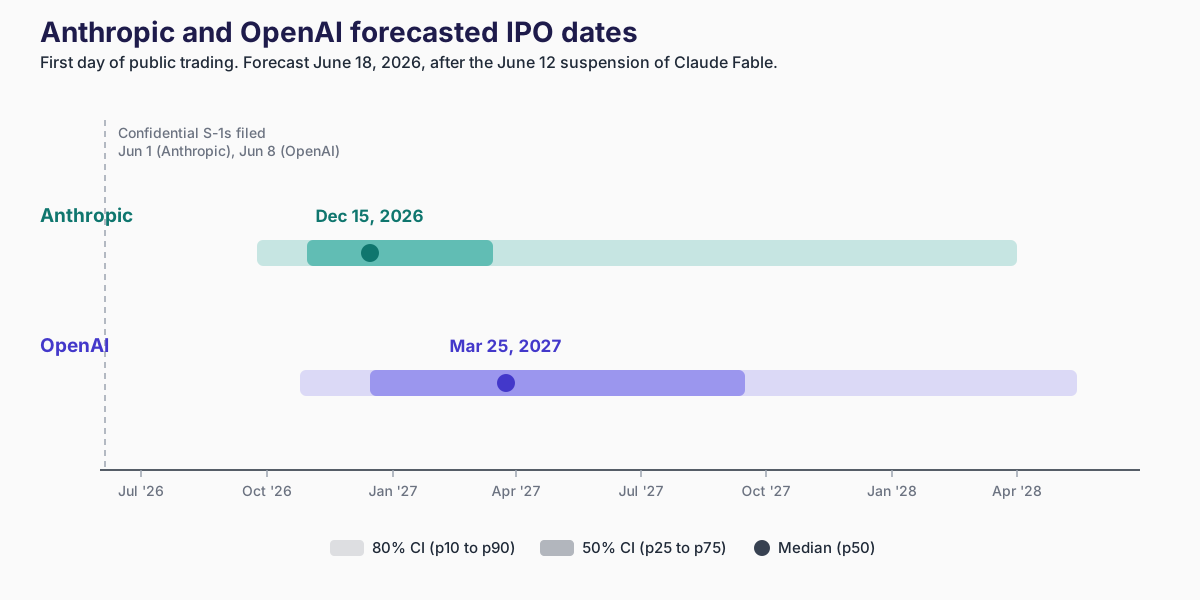
Anthropic's June 1 filing started a procedural clock, and the clock is running fast. Confidential SEC review for a company of this scale typically runs three to six months; press reports now point at a debut before Thanksgiving with Goldman Sachs, JPMorgan, and Morgan Stanley leading. My re-run distribution has a p10 of November 17, 2026, a median of November 24, 2026, and a p90 of May 14, 2027. The June 18 version of this page carried a worst case out at April 2028, priced off an unresolved export order against the flagship; Commerce lifted that order on June 30, Fable and Mythos returned worldwide July 1, and the tail came in by nearly a year.
Prediction markets sit a little ahead of my forecast on the timing. Polymarket puts, as of October 16, about 55% on an Anthropic listing by November 30 and about 70% by year-end; my curve has about 52% and 62%. The friction that keeps the tail long is unchanged: gross-versus-net revenue accounting is the question SEC reviewers will spend the most time on, AI-safety risk factors are novel disclosure territory, and a Pentagon supply-chain-risk designation is still live, upheld 2-1 by the D.C. Circuit on September 25 with Anthropic seeking rehearing (CNBC). None of that blocks a listing. All of it adds comment cycles.
OpenAI filed on June 8 and then immediately played it cool: "We have not decided on timing yet; it may be a while… this gives us the option to go public sooner if that ends up being best." In June I wrote that the market was underweighting how literally OpenAI meant that sentence, forecasting about a one-third chance of a 2026 listing against Polymarket's 48%. The market has since come all the way through my number and past it: Polymarket prices a 2026 OpenAI listing around 4% as of October 16. The July 13 re-run of our OpenAI model moved the median first trading day to July 15, 2027 with roughly a one-in-seven chance of 2026, after the New York Times reported OpenAI leaning toward 2027 and the company held no pre-IPO investor meetings through late June. CFO Sarah Friar has since told employees OpenAI "will be a public company in 2027," if not sooner (CNBC). Then on September 12 Sam Altman ruled out 2026, saying "right now would be an ill-advised moment to go public" (Techzine), and in October Bloomberg reported OpenAI in talks to raise $30 billion or more at a $1.4 trillion pre-money valuation (The Next Web). The October re-run moves the median out to March 15, 2028.
The thesis I led with in March, that the ability to raise ungodly amounts of private capital removes the single greatest motivation to list, half-survived. Both companies filed anyway, because the queue position itself is valuable. But a confidential filing is an option, not a commitment, and OpenAI is treating it as exactly that. Anthropic is the one behaving like a company that intends to exercise. It picked lead underwriters within 48 hours of filing, and it has a competitive prize to capture: first pure-play frontier AI stock. Polymarket gives Anthropic 95% odds of beating OpenAI to the bell as of October 16. My re-run forecast says 89%, up from 88% in August and 63% in June. Scoring that honestly: the market's 83% was closer to where the evidence has landed than my 63% was. I was pricing real doubt about a fast OpenAI counter-move that never materialized.
Now the valuations.
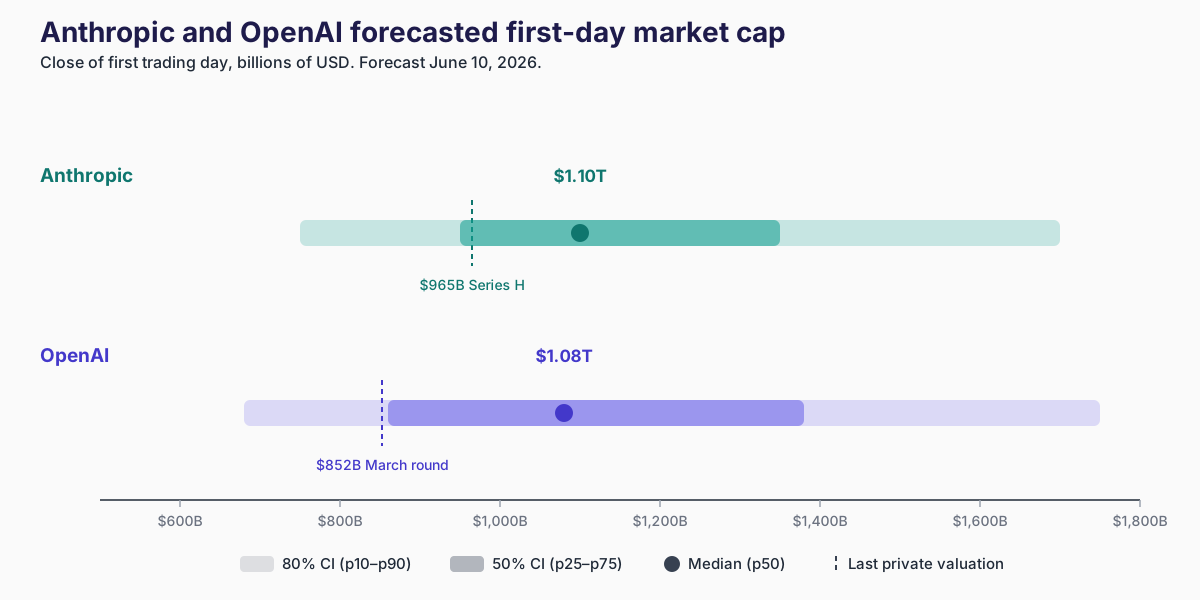
For Anthropic, I forecast a median first-day close of $1.80 trillion, an 87% premium to the $965 billion Series H that closed on May 28, a shade below August 20's $1.82 trillion. The premium is not speculative: secondary-market buyers were bidding around $1.05 trillion before the S-1 even went in, the official run rate crossed $47 billion in May, third-quarter revenue reached $16.8 billion (CNBC), and the company projected its first operating profit for Q2 2026: $559 million on $10.9 billion of quarterly revenue.
The downside scenarios (p10 $1.35 trillion) are concentrated in one place: the S-1 review itself. If the SEC forces gross-to-net revenue restatement, headline ARR drops 20-40% in one print and the multiple math everyone is carrying breaks. Operating margins in the single digits give public investors a second reason to price conservatively. Our full Anthropic forecast puts the 90-day downside near $1.1 trillion. And the mega-IPO pipeline (SpaceX's $75 billion June raise, then at least $60 billion each for Anthropic and OpenAI) is hitting the same pool of institutional capital within a few quarters.
The upside (p90 $2.35 trillion) is the retail scenario, now with a live warning label. SpaceX allocated up to 30% of its offering to retail, triple the usual, demand ran past 4x, and the stock ran to $2.5 trillion before giving the entire scarcity premium back within eight weeks. Cerebras popped 68% on day one in May. There is exactly one pure-play frontier-AI equity coming to market first, and scarcity at trillion-dollar scale now has exactly one precedent to price against, which cuts both ways.
For OpenAI, the re-run median is $1.70 trillion against a March private mark of $852 billion, up from $1.13 trillion on August 29. The near-tie I flagged in June came apart in August, and this month it mostly closed: Anthropic's median barely moved while OpenAI's rose, taking the gap between the two first-day medians from roughly $690 billion to about $100 billion, as OpenAI's listing moved out to 2028 and the reported talks at $1.4 trillion gave it a higher private anchor. The later listing still compounds more revenue under the number, but the market it lists into now has a worked example of what happens when growth arrives with a $25 billion half-year cash burn attached.
I'd also distinguish day one from day ninety, for OpenAI especially. Our full OpenAI forecast puts the expected 90-day post-IPO market cap at $1.77 trillion, against the $1.70 trillion first-day median here. The two are built differently: the first-day figure is an unconditional median, the 90-day figure a probability-weighted blend across the step-change scenarios, so they are not directly comparable. Ninety days is long enough for institutional models to digest the loss line, which FutureSearch now estimates at $63 billion GAAP for 2026 against the widely cited $14 billion non-GAAP figure.
So the race, as I now see it: Anthropic prices first, most likely between late November and February, at a meaningful premium to its last private round, and OpenAI follows more than a year later. On day one, public markets will price the AI race directly for the first time. The following ninety days will be about cash discipline, because SpaceX just taught this market to check.
Changelog
- March 31, 2026 — A March 2027 Anthropic IPO at a $560 billion first-day cap, with OpenAI following in May 2027 at $1.04 trillion.
- April 8 — Anthropic's $30 billion run-rate announcement lifted its first-day median to $643 billion.
- June 10 — Re-ran everything after the $65 billion Series H, the $47 billion run-rate disclosure and both confidential S-1 filings: Anthropic December 15, 2026 at $1.10 trillion, OpenAI March 25, 2027 at $1.08 trillion, 63% Anthropic first.
- June 18 — The Claude Fable launch and its June 12 export suspension widened Anthropic's date tail and its downside without moving the medians.
- August 6 — After Fable's July 1 restoration and reports that OpenAI was leaning toward 2027, Anthropic pulled in to November 30, 2026 and OpenAI moved out to July 15, 2027, with Anthropic-first rising from 63% to 85%.
- August 20 — Anthropic's $65B end-July run rate and reports of an October window at a $2T+ valuation pulled its pricing date to October 26, 2026 and lifted its first-day cap to $1.82 trillion.
- August 29 — Held against every other forecast we publish on AI, OpenAI's first-day cap rose to $1.13 trillion. Anthropic's date and first-day cap were revised too; I did not take those and they stand at their August 20 values.
- October 16 — Re-ran every forecast: Anthropic's pricing date to November 24, 2026 with its first-day cap a shade lower at $1.80 trillion; OpenAI's first trading day out to March 15, 2028 after Sam Altman ruled out 2026, its first-day cap up to $1.70 trillion; and Anthropic-first at 89%.
The full financial models behind each company are in our Anthropic forecast and OpenAI forecast.