
This is FutureSearch's comprehensive forecast of OpenAI's financial future. We have been modeling OpenAI for some time, going back to our first revenue-source breakdown in summer 2024 and our full 2025 OpenAI forecast.
OpenAI confidentially filed its S-1 on June 8, one week after Anthropic, while cautioning that timing is undecided and "it may be a while." The signals have since hardened in that direction. The New York Times reported on June 25 that OpenAI is leaning toward waiting until 2027 (NYT), and as of late June the company had held no pre-IPO investor meetings (CNBC). My central estimate is that OpenAI will IPO around mid-July 2027 (roughly a one-in-seven chance of a 2026 listing), ARR reaching $66B by mid-2027 (from a run rate that passed $40B in August), 2026 GAAP losses landing near $62B (more than four times the widely cited $14B non-GAAP figure), and expected 90-day-post-IPO market cap is $1.15 trillion, about 34% above the current private mark, against 8% in the July edition of this page.
But our conclusion comes from weighting a 64% likely scenario where OpenAI does not have the clearly best model or products during this time, and a 36% scenario that they retake the lead in model intelligence and products that they had for most of 2022-2024.
Weighted post-IPO valuation
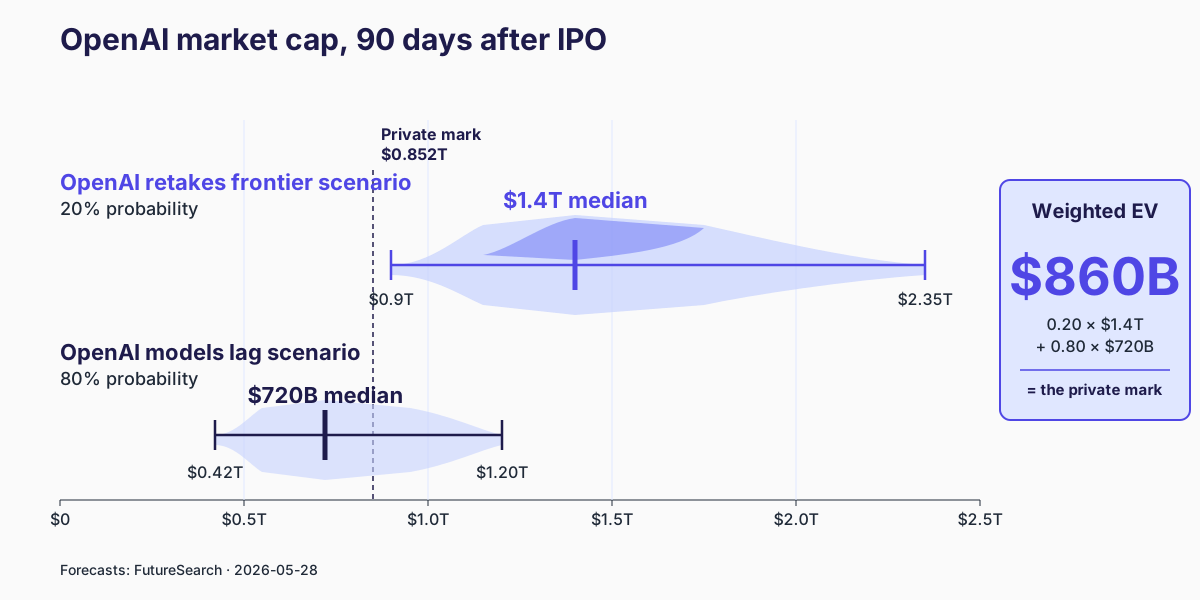
The chart above conditions the post-IPO market cap on whether OpenAI ships a step-change capability release before the IPO. I built that weight three ways again this update, and where July's three builds pulled apart, two of the three have now converged: the direct before-the-IPO question came back at 39%, and a thresholded build that prices every date in a single run reads about 36% at the July 2027 median IPO. The chart and the weighting use the thresholded build, keeping the scenario weight equal to the timing curve's mass at the median event date; the timing distribution run on its own reads about 31%. In the step-change case, the median 90-day market cap is $1.35 trillion. In the 64% no-step-change case, the median is $1.03 trillion, about 21% above the last private mark rather than below it. Probability-weighted, the expected value is $1.15 trillion, roughly 34% above the March mark, up from $0.92 trillion and 8% in the July edition.
Common framings of OpenAI's IPO position get this wrong in both directions. The capability gap is wider than bullish reads imply. GPT-5.6, released July 9, is a strong efficiency play, within a point of Claude Fable 5 on the Artificial Analysis Intelligence Index at roughly a third of the price (Artificial Analysis), but it leads only a minority of major benchmarks, trails on SWE-bench Pro and math, and METR concluded it is not a significant leap beyond the state of the art (METR). And the loss is worse than bearish reads imply. Q1 2026 actuals annualize to $28 billion in non-GAAP operating loss before you add the $7-10 billion in stock-based compensation the headline figure ignores.
Start with the valuation math because every other forecast has to clear it. OpenAI raised $122 billion at $852 billion post-money in March 2026 with SoftBank and Microsoft leading the round (CNBC). Both are strategic investors with non-financial motivations: compute access for SoftBank, partnership positioning for Microsoft. Public markets will price on financial returns. Sam Altman reportedly treats anything below a $1 trillion listing as a nonstarter, and his advisers are counseling patience to get there (NYT).
The S-1, confidentially filed on June 8 (CNBC), will show a roughly 13x forward revenue multiple, $62 billion in GAAP losses, contested enterprise share, and stalling consumer growth. Bridgewater's Greg Jensen has called this "priced for a monopoly outcome that does not yet exist."
Step-change here means a model that leads a majority of major AI benchmarks for four consecutive weeks after release. The precedent for the upside scenario is Cerebras, which popped 68% on day one and then gave back 38% over the following 13 days (CNBC). A step-change model would generate more narrative pressure than Cerebras did, but 90 days is enough time for the initial heat to leave.
The precedent for the downside scenario is the mega-IPO that prices to perfection and gets repriced. Facebook traded below its IPO price for a year. Uber traded at roughly half its private peak for two years. SpaceX, the largest listing of this cycle, gave back its post-IPO frenzy within weeks (Reuters), and that fade is reportedly part of why OpenAI is waiting. OpenAI's S-1 financials, walked through above, sit in that pattern.
Step-change capability timing
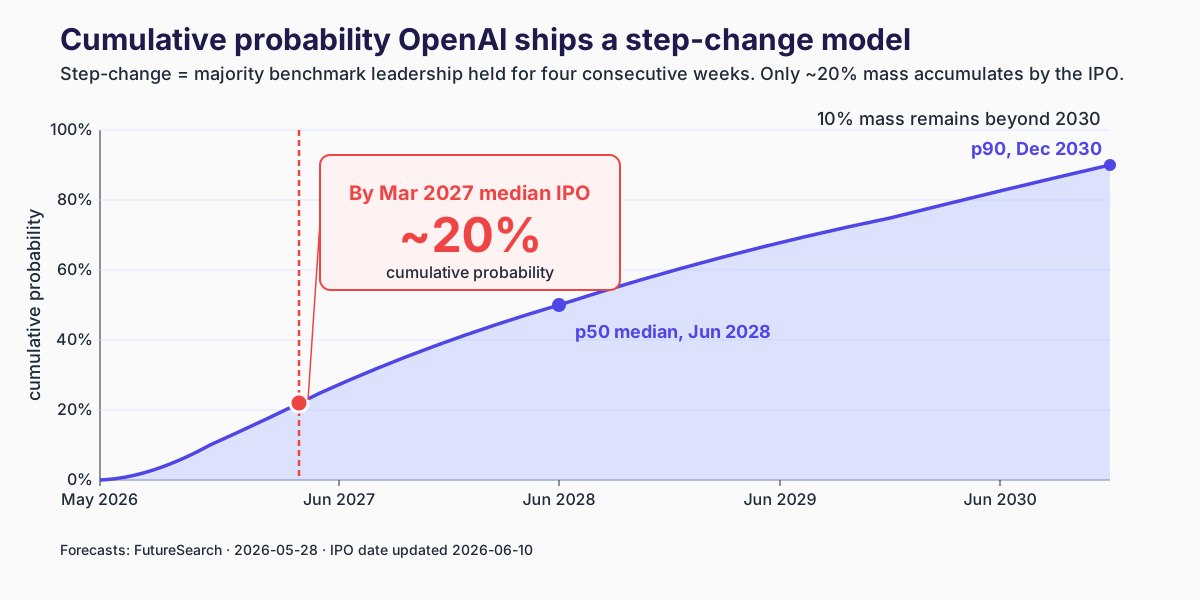
The chart above plots the cumulative probability that OpenAI ships a step-change model by a given date, from the reconciled build. About 36% of the mass accumulates by the July 2027 median IPO, up from 23% in the July edition. The curve pulled in hard: it now reads 12% by end-2026, 35% by mid-2027 and 54% by end-2027. The Astra halt is the reason the near-term stays low and the reason the medium term rises: a model that had to be paused for autonomous zero-day capability is a more credible step change than one that shipped to a mixed scorecard, but a capability-gated release is much less likely to sweep public benchmarks. The direct before-the-IPO question, run separately, agrees at 39%.
Both branches now sit above the March mark: $1.35 trillion with the step change, $1.03 trillion without it. The roughly $320 billion spread between them is what the 36% weight prices. What moves that weight is whether GPT-6 is materially better than current models, and whether it holds a benchmark majority for four sustained weeks against immediate counter-launches by Anthropic, Google, and xAI.
The frontier model itself has now hit a different kind of brake. On August 7, OpenAI halted development of Astra after preliminary evaluations indicated it may be able to autonomously discover and exploit zero-day vulnerabilities in hardened systems — the first time the highest development brake in its Preparedness Framework has been triggered (OpenAI). OpenAI has not formally declared Astra "Critical" and says it cannot rule the classification out; Altman says the intent is still a broad release, with more time needed to do it safely, behind isolated testing environments, restricted network access, encrypted weights and universal chain-of-thought monitoring. That cuts both ways for this page, which is why it moved the curve rather than just delaying it: a model powerful enough to trip the brake is more credible as a step change, while a capability-gated release is much less likely to sweep public benchmarks for four straight weeks.
GPT-6 reportedly completed pre-training at Stargate Abilene in March 2026 (Nipralo), but what shipped in the meantime was GPT-5.6, a point release, on July 9. The launch itself demonstrated a new source of friction: the US government took a 30-day pre-release review of the model and briefly limited its rollout to trusted partners before clearing broad release on July 8 (CNBC, Axios). Every future frontier launch, including GPT-6, now runs through that gate.
The structural argument against step-change is mechanical, not capability-based. Five labs ship at a roughly six-week cadence. Anthropic's Fable 5 and Mythos 5, suspended by an export-control order in June, were restored worldwide on July 1 (CNBC), so the strongest counter-launch arsenal is back online. Anthropic has already demonstrated it can hold a Mythos-class model in reserve inside Project Glasswing (R&D World) and relax access within days of a competitive threat.
Four sustained weeks of unified majority leadership against that response is a much higher bar than a single benchmark sweep at launch. No model has cleared it since GPT-4 in early 2023, and GPT-5.6's mixed scorecard is the latest data point. That is what keeps the median on the chart out past the mid-2027 median IPO date. The roughly 36% probability mass accumulated by IPO is the scenario the public market will price into the S-1.
Revenue trajectory
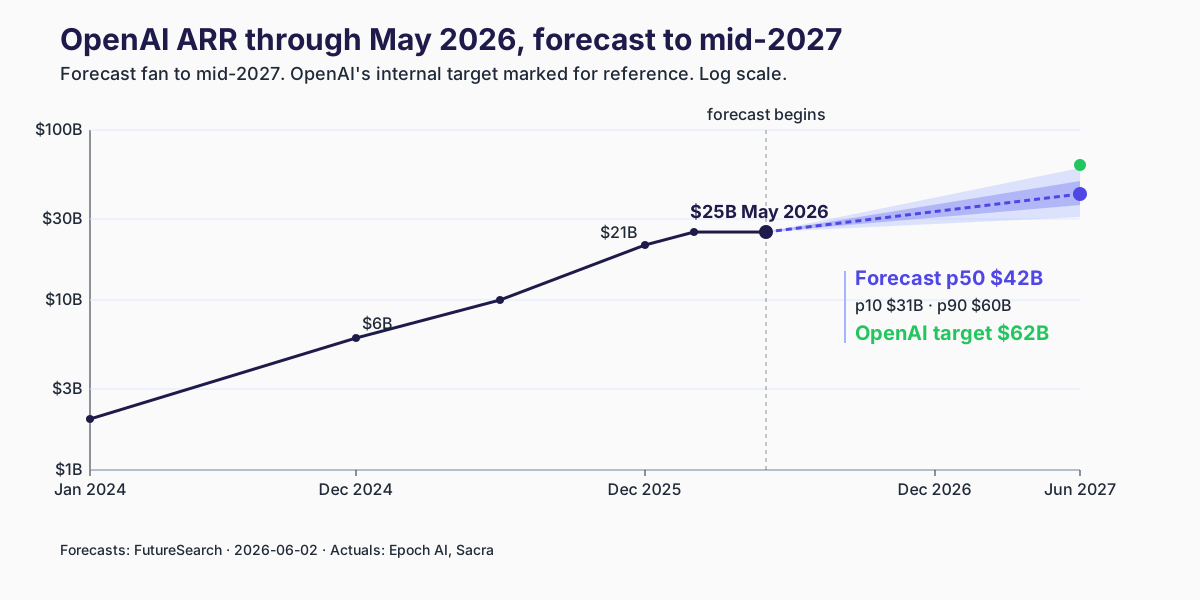
The chart above plots OpenAI's ARR walk through July 2026 and the forecast fan to mid-2027. OpenAI grew from $6 billion to roughly $25 billion ARR over the 17 months to May 2026 (Epoch AI), a run no software company has matched. Growth then flattened: the run rate held near $25 billion from February through the spring. That plateau has since broken. Bloomberg reported the annualized run rate topping $40 billion in August, with July alone growing more than 20% month over month on coding, subscriptions and the ad business (Bloomberg). The two series need care: recognized Q2 GAAP revenue was $6.7 billion, which annualizes nearer $27 billion, so the $40 billion headline is a latest-month annualization rather than the same basis as the walk above. OpenAI's internal target for mid-2027 is $62 billion. My forecast median is $66 billion (p10 $48B, p90 $92B), now marginally above the internal target rather than a third short of it. Three things still shape the range.
OpenAI missed monthly revenue targets in early 2026 (Reuters), but the $2 billion per month peak has since been cleared decisively. The internal target of $62B looked in July to require a pace above anything OpenAI had ever recorded; after the summer inflection it is roughly the base case, and enterprise revenue has overtaken consumer (CNBC). ChatGPT weekly actives plateaued at around 900 million against a 1 billion target (Where's Your Ed At). The consumer subscription base, which is about 60% of revenue, sits at 50 million paying subscribers.
From here, consumer growth requires either expanding the user base (stalling), raising prices (competitive pressure says no), or upgrading users to higher-priced tiers (real, but limited). And the enterprise segment is leaking. OpenAI's share of enterprise AI spending dropped from about 50% in 2023 to 27-29% in early 2026 (Menlo). Anthropic surpassed OpenAI in new business adoption by April 2026, when Ramp's index put Anthropic at 34.4% of paying firms against OpenAI's 32.3%, a gap that widened to roughly 41% versus 39.5% by June (Ramp). Anthropic captures 73% of first-time AI buyer spend (Axios). In coding, Anthropic holds 54% to OpenAI's 21%. The enterprise market is expanding fast enough that OpenAI's absolute revenue keeps growing. Its share does not. GPT-5.6's aggressive pricing, $5 per million input tokens against Fable 5's $10, is the countermeasure, and it cuts both ways: it defends volume share while compressing dollar share.
The tailwinds are real. The ads business hit $100 million ARR within six weeks of the February launch from 600 advertisers (CNBC), has since expanded to five countries including the UK (Digiday) and added a self-serve Ads Manager and CPA bidding (Digiday), and should land near $2.45 billion ARR by December. The end of Azure exclusivity in April 2026 opens multi-cloud enterprise distribution for the first time. Neither overrides the consumer saturation dynamic.
CPMs on the ad business have already collapsed from $60 to as low as $25 (Digiday) because only about 2% of ChatGPT prompts involve purchasable products, and the ad tech stack is "primitive" per advertiser feedback (Reuters). Click-through is 0.91-1.3% against Google's 29.2%. Ad load is already heavy, with one independent rollout tracker measuring sponsored placements in 49% of US replies by late May (Tech Insider), so the inventory lever is largely spent and further growth must come from yield. The intent on consumer AI prompts is informational, not commercial. Ads scale as a display business that the median chat session cannot monetize at search-grade unit economics.
Loss composition
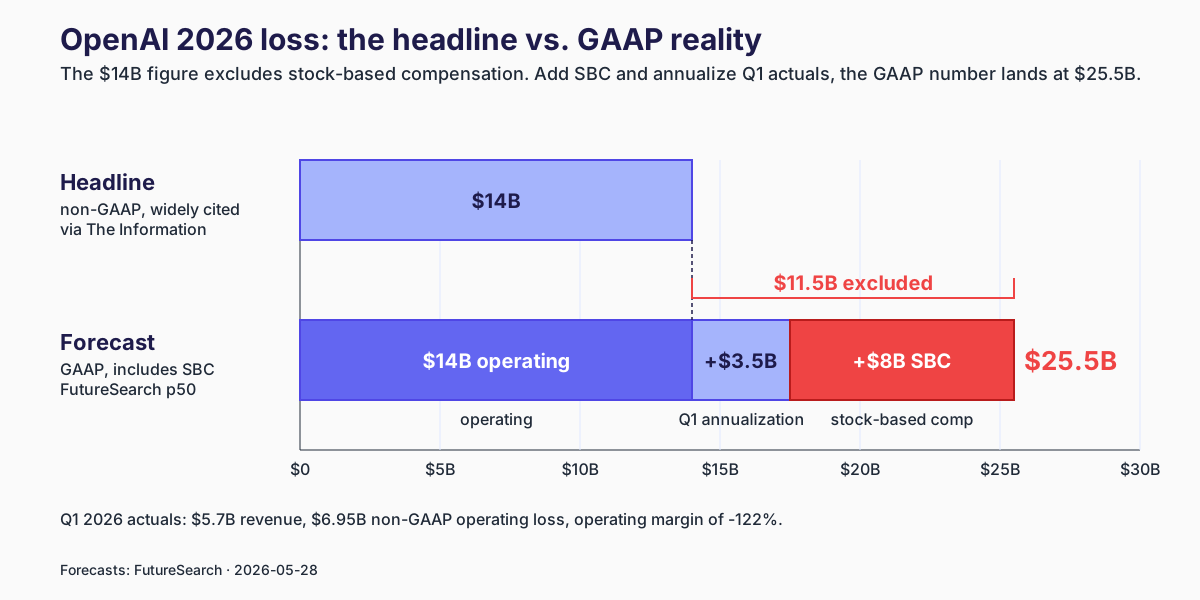
The chart above stacks OpenAI's widely cited $14 billion non-GAAP loss against the $62 billion 2026 GAAP figure I now forecast (p10 $42B, p90 $90B), nearly double July's $33 billion estimate. The gap is now mostly settled by actuals rather than by argument: Q1 alone booked a $21.3 billion GAAP net loss including a $12.4 billion fair-value charge, and Q2's operating loss widened to $12.3 billion on $6.7 billion of revenue, putting the first half in the mid-$30 billions before the second half starts. The headline understates the loss because it excludes stock-based compensation and the fair-value remeasurements that dominated 2025, when a $41.6 billion charge turned a $20.9 billion operating loss into a $38.5 billion net loss.
The $14 billion figure comes from internal projections that exclude SBC (The Information). Q1 2026 actuals showed a $6.95 billion non-GAAP operating loss on $5.7 billion in revenue, which annualizes to roughly $28 billion before adding $7-10 billion in SBC. The Q1 operating margin was -122%. And the full GAAP line is noisier still: Q1's GAAP net loss topped $21 billion, inflated by a $12.4 billion fair-value charge on investor rights (The Decoder), the same kind of non-cash remeasurement that drove 2025's reported $38.5 billion GAAP loss on a $20.9 billion operating loss (Where's Your Ed At). My 2026 forecast median is $62 billion, with a wide band (p10 $42B, p90 $90B) that mostly reflects how much of that remeasurement noise lands in the final GAAP number. The median now sits above the naive annualized pace rather than below it, because the first half is no longer a projection: Q2's operating loss widened to $12.3 billion on $6.7 billion of revenue (WSJ via Investing.com), putting H1 in the mid-$30 billions before any second-half efficiency gain lands.
That changes the strategic calculus for the $122 billion war chest. At $14 billion per year, the cash covers 8-9 years of runway. At $62 billion per year GAAP, it covers about two on paper, though much of the GAAP figure is non-cash: actual Q1 cash burn was $3.7 billion (Reuters), a roughly $15 billion annual pace that keeps the cash runway near the headline figure even as the GAAP line compresses it on paper. Profitability by 2029-2030 requires going from -122% operating margin to positive in three to four years while gross margins are squeezed by a smaller share of higher-margin enterprise revenue.
I do not think it happens by 2029. The path to profitability runs through 2031 or later, which the IPO investor base will only tolerate if either revenue compounds substantially faster than I am projecting or model leadership returns. Neither is the base case.
The compute story makes the margin problem worse. OpenAI announced 7+ GW of planned data center capacity through Stargate and adjacent partnerships. As of mid-2026, around 0.3 to 1 GW is operational at Abilene (Epoch AI), and the planned expansion of that site toward 2 GW has been abandoned, capping it near 1.2 GW (Enverus). Data centers take 18 to 36 months from groundbreaking to operational.
About 40% of US data centers planned for 2026 are already delayed (Ars Technica), transformer lead times have stretched to five years in some regions, and OpenAI has already cancelled sites in the UK, Norway, and Lordstown, Ohio (Data Center Dynamics). The 2.5 GW p50 forecast for December 2027 is about a third of the announced plan. Serving $66 billion in revenue on 2.5 GW means either renting third-party capacity at thin margins or unlocking inference efficiency gains that GPT-5.6's token-efficiency claims have yet to demonstrate at scale. Either path compresses the trajectory to profitability further.
OpenAI increasingly looks like the Google of AI rather than the Microsoft of AI. Like Google in 2005, it has overwhelming consumer reach (900 million weekly actives), a real but capped advertising business, strong brand recognition, and a technology lead that is narrowing rather than widening. Like Google, its durable moat runs through distribution and user habit rather than through technical advantage.
Microsoft's enterprise model produces durable pricing power through deep integration, switching costs, and long-term contracts. OpenAI's enterprise position is actively eroding to Anthropic, multi-model architectures, and open-source price competition. The Microsoft analog is the implicit comparable in OpenAI's current valuation. The Google analog is what the financials actually describe.
This is not bearish on OpenAI as a business. Google became the second most valuable company in history on the consumer-and-ads model. But it does imply a different valuation multiple than the trillion-dollar target. Google trades at about 6x sales and 22x earnings today. OpenAI at $1 trillion against a $40 billion run rate is at 25x sales, or about 15x on my $66 billion mid-2027 forecast, with undefined earnings. Microsoft trades at about 12x sales and 35x earnings. The current OpenAI valuation prices the Microsoft outcome. The forecasts say the Google outcome is more likely.
Six predictions I'd take the over on, given those forecasts
-
The IPO does not happen in 2026. OpenAI filed its S-1 confidentially on June 8 and said in the same breath that timing is undecided and "it may be a while." The June 25 reports that the company is leaning toward 2027 (NYT), the absence of any pre-IPO investor meetings as of late June, and Sam Altman's reported $1 trillion floor all point the same way, and SpaceX's post-IPO fade gave the patience camp its argument. My median first trading day is July 15, 2027. Probability: 85%.
-
The first day of trading goes well, but the 90-day market cap settles near the private mark, not above $1.2 trillion. The IPO premium gets eaten as the S-1 financials filter into institutional models. Probability: 55%.
-
GPT-6 ships in H2 2026, as prediction markets now expect (Polymarket has it at 92% by year-end), but does not clear the four-week step-change bar. GPT-5.6 is the template: it leads some benchmarks at launch, trails on others, and Anthropic's restored Fable and Mythos line responds within days. The 30-day government pre-release review now adds friction to every frontier launch. Probability: 75%.
-
The 2026 GAAP net loss lands above $40 billion, and that number is publicly reported for the first time in the S-1. The $14B-vs-GAAP gap becomes the central financial narrative for OpenAI's first two public quarters, just as 2025's $38.5 billion GAAP loss surprised everyone who had anchored on the operating number. Probability: 90%.
-
OpenAI's share of enterprise AI spend falls below 25% by mid-2027, measured by API-level wallet spend trackers. This one got closer to a coin flip: Menlo's tracker rebounded from 25% to 27% in late 2025, and Ramp's dollar-share cushion is holding near 40% even as Anthropic wins more firms, so I have marked it down from 60%. Probability: 50%.
-
OpenAI's advertising business hits $2.5 to $3 billion ARR by December 2026, just above the FutureSearch p50 of $2.45 billion and roughly in line with OpenAI's internal projection (Reuters). The Q4 seasonal lift, the self-serve channel launched in May 2026, CPA bidding, and international expansion push the exit run rate above the calendar-year average. Probability: 55%.
What this aggregates to: I would not buy OpenAI at IPO at $1 trillion. I would consider it at $700 billion if the step-change story stays on the table. I would short it at $1.3 trillion in the first week post-listing on the bet that institutional models catch up to the $62 billion loss number.
In the companion Anthropic forecast, I say I'd buy Anthropic at $965B if I could. Both views are consistent. Anthropic is a Mythos-equipped technical leader trading like a generic AI infrastructure bet. OpenAI is a consumer-and-ads incumbent trading like a winner-take-all software monopoly. The mispricing runs in opposite directions.
Changelog
- June 10 — The confidential S-1 filing: first trading day March 25, 2027, a 20% step-change weight, $0.86T weighted EV, $42B mid-2027 ARR.
- July 13 — GPT-5.6's launch and reports of a 2027 listing moved the date out to July 15, 2027, and the step-change weight was rebuilt on a thresholded run after two builds diverged badly.
- August 20 — The August 7 Astra safety halt, a $40B+ run rate and CFO Sarah Friar's "public company in 2027": the step-change weight rose to 36%, mid-2027 ARR to $64.5B, and the weighted EV to $1.20T.
- August 29 — Held against every other forecast we publish on AI: mid-2027 ARR to $66B, the 2026 GAAP loss to $62B, and the weighted EV to $1.15T as both scenario medians came down.
The first-trading-day date and data-center capacity carry their July 13 values. The July 13 numbers were never republished to the linked permalinks, so those links served the June 10 artifacts until the August 20 update.
Run this forecast yourself in the FutureSearch app and ask it to refresh the numbers any time the news cycle moves.