
This is FutureSearch's comprehensive forecast of Waymo's technical and financial progress over the next year and beyond. (Disclosure: I worked at Waymo in 2019-2020 as a System Engineer, but these forecasts are based entirely on public information.) I first published this page on May 27, 2026, re-ran every forecast on August 6, 2026 after Alphabet's Q2 earnings and the first paid Ojai rides, re-ran the weekly-rides forecast again on August 20 after the CPUC cleared Waymo to expand across 18 California counties, and re-ran every forecast on October 16. The changelog at the end records what moved.
My central estimate is that weekly paid rides reach 750,000 at the Q4 2026 median (p10 550,000, p90 980,000), short of co-CEO Tekedra Mawakana's one-million target stated in February (Bloomberg). Waymo sat at 500,000 weekly rides at Q1 earnings (CNBC), and at Q2 earnings on July 22 Alphabet cited the same "past 500,000" milestone rather than a new number (Alphabet), which reads as a flat quarter.
The first paid public ride in Waymo's new car, the Ojai, has now happened. Waymo began charging for Ojai rides in Phoenix on July 29, 2026, per its rider notices and multiple independent rider reports (r/waymo). My May forecast put the median at October 1 with a p10 of July 20, so the actual landed inside my 80% range, about two months ahead of my central estimate. I grade that call below. FY2026 Other Bets operating loss lands at $8.1B at the median. The first paid driverless ride in London arrives around February 2028 at the median, with a p90 in mid-2029.
I also forecast the outcomes of major regulation in the next 12 months, giving a 7% probability of formal NHTSA enforcement before mid-2027, 33% probability of US federal action restricting Ojai imports before June 30, 2027, 2% probability of federal AV legislation signed into law before January 3, 2027, and 5% probability of Alphabet breaking out Waymo as a separate reporting segment before mid-2027. Waymo's chassis clear customs as stripped-down gliders without connected-car hardware, a workaround that has drawn fresh scrutiny as volumes ramp (Forbes).
Overall, I think Waymo's $126 billion implied valuation from their February 2026 fundraise modestly overvalues the company.
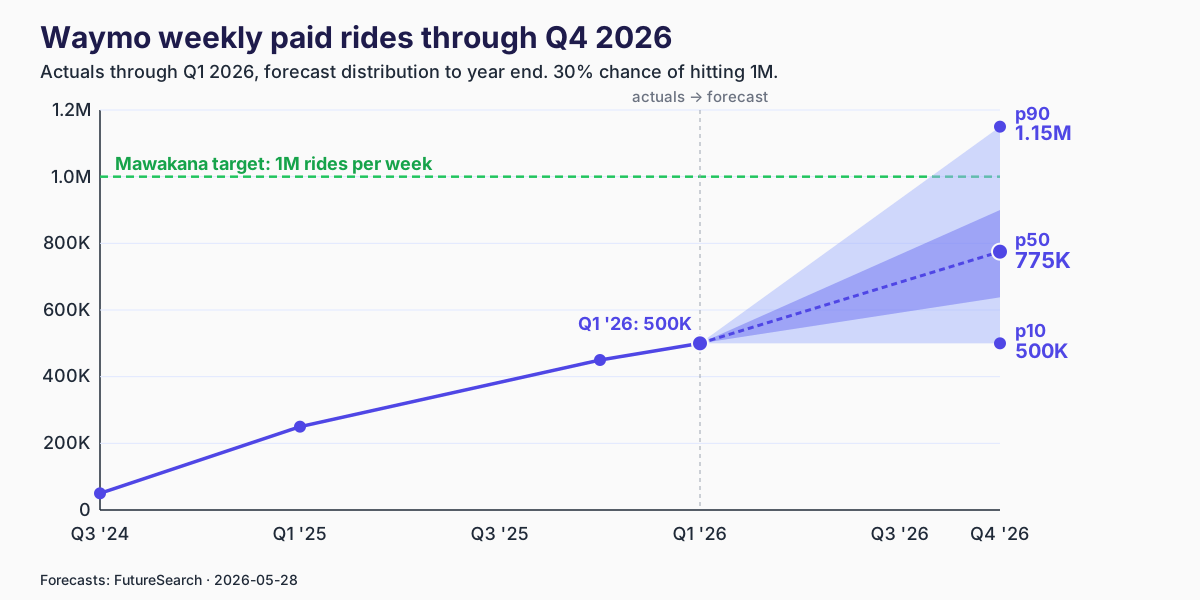
The chart above plots Waymo's weekly paid rides through mid-2026 with the Q4 2026 forecast fan, and marks co-CEO Tekedra Mawakana's stated one-million target (Bloomberg) for reference. The new data point is a flat one. Alphabet's Q2 call on July 22 repeated the "past 500,000" milestone it had already cited a quarter earlier (Alphabet), so the true mid-year run rate was likely only marginally above 500,000. The stall has visible causes. Waymo suspended freeway rides from May into July, ran a roughly 3,800-vehicle software recall, and its California ride growth decelerated sharply through the spring (TechCrunch). Quarterly CPUC filings have since put numbers on that stall: California trips per day fell from 47,205 in April to 44,964 in June, an outright decline in the state that carries roughly three-quarters of the volume. On August 14 the CPUC approved expansion across 18 California counties and authorized the Ojai vehicles, scaling the Bay Area and Los Angeles service and clearing Sacramento and San Diego (Electrek). Waymo says the rollout "will be gradual and guided by our safety framework," and roughly 950 Ojai units were counted staged at the Mesa plant in August (Electrek), so the supply is there once deployment follows. Since then Waymo has opened to riders in Denver, San Diego and Tampa and, on September 14, Las Vegas, its fifteenth US city (TechCrunch).
Fleet math still sets the ceiling on the million target. Waymo's utilization runs about 20 trips per vehicle per day, so 500,000 weekly rides take roughly 3,600 active vehicles. One million weekly rides need around 7,200. Waymo had been adding 265 to 300 vehicles per month (Business Insider), and the Ojai ramp is what could bend that curve in Q4. My re-run median of 750,000 assumes the operational pauses end and Ojai deliveries accelerate through the fall, and it still leaves the one-million print at roughly a 1-in-10 chance.
The target requires faster Ojai deliveries, higher per-vehicle utilization, or both. The theoretical utilization ceiling sits around 40 trips per day (Robonomics), so headroom exists. The question is whether Waymo's operations team can execute against it under the current load.
The current load is intense. Waymo has halted service in five cities this month because the cars keep driving into floodwater (TechCrunch). NHTSA is running two investigations, one of which involves a child struck near a school in Santa Monica. The California Public Utilities Commission has suspended Waymo's 6th-generation deployment authorization through at least June 27 (CPUC), which means California cannot host a public Ojai launch before late July at the earliest. Waymo's own public messaging on Ojai shifted from "welcoming riders this summer" in February to "when we are ready, we will certainly open our doors" in April (SF Examiner). That rhetorical drift is the public version of an internal schedule slip.
That forecast has now resolved, and it is worth grading. In May I put the first paid public Ojai ride at a median of October 1, 2026, with a p10 of July 20 and a p90 of March 15, 2027. The actual date was July 29, 2026, in Phoenix, where Arizona imposes no fare-authorization requirement. Waymo emailed riders that free Ojai trips would end and began charging normal fares (rider reports). The outcome landed between my p10 and my median, about two months ahead of my central estimate. What I got right was the mechanism, a schedule slip against Waymo's "summer" messaging followed by a fast monetization move once the Trusted Tester phase stabilized. What I underweighted was the state split. California is still not charging: the CPUC advice-letter suspension covering the Ojai ran until August 14, 2026, when the Commission approved the vehicle along with expansion across 18 counties (Electrek), so Arizona simply went first. The date that mattered most on my May list arrived early, and the cost story below now has a live paid data point behind it.
The Ojai is the gating factor on Waymo's cost structure. Each Jaguar I-PACE in the current fleet costs $150,000 to $200,000 outfitted. Each Ojai uses a Zeekr-built base vehicle that costs around $32,000 and carries 42% fewer sensors (TechCrunch). A robotaxi pencils out to a one-year vehicle payback at $125,000 and 30 trips per day (per the framework cited in Contrary Research). At $32,000, the payback drops to three or four months. That gap separates a capital money pit from a viable business.
The Ojai's cost advantage carries a geopolitical price tag. Each unit is built in Ningbo by Zeekr (a Geely subsidiary), shipped as a glider chassis to Mesa, Arizona, and outfitted with Waymo's sensor stack on US soil (Detroit News). Senator Bernie Moreno told Waymo's Chief Safety Officer at a Commerce Committee hearing in February that it "seems like you're getting in bed with China" (Business Insider). Moreno and Senator Slotkin then introduced the Connected Vehicle Security Act of 2026 to ban Chinese-linked vehicle imports (NBC News).
My probability of a US federal action restricting Ojai imports before June 30, 2027 is 33%, up from 27% in August and 15% in May. The Ojai clears the Commerce connected-vehicle rule because it arrives as a stripped-down glider, with no native sensors, computing, or telematics at the port, and Waymo integrates its US-built autonomy stack in Mesa (Telemetry). Thousands of chassis have cleared the Port of Los Angeles this way, despite an effective duty burden near 127% (Forbes). In May I leaned on the Volvo exemption (CNBC) as evidence the administration was not about to slam the door. That still holds for the rule as written. The new risk is the loophole itself: a workaround this visible, at this volume, in an election-adjacent year, invites a rule amendment or legislation aimed squarely at it, and the Moreno-Slotkin bill gives Congress a ready vehicle.
The hedge is the Hyundai Ioniq 5 built at Hyundai's Metaplant in Georgia (Telemetry), but shipments do not begin until Q4 2026 against an order of 50,000 units over multiple years. I put the first paid public ride in an Ioniq 5 at a median of May 2027, with an 80% interval from February to December 2027. A China disruption inside the next twelve months would catch Waymo in the worst possible window. The risk hides in the tails. It does not show up in the quarterly numbers.
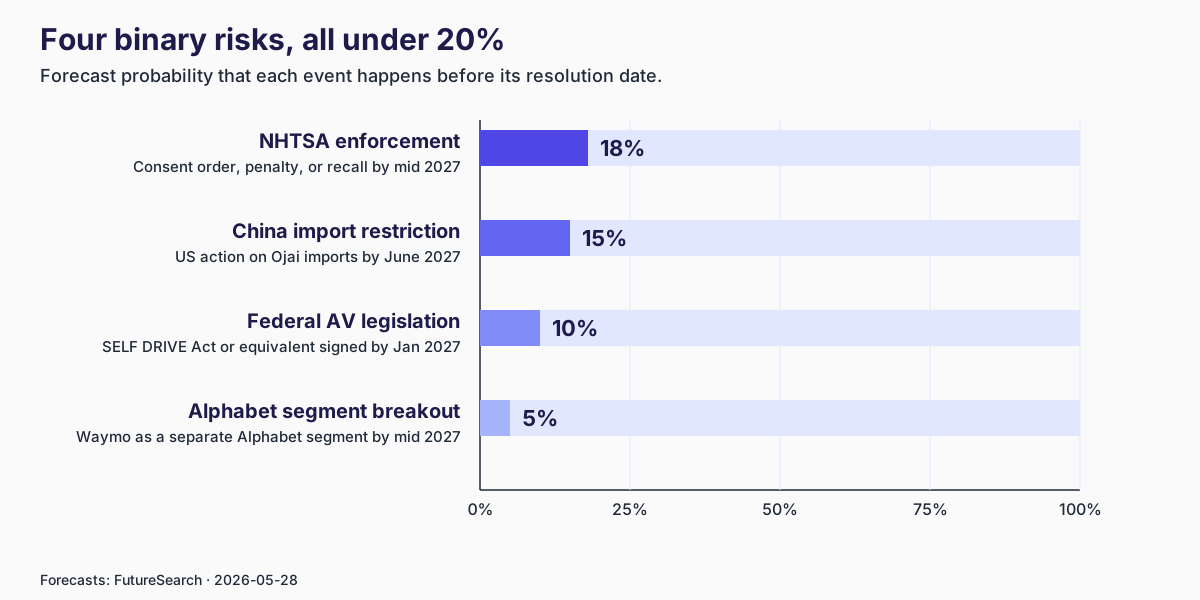
The chart above shows the four binary regulatory forecasts I track. The China import restriction (33%) is the highest-probability risk, for the glider-loophole reasons above. NHTSA enforcement comes down to 7%, and the reason is Waymo's own record through a rough spring. Every safety campaign to date has been voluntary: the December 2025 school-bus recall, a May 2026 flooded-roadway recall, and a June 2026 construction-zone recall, all Part 573 voluntary actions (NHTSA). Voluntary recalls are not enforcement, and each one gives the agency a low-conflict off-ramp. The 7% probability of formal enforcement (a consent order, civil penalty, or mandated recall) before mid-2027 prices the two investigations that stay open.
The Cruise precedent is the right calibration. NHTSA issued a $1.5 million consent order against Cruise in 2024 for concealing data about a pedestrian dragging incident (NHTSA). The underlying defect alone would not have triggered enforcement. Waymo contacted NHTSA the same day as the Santa Monica child-strike incident (Waymo). I see no public evidence of concealment.
Two structural factors push the enforcement number down. Transportation Secretary Sean Duffy is advancing an AV framework plan (NHTSA), and NHTSA's investigative capacity has shrunk under recent staffing reductions (Foley). Investigations run 18 months or longer, so the current ones may not conclude inside the resolution window.
The school-bus investigation is still the most dangerous one. The December 2025 voluntary recall was supposed to fix bus-passing behavior; violations continued into 2026, and NHTSA sent a second document request in May, the standard escalation marker. A child struck near a school generates congressional pressure NHTSA cannot wait out. But investigations of this kind run 18 months or longer, and neither open case has produced an enforcement signal since the spring.
Federal AV legislation probably does not happen on this timeline, and the odds have fallen further. My probability of the SELF DRIVE Act or equivalent being signed before January 3, 2027 is 2%, down from 5% in August and 10% in May. The 2026 bill (H.R. 7390) has not moved since its 12-11 party-line subcommittee vote in February: no full-committee markup, no floor action (Congress.gov). Its predecessor, the AV START Act, died in the Senate in 2018 after passing the House unanimously, killed by a coalition of labor, disability rights groups, trial lawyers, and state regulators. That coalition has not changed since.
The surface transportation reauthorization, now extended to December 11, 2026 (Holland & Knight), is the most plausible legislative vehicle, but the current House version (the BUILD America 250 Act) only extends AV authority to FMCSA for commercial vehicles, not NHTSA for passenger vehicles (Holland & Knight). Adding passenger AV provisions would jeopardize the 62-2 committee vote the transportation bill enjoys today. Waymo spends the next 18 months operating inside a state-by-state regulatory patchwork.
London is Waymo's first international shot and probably its longest. The company has about 100 Jaguar I-PACEs testing across a 100-square-mile area (TechCrunch), against a stated target of commercial driverless launch in 2026. As of October, Waymo's own UK page still says commercial rides are unavailable and every trial runs with an in-vehicle Autonomous Specialist (Waymo). The empty-seat validation phase that precedes every Waymo city launch has not visibly started, and Waymo's domestic ramp-ups take 9 to 18 months from that point. My re-run pushes the first paid driverless London ride out to a median of February 2028, from November 2027 in August and August 2027 in May, with a p90 in mid-2029.
The UK's pilot application process opened on May 22, 2026 (UK government). No country has gone from "applications open" to commercial driverless service in under five months. Each operator needs a Vehicle Special Order from the Vehicle Certification Agency, an Automated Passenger Service permit from Transport for London, and a novel safety case review. The UK government's own published timeline for the permanent AV Act framework is H2 2027 (UK government). A Waymo vehicle driving into a police cordon in Harlesden in April (BBC) did not help Waymo's public-trust case. Baidu's Apollo Go and the UK's own Wayve are also competing for regulator attention, which lengthens the queue.
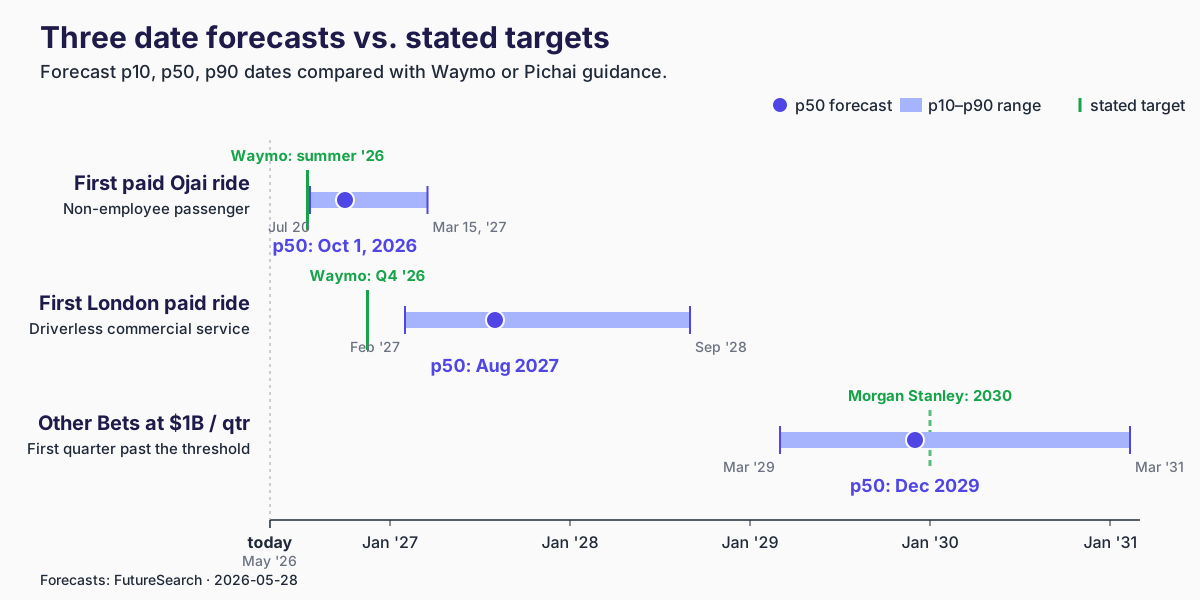
The chart above plots the three date forecasts: the first paid public Ojai ride (forecast p50 October 1, 2026, actual July 29), the first paid driverless ride in London (p50 February 2028), and Other Bets crossing $1 billion per quarter (p50 November 2029). The Ojai and London milestones are operational. The Other Bets milestone is the financial threshold at which Waymo's segment becomes material in Alphabet's financials.
Alphabet does not break Waymo out as a separate reporting segment, so my forecast lives at the Other Bets level. My probability of Alphabet changing that before mid-2027 is 5%. The accounting math kills it: Other Bets' $382 million of Q2 revenue is below 0.4% of Alphabet's total, well under the ASC 280 10% threshold that mandates separation (Alphabet). Alphabet defended this aggregation to the SEC in 2017 and has every incentive to maintain it.
I forecast $8.1 billion of Other Bets operating loss for FY2026 at the median, down slightly from $8.2 billion in August and my May median of $8.5 billion. The first half is now on the books: a $2.1 billion loss in Q1 and $1.8 billion in Q2, so $3.9 billion through June. The back half carries the Ojai fleet ramp and continued AI-era compute spending, partially offset by the Q4 Google Fiber deconsolidation.
My p10 of $7.5 billion assumes cost discipline holds and the Fiber exit lands early. My p90 of $9.9 billion includes another stock-based compensation true-up like the $2.1 billion charge Alphabet took in Q4 2025 (SEC) tied to Waymo's rising valuation.
The forecast I find most surprising is the date Other Bets revenue crosses $1 billion per quarter: my median is November 2029, and the distribution carries a real tail in which it never happens at all. The segment is shrinking by construction. Verily deconsolidated in Q1 2026 (Engadget) and Google Fiber follows in Q4 when the Astound transaction closes, so Waymo has to grow ride revenue from roughly $130 million per quarter toward $900 million essentially alone, a 7x climb at a doubling-per-year pace that has just shown its first flat quarter.
Conservative analyst models push the timeline out further. Morgan Stanley projects $2.5 billion annual by 2030 (Morgan Stanley). TD Cowen has $6.1 billion in gross bookings by 2034 (Yahoo Finance). Sundar Pichai has been telling investors Waymo will become "meaningful in our financials" by 2027-2028 (CNBC). Meaningful revenue is visible by 2027-2028. Meaningful profit will not show up before 2029.
The competitive picture fortifies Waymo's position more than it threatens it. Tesla's robotaxi fleet stands at 25 unsupervised vehicles across Austin, Dallas, and Houston, with 14 logged crashes (Automotive World). Musk has deferred scaling to FSD V15, which Morgan Stanley projects takes Tesla to about 1,000 vehicles by year-end, around 3-4% of Waymo's current fleet.
Tesla's cost-per-mile advantage at $0.81 versus Waymo's roughly $1.40 (Morgan Stanley) matters at scale, and Tesla is years from that scale. Zoox sits further along but in the prove-the-tech phase. The more interesting dynamic is Baidu's Apollo Go: 22 cities globally, 250,000 weekly trips, partnerships with both Uber and Lyft for London. The geopolitical anxiety that drives Waymo's Ojai supply-chain risk is anxiety about the same Chinese AV capability Apollo Go demonstrates.
Pulling it together, my base case (40-50% probability) is that Waymo reaches 600,000 to 850,000 weekly rides by year-end 2026, falling short of the million. Paid Ojai service, live in Phoenix since July 29 and open to all riders in San Francisco and Los Angeles since August 20, keeps spreading. Safety incidents continue to create friction without triggering formal enforcement. London slips to early 2028. The China supply chain holds through the window. FY2026 Other Bets loss lands in the $8-9 billion range. Waymo grows fast and stays unprofitable, with the path to profitability visible and not yet reached.
The bull case (15-20%) is that the spring's operational pauses prove to be the bottom, the school-bus pattern stops, the Ojai fleet ramp accelerates through Q4, the million-ride number hits anyway, and the cheap-vehicle economics start showing up in the segment loss line. The Waymo narrative flips from "expensive experiment" to "inevitable platform" and the $126 billion valuation starts to look cheap.
The bear case (15-20%) is that a fatality or another child injury triggers NHTSA enforcement and political backlash. Ride growth stays flat near 600,000 as the spring stall extends. Washington closes the glider loophole before the Ioniq 5 ramp covers the gap, the risk I now price at 33%. FY2026 loss balloons past $10 billion. The Waymo IPO timeline slides past 2030.
The tail (5-10%) is multiple bear cases compounding at once. An incident with political fallout during the NHTSA investigations, Ojai supply-chain disruption, and federal legislation that imposes new operational restrictions on robotaxi operators. Waymo's growth reverses for the first time. The $126 billion valuation is least equipped to survive this scenario, and it is the scenario the current narrative most underprices.
It's clear that Waymo's prospects are not a technology question. Waymo has driven 200 million miles with no safety driver and provided more than 20 million paid rides. That settles the technology question. The open questions are industrial. Can the Ojai pipeline scale fast enough? Can Waymo's software teams fix the behaviors behind three recalls while validating ODDs in six new cities? Can the political environment stay permissive while incidents accumulate? Can the China supply chain survive long enough for the Hyundai backup to take over? Conventional Waymo coverage treats it as a technology story and undercounts these. The unit economics at scale are compelling. The gauntlet between today and at scale is longer and bumpier than the $126 billion valuation implies.
About this forecast. This page was first published on May 27, 2026, with light edits on May 29, on forecasts run against public information as of late May. On August 6, 2026 I re-ran every forecast after Alphabet's Q2 earnings and the start of paid Ojai rides. The revisions: weekly paid rides at the Q4 call moved from a 775,000 median (p10 500,000, p90 1.15M) to 765,000 (p10 590,000, p90 1.03M) on the flat Q2 print; the first paid Ojai ride resolved July 29, 2026 against my October 1 median and July 20 p10; the London median slipped from August 2027 to November 2027 with the p90 moving from September 2028 to late 2029; FY2026 Other Bets operating loss tightened from $8.5B to $8.2B with the first half booked at $3.9B; the $1B-per-quarter crossing moved from December 2029 to February 2030 with a new tail in which the shrinking segment never crosses; NHTSA enforcement fell from 18% to 14% after two more voluntary recalls and no enforcement signal; the China import restriction rose from 15% to 27% on scrutiny of the glider-import workaround; federal AV legislation fell from 10% to 5% as H.R. 7390 stalled; and the Alphabet segment breakout held at 5%. The May version of this page carried two judgment overrides of the model (imports at 15% against the model's 20%, legislation at 10% against 12%); this update reports the re-run model numbers directly. On August 20, 2026 I re-ran the weekly-rides forecast alone, after the CPUC approved Waymo's expansion across 18 California counties on August 14. It moved the opposite way from what the unlock implies: the Q4 median fell from 765,000 (p10 590,000, p90 1.03M) to 713,000 (p10 537,000, p90 1.0M), because quarterly CPUC filings published since the August 6 run show California trips per day declining from 47,205 in April to 44,964 in June, and that hard print outweighs the removal of the regulatory brake. The odds of a one-million print at the Q4 call eased from roughly 1-in-8 to 1-in-10. The other eight forecasts on this page were not re-run in this pass and carry their August 6 values. On October 16, 2026 I re-ran every forecast: weekly paid rides at the Q4 call to a 750,000 median (p10 550,000, p90 980,000), the London median to February 2028, FY2026 Other Bets operating loss to $8.1B, the $1B-per-quarter crossing to November 2029, NHTSA enforcement to 7%, the China import restriction to 33%, federal AV legislation to 2%, with the Alphabet segment breakout unchanged at 5%, and added the first paid Ioniq 5 ride at a May 2027 median. Earlier versions compared the FY2026 loss with about $5.5 billion in 2025; Alphabet's filings put the 2025 loss well above that, so the comparison is gone.
Open the world-model explorer in its own tab
Forecast these yourself in the FutureSearch app. Type in any related question and see how the numbers move.