
An August 6, 2026 update of our April forecast, re-run after SpaceX's first post-IPO earnings report and again on October 16. The original article is preserved in full below.
At about $146 a share, near $1.9 trillion, SpaceX trades about 50% above my $1.25 trillion sum-of-the-parts fair value. In June, at $192 and $2.5 trillion, I wrote that the price was roughly twice fair value and that the scarcity premium would deflate as the lock-ups expired, pulling the stock toward $137 by mid-2027. The premium deflated in eight weeks instead. The first earnings report on August 4 beat revenue estimates and the stock still fell hard, because the same report disclosed $28.5 billion of first-half capital spending and about $25 billion of negative first-half free cash flow (SEC). The stock has since climbed back to $146, its October 16 close (Nasdaq).
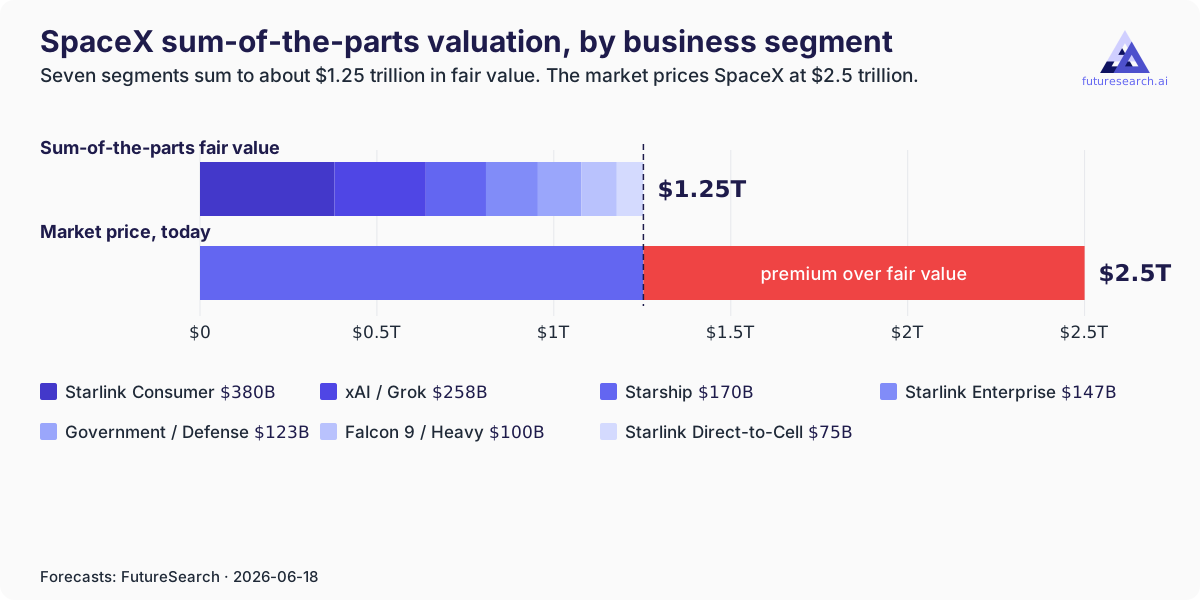
Our April sum-of-the-parts, the seven segments summing to $1.25 trillion, against the roughly $1.9 trillion market price on October 16.
When I called this IPO overpriced in April, I forecast a $158 day-one close; it closed at $160.95. In June I forecast the deflation path; the direction was right and the speed was not. I grade both calls below. I re-ran every forecast on this page against the earnings print in August, and again on October 16.
What SpaceX is worth
The chart above is my April sum-of-the-parts, seven segments valued as standalone businesses and summed to a fair value near $1.25 trillion, about $96 a share. That work is preserved in full below. Morningstar's discounted cash flow lands lower, near $780 billion, about $60 a share (Morningstar). Both sit far under the $1.9 trillion the market pays.
The earnings print reset the revenue line. First-half revenue is now booked at $12.5 billion, $4.69 billion in Q1 and $7.81 billion in Q2, up 92% year over year (SEC). My re-run median for total 2026 revenue is $45 billion, up from $41.3 billion in August and $24 billion in June, and the revision is almost entirely the compute contracts I flagged then as the fat right tail. They are getting recognized, and management now promotes a company-wide annualized run rate above $100 billion by December. Starlink stays the volume engine, $7.5 billion in the first half on 12 million subscribers, with ARPU stabilizing around $66 a month (CNBC).
The AI segment question I posed in June, product business or landlord renting GPUs, has been answered by the filings: both, reported as one segment. SpaceX's reported AI segment bundles Grok, X advertising, cloud compute leasing, and, since the acquisition closed on August 14, Cursor. It did $2.56 billion in Q2, up 247% year over year, about $10 billion annualized already (SEC). My re-run median for the AI segment's annualized revenue at year-end is $61.75 billion, up from $47.5 billion in August and against $9.9 billion in June on the strict product-only reading. The driver is contracted, not speculative: the Anthropic compute lease at $1.25 billion a month (TechCrunch) and the Google lease at about $920 million a month ramping from October (CNBC) sum to roughly $26 billion a year on their own. The valuation question survives the relabeling. Compute leasing is real revenue at data-center margins, not frontier-lab margins, and the market learned on August 4 what it costs to build the data centers underneath it (Forbes).
That cost is the story of the quarter. Capital spending hit $18.4 billion in Q2 alone, up from $10.1 billion in Q1, putting first-half free cash flow near negative $25 billion. The net loss narrowed to $541 million and the company holds about $100 billion of cash from the IPO raise, so this is a funded burn, but it is a burn at a scale with few precedents. Goldman Sachs does not model the company turning free-cash-flow positive until 2031 (Reuters). A business burning $12 billion a quarter to grow is worth a good deal less than one already throwing off cash, and the market repriced exactly that distance in one session.
What the $2.5 trillion bull case required
To pay $2.5 trillion, you had to believe everything would go right at once, the 75th percentile across every segment rather than the sum of independent medians. That was the core of the original article, and I turned it into a forecast: four milestones that together make up the bull case, each forecast separately, then the joint outcome. Two months later the milestones are mostly landing and the price collapsed anyway, which is the point. The milestones that are landing are the growth ones. The one that failed is cash.

The four bull-case milestones and the re-run probability of each: Starlink reaching 15 million subscribers (80%), a Starship operational orbital mission (80%), the AI segment reaching $10 billion (98%), and positive free cash flow (4%).
The AI-revenue milestone is nearly resolved at 98%, since the reported segment already annualizes around $10 billion and the compute leases keep ramping. Starship rose from 74% in June to 91% in August after Flight 13 deployed 20 production Starlink V3 satellites in late July (Phys.org), and is now 80%: Flight 14 reached orbit on September 28 and deployed 26 Starlink V3 satellites, but an engine failure on ascent cut the flight short (SpacePolicyOnline). Starlink is at 80%, up from 76% in August; 15 million still requires 3.0 million net adds in the back half against 3.1 million added in the first. Free cash flow is at 4%. At least three of the four now land with 64% probability; all four with 3%.
The capital spending required to hit the AI-revenue milestone and to fly Starship at the needed cadence is the same spending that kills the profitability milestone. In June I wrote that the two engines of the growth story were the thing preventing the profitability story, and the August 4 selloff was the market pricing that exact tension. The growth sweep is happening. The cash never arrives with it inside this window.
Why it trades above value
The original article bet the gap between price and value would converge over quarters, not days. In the first five trading days the stock did the opposite, running from $161 to about $192 as the gap widened to roughly 50%. In June I wrote that the run-up was the thesis, a scarcity premium on a 4% float, and that it would deflate on the lock-up calendar. It deflated ahead of the calendar. The stock drifted into the $120s through July as the first unlock approached, then broke to about $108 on the August 4 earnings report, and recovered to $146 by October 16. The mechanics below still matter, because most of the supply is still locked.
At the IPO only about 4% of the company floated, and MSCI's early index-inclusion rules forced price-insensitive passive buying into that tiny float the day after listing. The dislocation is a supply problem, running on mechanics the business cannot change, and those mechanics unwind on a set calendar:
- August 6, 2026. Following the August 4 report, about 20% of locked shares released on the first-unlock schedule (Yahoo Finance). The conditional further 10% tranche required the stock to hold 30% above the $135 offer, above $175.50, and did not trigger. Further 7% steps followed every few weeks from August 20.
- After the third-quarter report. Another 28% of locked shares release two trading days after SpaceX reports the third quarter, which it had not done by October 16 (prospectus).
- December 8, 2026. The 180-day lock-up expires. By this point the tradable float has expanded from about 4% to as much as 58%, roughly fourteenfold (Business Insider).
- Early 2027. The first audited financial statements arrive with the annual report for 2026; the quarterly statements are unaudited.
- June 12 to 13, 2027. Musk's roughly 42% stake comes off its 366-day lock-up, the single largest block, landing just before my one-year mark.
Musk's block stays locked until next summer, which removes the largest seller for most of the window, and as the float grows passive funds have to keep buying to hold their index weights. S&P 500 inclusion would add a wall of demand, but it is blocked, because the index requires GAAP profitability and SpaceX is deeply unprofitable, with a $4.9 billion net loss in 2025. Net of all of it, the scarcity premium still bleeds off through each unlock.
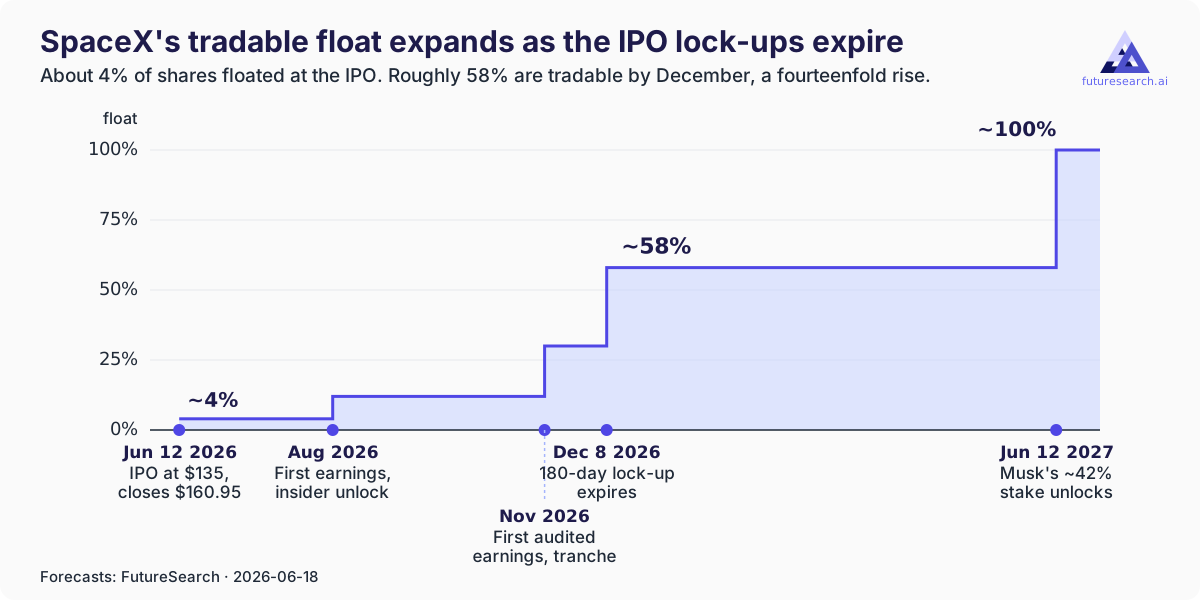
SpaceX's tradable float over the lock-up calendar, from about 4% at the IPO to roughly 58% by the December expiry.
Where that leaves the stock
In June the shape of this section was a glide: the stock should drift down toward value as the float normalizes, without reaching it. In August it reached $108, about 12% above my $1.25 trillion sum-of-the-parts. It now sits at $146, about 50% above it, and the re-run forecast says it roughly stays there: the forward path runs between $138 and $145 on wide tails.
The first of the five points tied to the supply calendar has resolved. I forecast a $97 median five trading days after the August 6 unlock, with an 80% interval of $62 to $155; the stock closed at $141.29 on August 13, between my 75th and 90th percentiles. I re-forecast the other three and added the November release. The medians run from $146 today to $142 five trading days after the 28% release that follows the third-quarter report, $138 a month past the December lock-up expiry, $145 after the first audited earnings in early 2027, and $142 at June 30, 2027, just after Musk's stake unlocks.
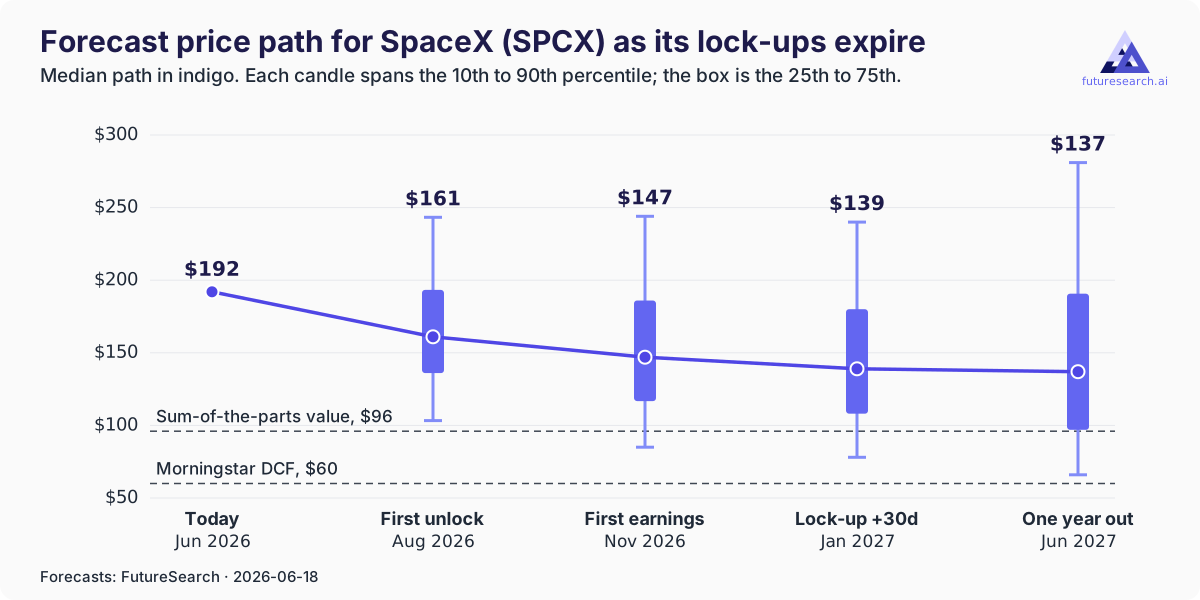
Forecast price path for SPCX at five dates on the lock-up calendar, re-run October 16. Median in indigo, candles span the 10th to 90th percentile.
The mid-2027 median of $142 is about where the stock trades today, about $1.9 trillion, about 50% above my $1.25 trillion sum-of-the-parts and well above the $780 billion DCF. The 25th percentile of $110 sits above the sum-of-the-parts $96, and the 10th percentile of $82 below it, so the left tail prices the world where the cash burn keeps repricing the growth. The right tail is just as live: the p90 of $240 is the world where the compute business re-rates the whole company, revenue really does exit 2026 above a $100 billion run rate, and the AI landlord gets an AI multiple. The distribution is wider than June's precisely because the business is changing faster than the float mechanics that used to dominate it.
Everything here is dated and gradable. The live questions are what the first audited statements say about the burn, whether Starship converts Flight 14's satellite deployment into a fully successful operational mission, whether Starlink finds 3 million net adds in the back half, and how the stock takes the December lock-up and Musk's June 2027 unlock. I will grade each against its resolution date as it arrives, and update this page when I do.
I first ran these forecasts on June 18, 2026 and re-ran all of them on August 6, 2026, after the first earnings report, and again on October 16. Every question carries explicit resolution criteria and a resolution date.
Run this SpaceX forecast yourself, free →
How the original call scored
The day-one price call was a hit. I forecast a median day-one close of $158, a 17% pop. SPCX closed its first session at $160.95, up 19%, an error under 2%. I will keep the caveat I made at the time. This was not a sharp call that beat the market. The Hyperliquid pre-IPO perpetual had already converged to about $157 by June 10 (CoinDesk), so the best market signal and my model landed in the same place. I matched the best available number. I did not beat it.
The fair-value thesis now has a partial verdict. The bet was that price converges toward my roughly $1.25 trillion estimate over quarters, not days. Eight weeks after listing, the stock sits about 12% from that estimate, so the direction and the destination were right, and the June essay's mechanism, scarcity premium deflating into the unlock calendar, is most of why. What I got wrong was the speed and the trigger. My June glide put the first checkpoint at a $161 median with a $103 tenth percentile; the stock reached $108 before the checkpoint arrived, brushing that p10, because the earnings report repriced the cash burn in one session rather than letting the unlocks do it over two quarters. Directionally strong, calibration honest, speed underestimated. By October 16 the stock had climbed back to $146, about 50% above that estimate (Nasdaq). What remains is whether $1.25 trillion is still the right value for a business whose revenue is doubling, and that is what the re-run forecasts above now track.
The revenue call missed low, and this page should say that more plainly than "revised." In June I put 2026 revenue at a $24 billion median with a right tail out to $33 billion. The October re-run puts it at $45 billion, above the top of that range, and the AI segment moved from $9.9 billion to $61.75 billion. I did name the compute contracts as the thing that would decide it, which counts for something, but naming a risk is not the same as pricing it, and an outcome that clears your 90th percentile within four months is a calibration failure rather than an update. Part of the AI-segment gap is definitional, since SpaceX now reports compute leasing inside that segment and my June number was product-only, but the total-revenue miss has no such excuse. The pattern across all three calls is the same one: I read the direction right and the speed slow, on the way down for the stock and on the way up for the business.
Changelog
-
April 1, 2026 — First published; last edited June 11, the night before trading began, with a $158 day-one forecast against a $160.95 actual.
-
June 18 — A rewrite for the post-IPO market: a glide from $192 toward $137 by mid-2027, the four bull-case milestones at 94/74/40/8%, and 2026 revenue at a $24 billion median.
-
August 6 — The first earnings report (Q2 revenue $7.81B, first-half free cash flow near negative $25B) and the fall to $108 flattened the price path to $97/$104/$102/$105 and lifted 2026 revenue to $41 billion.
-
August 29 — Held against every other forecast we publish on AI, the path steepened after the November checkpoint to $97/$110/$104/$108, 2026 revenue rose to $41.3B, the AI segment to $47.5B, its $10B milestone to 96%, and at-least-three-of-four bull-case milestones fell from 73% to 67%.
-
October 16 — The August unlock graded ($141.29 against a $97 median) and the stock back at $146: the price path to $142/$138/$145/$142 with the November release added, 2026 revenue to $45B, the AI segment to $61.75B, Starship to 80% after Flight 14, and at-least-three-of-four bull-case milestones to 64%. The first audited earnings come with the 2026 annual report, not in November.
The original article, preserved
Published April 1, 2026, last updated June 11, 2026, the day before trading began. Preserved as written.
This page has had three versions, not two. Between this one and the current one sat a June 18 rewrite, titled "SpaceX at $2.5 Trillion: Trading at Twice Its Fair Value," which was the live article for seven weeks. Its forecasts are the ones graded above, and every number it published is recorded in the changelog, including the ones it got wrong.
A $1.75 Trillion IPO Would Be Overpaying 30% for SpaceX
A forecast of the fair market value of SpaceX's businesses as it IPOs at $135 per share, roughly $1.77 trillion, on June 12, 2026
SpaceX has priced the largest IPO in history at a fixed $135 per share, roughly $1.77 trillion, with trading set to begin June 12 (Nasdaq: SPCX). Our sum-of-the-parts forecast puts SpaceX's median fair value near $1.25 trillion, about 29% below that price.
SpaceX filed confidentially for an IPO on April 1, 2026, flipped its S-1 public on May 20, and set a fixed $135 price with no bookbuild range, an unusual structure for any IPO and unprecedented at this size. Order books closed June 10 at roughly 4x oversubscribed, with more than $250 billion in orders against the $75 billion raise.
I found this valuation interesting because SpaceX is a conglomerate now, so valuing the business segments together has a lot of intangible value. But my particular interest was because the IPO will happen in June (or later), so the question is not: what is SpaceX worth now, but what will SpaceX be worth then?
That's a forecasting question, so I decided to forecast it.
I broke SpaceX into seven business segments and forecast what the fair market value of each will be as of June 2026, assuming the IPO happens then. My conclusion is that for the company to be fairly valued at $1.75 trillion in June, each of its businesses would need to outperform between now and then.
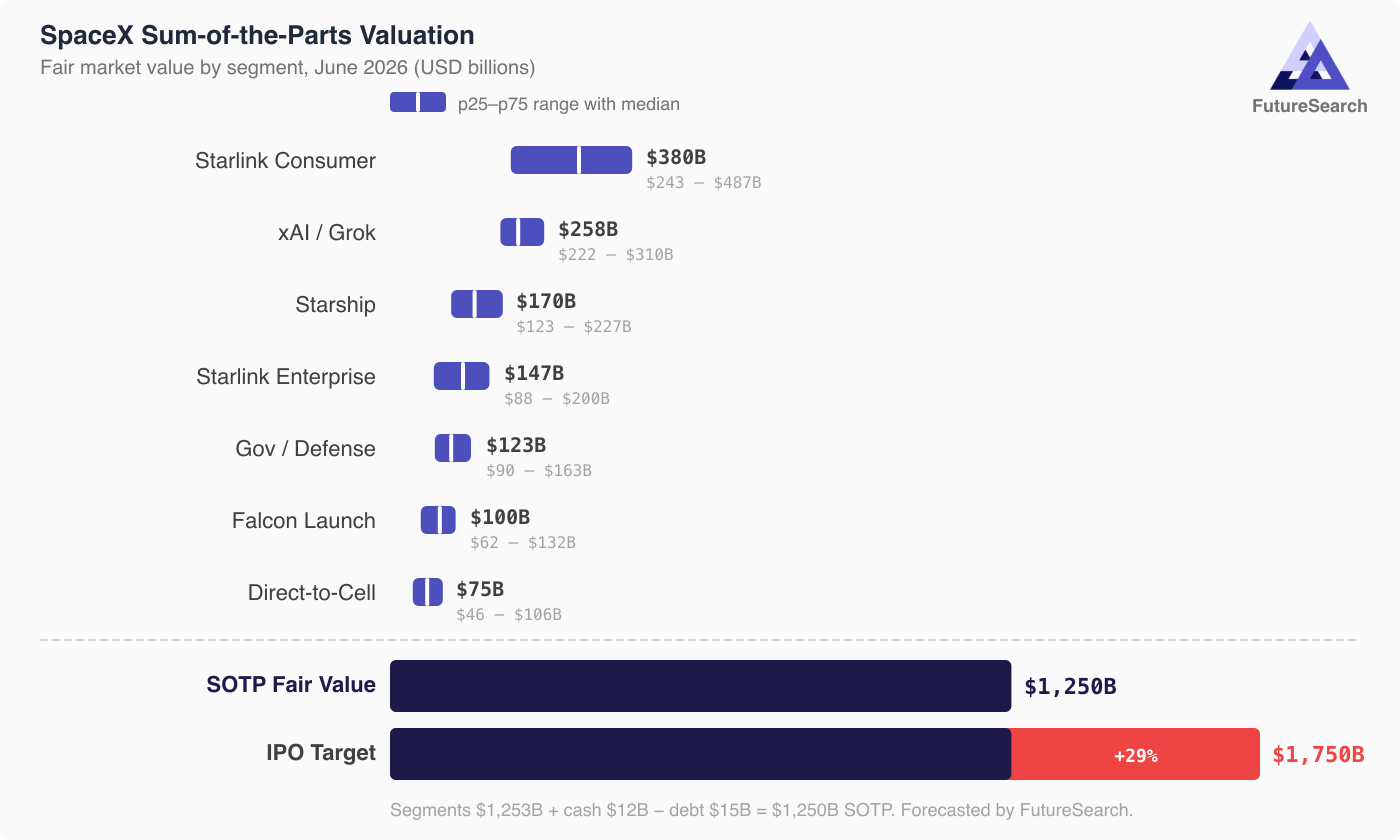 Red on IPO bar shows the 29% premium over median forecasted fair value.
At median forecasted values: Starlink Consumer Broadband at $380B (9.2M subscribers, ~38x revenue), xAI/Grok at $258B (anchored by the $250B merger), Starship Commercial Launch at $170B (pre-revenue option value), Starlink Enterprise/Maritime/Aviation at $147B, Government/Defense at $123B (~$22B contract backlog), Falcon 9/Heavy at $100B (~60-70% of global launches), and Starlink Direct-to-Cell at $75B (backed by $17-19B in EchoStar spectrum).
This totals $1,253B. Adding $11.6B in cash and liquid assets, subtracting ~$15B in total debt (SpaceX standalone obligations, remaining xAI inherited debt, EchoStar spectrum commitments), the sum-of-the-parts equity value is approximately $1,250 billion, 29% below the $1.75 trillion IPO target.
Run this SpaceX forecast yourself, free →
Where does the $500 billion gap come from? The SOTP method sums forecasted medians, but the IPO prices correlated upside, as if all businesses are valued more in my 75th percentile forecast. If investors are bullish on Starlink, they're simultaneously bullish on Starship, xAI, and defense. Taking the 75th percentile across all segments instead of the 50th brings the total to ~$1,675B, close to the target. The $1.75T price is "everything goes right" pricing.
SpaceX may also be one of the rare conglomerate premium cases. Conglomerates usually trade at a discount because investors prefer pure-play exposure. But the narrative that Starlink + Starship + xAI creates something no single segment could (orbital data centers, AI-powered global connectivity) may justify paying above the sum of parts. And the largest IPO in history will generate extraordinary retail demand: an up-to-30% retail allocation versus the typical 5-10%.
The gray market spent the run-up moving toward this page's number, though it has a long way to go. The most active pre-IPO market, the Hyperliquid SPCX perpetual, slid from about $216 in mid-May to about $157 on June 10, cutting the implied first-day pop from 60% to roughly 16%. That still prices SpaceX near $2.06 trillion. Our own price forecast, run the night before trading, lands in the same place: a median day-one close of $158, a 17% pop. To be clear, these are two different quantities: $158 is a prediction of what the stock will trade at on day one, and $1.25 trillion is an estimate of what the business is worth. The bet underneath this article is that the first number converges toward the second over quarters, not days.
A few things stand out. Starlink in all three forms (consumer, enterprise, direct-to-cell) accounts for $602B, or 48% of segment value and 34% of the IPO price. A longer-term forecast of whether Starlink can grow from 9.2M subscribers to 50M+ while expanding revenue per user through enterprise, maritime, aviation, and direct-to-cell channels is critical. I anchored to what others are saying, but I'm skeptical.
The other area where I'm extremely skeptical is xAI at $258B, with ~$430M quarterly revenue against $1.46B quarterly losses, valued almost entirely on the merger anchor from four months earlier. I've forecasted previously that I'd need to see more evidence that xAI is a frontier lab before believing it could be worth this much.
Starship at $170B is pure option value on technology still in advanced testing. And the physical assets (satellites, launch pads, factories, the Falcon fleet) are worth roughly $46B at fair market value, 2.6% of the IPO price. Nobody is buying SpaceX for its factories.
Finally, I should say the fair market value really is just what people are willing to pay. Perhaps the intangibles are worth a 30% pop, that wouldn't be that unusual in IPOs. But based on my forecasts of value, it's not worth it unless everything goes really well all together for them. Trading begins June 12, and I'll grade this forecast against the close.
Want to reproduce this result? Here's the starter prompt to use:
Break SpaceX into its major business segments and forecast the fair market value of each one in billions USD, as of the planned June 2026 IPO. Treat each segment as if it were a standalone company. Then sum the medians, add cash, subtract debt, and compare to the rumored $1.75 trillion IPO target.
Or, if you'd prefer a step-by-step walkthrough (including help adding FutureSearch to Claude Code), then see the SpaceX valuation guide.
See also: Forecasts of Anthropic and OpenAI's IPO dates and post-IPO valuations
Run this forecast yourself in the FutureSearch app and ask it to refresh the numbers as the lock-up calendar plays out.